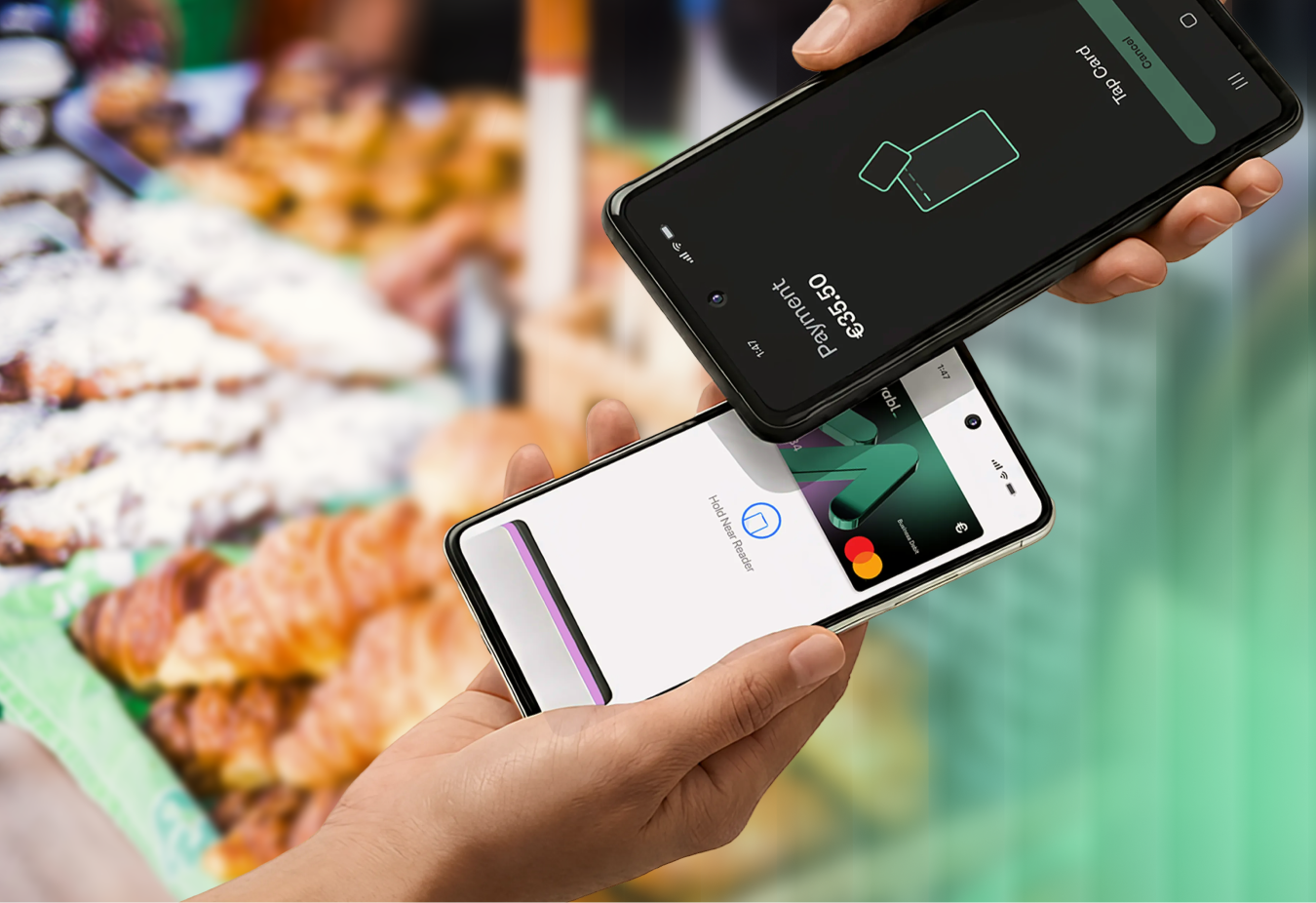
For merchants, summer trading looks different from the rest of the year. Food festivals, weekend markets, pop-up shops, sporting fixtures, seasonal beach vendors and mobile service providers all share the same operating model in this season: high footfall, temporary locations and a short window to convert interest into a sale. In that context, the way merchants take payment at remote locations directly affects how much revenue they capture during the season.
As preferences change and cards become the dominant payment model, cash-only checkouts are becoming hard to justify from a merchant’s perspective. Traditional card terminals, which incur rental fees, delivery lead times and reliance on power and space, are not a practical sole option for accepting card payments. Tap to pay removes that friction.
What Tap to pay is
Tap to pay is a form of SoftPOS, or Software Point of Sale. It turns a standard NFC-enabled Android device into a card terminal, using the phone's built-in chip to communicate with the customer's card, phone or wearable. There’s no card reader attachment, no hardware to wait on and no separate device to charge or safeguard.
The technology is no longer a niche use case either. Visa reported in March 2025 that global adoption of its ‘Tap to Phone solution’ grew 200% year on year, with the UK recording 234% growth. Close to 30% of merchants using it were new small businesses, signalling that SoftPOS is opening card acceptance to sellers who previously found terminals too expensive or too slow to procure. Grand View Research valued the global SoftPOS market at $365 million in 2024, and projects it to reach $1.24 billion by 2030.
Why it fits for summer traders
The businesses that get the most from Tap to pay share common traits. They operate across multiple or temporary locations or need to take payment wherever the customer happens to be.
That covers a range of potential use cases: festival vendors accepting payments, market traders and pop-up retailers with no fixed infrastructure, mobile beauticians, personal trainers and delivery drivers taking payments without needing a physical terminal and cafés taking payments at the table.
For those merchants, the benefits of using Tap to pay show up quickly:
- No hardware overheads: There’s no terminal to buy, rent, recharge, maintain or replace. Plus merchants pay per transaction rather than committing to fixed monthly costs.
- Portability: As long as the device has Wi-Fi or a mobile signal, merchants can accept payments anywhere they are.
- Fast activation: After onboarding with a payabl. acquiring account, a merchant receives an activation code by email, downloads the app from the Google Play Store and enters the code. The device is ready to take payments.
- Backup acceptance: When a primary payment terminal fails, a Tap to pay-enabled phone keeps trading going without waiting on charging or replacing a unit.
- Full transaction range: Sales, refunds, reversals and tips are supported, along with Visa, Mastercard and digital wallets including Apple Pay, Google Pay and Samsung Pay.
Tap to pay addresses common pain points encountered by merchants looking to expand. New staff devices can be added quickly and merchants can track all payment activity in one clear dashboard with payabl.one. Refunds and reversals can be processed directly from the app, meaning merchants can handle disputes on the fly and reduce their reconciliation burdens.
Security that matches payment terminals
A reasonable question from merchants is whether taking card payments on a phone is secure. The answer is that the security model is built into the hardware of the device. This means that card data is encrypted during transmission and is never stored on the device.
When a customer needs to enter a PIN, which typically happens for transactions above the contactless limit, the app uses PIN on Glass. This randomises the keypad layout on every entry, so fingerprint patterns can't be used to reconstruct the code. The app blocks screenshots and screen recording during PIN entry.
payabl. manages the PIN Cardholder Verification Method in line with PCI standards for SoftPOS. Plus, if a device is lost, stolen, or a staff member leaves, payabl. can deactivate app access remotely. There’s no physical recovery required, and access can be reinstated just as quickly.
Two real merchants, two different problems solved
payabl. helped Nafais, a perfume retailer in Limassol, Cyprus. Facing opening day with no card acceptance in place, Nafais needed a working setup fast. payabl. deployed in-store payments and Tap to pay in 2-3 days, and the business opened on time with working payments infrastructure. In-store payments now account for 65% of all Nafais transactions, running at roughly 5,000 transactions per month. Owner Demetra Tsitsi described the process as simple and smooth, freeing staff to focus on customers rather than payments.
We helped Chef's Kiss Food Festival too. For its 2026 edition, Chef's Kiss combined payabl. in-store systems at ticket booths with payment links for online workshop and food-experience bookings. The festival reported 93% year-on-year revenue growth and 86% growth in transaction volumes. Co-founder Antonis Kitazos said the setup gave the team peace of mind and let them focus on guest experience.
One needed to trade from day one without procurement delays, while the other needed reliable, portable acceptance across multiple touchpoints. Tap to pay and wider payabl. products handled both.
What merchants keep control of
Tap to pay is straightforward to run, but a few habits matter when managing the busier summer trading period: keep the device's operating system current and up-to-date (Tap to pay by payabl. is currently available on Android 11 or higher), download the app only from the official Google Play Store, use a screen lock to protect your device, and where possible, dedicate a separate device to payments.
Be ready before summer peaks
For a market trader, a festival vendor, a driver or a pop-up operator looking to maximise their summer trading windows, the barrier to full card acceptance is now an Android phone and a payabl. account. It's a meaningful shift, and drives revenue and growth when every skipped sale from missing payment infrastructure is a sale lost to another vendor.
Ready to accept cards anywhere this summer? Get started with Tap to pay by payabl.