
European payment solutions are the combined set of infrastructure, licences, and local payment methods that let a business accept, process, and settle money across the EU and UK, covering online checkout, in-person terminals, and multi-currency business accounts. For a SaaS finance leader, the right stack is the difference between predictable cash flow and a mess of reconciliation at month end.
If you run a subscription business or an ecommerce operation that sells into more than one European country, you already know that "just take payments" is not one task. It is a bundle of separate problems: which local payment methods your German, French, or Polish customers expect, which EU rules your provider must comply with, how many currencies you need to hold without losing money on conversion, and whether your online and in-person channels even talk to each other.
This guide walks through each of those pieces so you can build, or choose, a European payment solution that fits your business model rather than fighting it.
What counts as a "European payment solution"?
A European payment solution is not a single product. It is a stack made up of four layers that work together: a payment gateway that captures and encrypts transaction data, an acquiring relationship that moves money from the customer's bank to yours, a compliance layer that keeps the whole chain licensed under EU and UK rules, and a settlement layer that gets funds into your business account in the currencies you actually use.
Think of it like a European rail journey rather than a single flight. A flight gets you from A to B in one hop. A rail journey across the continent involves several operators, each running a different section of track, under a shared set of safety standards that let your ticket work across borders. European payment solutions work the same way: several providers or modules, one journey, governed by common rules so the handoffs are invisible to the passenger, your customer.
For a merchant comparing options, the practical question is whether you assemble that stack yourself from several vendors, or use a single regulated partner such as payabl.'s payment gateway, which combines online acquiring, POS, and Tap to pay in one relationship.
The regulatory backbone: PSD2, PSD3, and why it matters to your finance team
PSD2 is the EU directive that currently governs payment services across the bloc, requiring strong customer authentication (SCA) on most transactions and giving licensed third parties access to account data and payment initiation with customer consent. Every legitimate European payment solutions provider operates under it today.
PSD3, together with the new Payment Services Regulation (PSR), is the package set to replace PSD2. As of late 2026, the Council of the EU and the European Parliament have reached political agreement and are progressing the texts through final adoption, with application expected from around 2027 to 2028. The practical changes a finance team should watch for include a merger of payment and e-money institution licences, stricter IBAN-name verification to cut fraud, and expanded liability rules for authorised push payment fraud.
None of this is a reason to wait. A provider that is already a fully licensed European payments institution, such as payabl., absorbs this regulatory transition on your behalf; you should never need to re-paper your payment contracts every time Brussels updates a directive.
Why does compliance matter if I am not a bank?
Because your provider's licence is your liability shield. If your payment partner is not properly authorised, the regulatory exposure, and the risk of frozen funds or forced migration, lands on your business, not just theirs. Checking for an EU payments or e-money licence should be the first filter in any vendor shortlist, before price is even discussed.
SEPA and local payment methods: what your European customers actually expect
Here is a fact worth building a strategy around: a European customer who cannot pay the way they normally pay will abandon checkout, even if your product is exactly what they want. This is where cross-border payment solutions earn their keep.
SEPA (Single Euro Payments Area) lets businesses and consumers send euro transfers and direct debits across 36 European countries as easily as a domestic transfer, making it the backbone of recurring billing for subscription companies operating in the eurozone.
Beyond SEPA, local payment methods vary sharply by country:
- Germany and Austria lean heavily on bank transfers and instant bank payment methods.
- Netherlands and Belgium favour iDEAL and Bancontact respectively, often over cards.
- Nordic markets show strong adoption of mobile wallets and BNPL options.
- Southern Europe still runs predominantly on card payments, alongside growing wallet use.
- Germany, France, and Belgium are now also seeing early adoption of Wero, the European Payments Initiative's digital wallet, which expanded from peer-to-peer transfers into ecommerce acceptance.
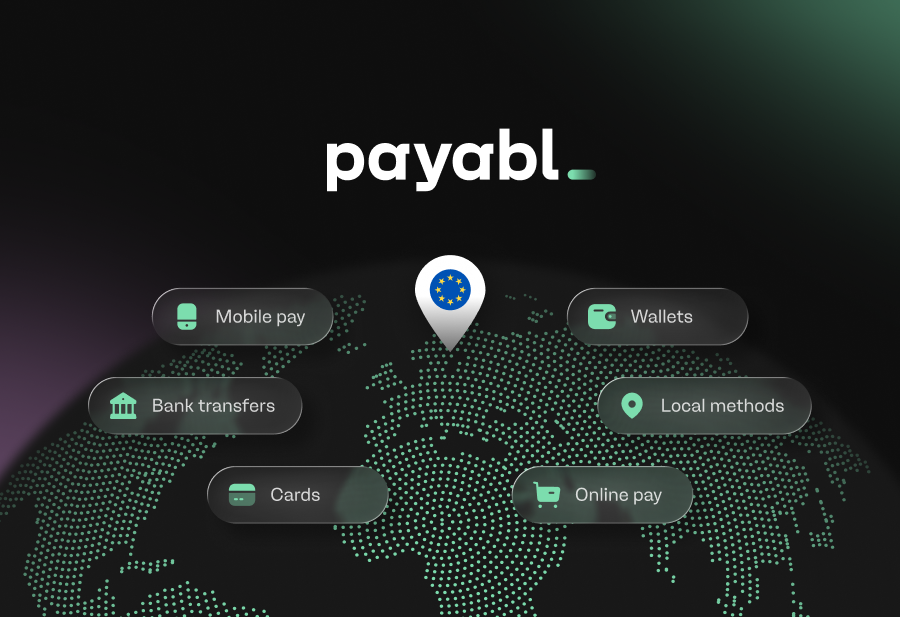
A payment solutions provider that only offers cards is quietly capping your conversion rate in every market outside your home country. payabl.'s local payment methods cover 300+ local and alternative payment options precisely so a Dutch shopper sees iDEAL and a German shopper sees their preferred bank transfer, without you building separate integrations for each.
Multi-currency business accounts: the quiet cash flow problem
A subscription company billing customers in euros, pounds, and Swiss francs faces a decision every finance leader eventually confronts: hold multiple currencies and manage conversion timing yourself, or let each sale convert immediately and absorb the FX spread on every transaction.
A multi-currency business account lets a company receive, hold, and pay out funds in several currencies without forced conversion on every transaction, which protects margin on cross-border revenue and simplifies reconciliation against local costs such as payroll or suppliers billed in the same currency.
For a CFO, this is not a nice-to-have. Every unnecessary conversion is a small, repeated cost that compounds across thousands of transactions a month. payabl.'s business accounts pair multi-currency holding with virtual and physical cards, so revenue collected across Europe can be spent or paid out without routing through a currency conversion every time.
Omnichannel payments: why online, POS, and Tap to pay need to be one system
Many European businesses still run three separate payment relationships: one for the website, one for a card terminal at a physical counter or event, and increasingly, one for Tap to pay on a phone. Each comes with its own login, its own settlement schedule, and its own reconciliation headache.
Picture a small Lisbon bakery that also caters weekend markets and sells pastries online. If the website, the shop till, and the market card reader each report to a different provider, the owner spends Monday mornings manually stitching together three spreadsheets just to know how much the business actually made that week. An omnichannel European payment solution removes that stitching entirely, settling online checkout, point-of-sale, and Tap to pay transactions into one view.
This matters even more for a subscription business layering in occasional in-person sales, such as trade shows, pop-ups, or sales demos where a card needs to be taken on the spot. A unified payments stack means that revenue, whether it came from a recurring SaaS invoice or a one-off in-person card tap, reconciles in the same place.
What is Tap to pay, and do I need it?
Tap to pay turns a compatible smartphone into a contactless card reader, letting a business accept card and wallet payments in person without buying a separate terminal. For a SaaS company, this is useful at conferences, sales visits, or pop-up events; for an ecommerce brand with any physical presence, it removes the cost and logistics of hardware terminals altogether.
How to choose a European payment solution: six questions for your shortlist
Before comparing pricing pages, run any provider through these six questions:
- Is it a fully licensed EU or UK payments institution? This is non-negotiable; it is your compliance shield.
- How many local payment methods does it support in your target markets? More coverage means fewer abandoned checkouts.
- Does it offer multi-currency accounts without forcing conversion? This protects margin on cross-border revenue.
- Can it unify online, POS, and Tap to pay? This matters even for a primarily digital business with any in-person touchpoint.
- Does it support recurring billing and dispute management? Essential for subscription and SaaS revenue models.
- What is the real cost, not just the headline rate? Factor in FX spread, chargeback handling, and cross-border fees, not only the percentage per transaction.
If you are weighing specific vendors against each other, payabl.'s comparison of the best payment service providers in Europe breaks down how payabl., Adyen, Mollie, Stripe, and others stack up on these exact criteria.
A European payment solution should remove friction, not add it
The right European payment solution is the one that disappears into the background of your business: it absorbs regulatory change, speaks every local payment method your customers prefer, holds currencies without punishing you for conversion, and treats your online and in-person channels as one system instead of three. Businesses that get this right spend less time reconciling spreadsheets and more time growing revenue, because their payments infrastructure is built to scale with the business, not against it.
That is the standard a European payment solution should be measured against: does it make cross-border, multi-currency, omnichannel payments feel as simple to your finance team as a single domestic transaction. When it does, payments stop being a monthly headache and become what they should always have been: infrastructure that just works.