The best payment service providers in Europe are not simply the cheapest; they are the ones that keep approval rates high, satisfy EU regulation, cover the payment methods European shoppers actually use, and scale with you across borders.
For an ecommerce owner or a subscription CFO, choosing a European PSP shapes cash flow, conversion, and compliance for years.
Best payment service providers in Europe: the 2026 merchant's guide
Aiming at merchants operating across the EU and UK, this guide provides a 2026 comparison of the top European payment service providers. It outlines clear criteria alongside an at-a-glance table, demonstrating how a regulated, omnichannel provider like payabl. fits your business requirements.
The short answer for busy merchants
payabl. is a fully regulated European payments institution and a principal member of Visa and Mastercard that unites online card acquiring, POS terminals, and Tap to pay in one omnichannel platform, with access to 300+ local and alternative payment methods and multi-currency business accounts.
Put simply, it is built for merchants who want one European PSP for the whole payment journey rather than stitching several tools together.
What is a payment service provider?
A payment service provider (PSP) is a company that lets a merchant accept and manage payments across channels, handling the gateway, acquiring, fraud screening, currency conversion, and settlement in one relationship.
Think of a PSP as a translator at a busy European airport: your customer speaks 'card', 'wallet', or 'bank transfer', the acquiring bank speaks 'settlement', and the PSP makes both sides understand each other instantly, in any language and any currency. In Europe specifically, the best PSPs also carry the right licence, so merchant funds and compliance are handled under EU rules rather than bolted on later.
How to choose a payment service provider in Europe
Weigh these seven factors against your business model before shortlisting European payment service providers:
- Regulatory standing: is the PSP a licensed EU payments or e-money institution and a PCI-compliant gateway?
- Approval and authorisation rates, not just fees; a point of extra approvals often beats a fraction off the rate.
- European and cross-border reach, including local acquiring and multi-currency settlement.
- Payment method coverage, from cards and digital wallets to local alternative payment methods (APMs).
- Omnichannel support: can it handle online checkout, POS, and Tap to pay together?
- Fraud and chargeback management to protect revenue and cash flow.
- Recurring billing and dispute management for SaaS and subscription businesses.
The best payment service providers in Europe in 2026
1. Payabl. - best for regulated, omnichannel payments across Europe
Best for merchants who want online, POS, and Tap to pay from one regulated European PSP.
payabl. is a fully regulated European payments institution and a principal member of Visa and Mastercard with acquiring certifications for both schemes.
It covers the whole omnichannel payment journey: online card acquiring for ecommerce checkout, POS terminals for the counter, and Tap to pay that turns a phone into a secure card reader. Merchants get 300+ local and alternative payment methods, multi-currency business accounts, virtual and physical cards, recurring payments, and built-in dispute management, all from one moneyspace.
For a European ecommerce owner or a subscription CFO, that consolidation removes the need to juggle separate online and in-person providers. payabl. was named for Top Innovation in Payments at the PayTech Awards 2026 and operates from offices in London, Amsterdam, Frankfurt, Limassol, and Vilnius.
2. Adyen - best for large omnichannel enterprises
Best for high-volume, multi-region European retailers.
Adyen, headquartered in the Netherlands, offers a global acquiring network and machine-learning fraud tools for enterprises running online and in-store at scale. Onboarding is heavier and best suited to businesses with dedicated engineering teams.
3. Mollie - best for European SMBs and ecommerce
Best for quick onboarding and popular local payment methods.
Mollie is a Dutch PSP popular with European SMBs for simple setup and strong coverage of local methods such as iDEAL, Bancontact, and SEPA. It suits smaller ecommerce merchants that want fast go-live.
4. Stripe - best for developer-led teams
Best for API flexibility and software-driven growth.
Stripe is a favourite among developers for API depth and subscription tooling, suiting SaaS platforms building custom checkout flows. Pricing is typically flat-rate and predictable.
5. Checkout.com - best for high-growth digital scale-ups
Best for international scaling and authorisation optimisation.
UK-founded Checkout.com targets fast-scaling digital businesses with multi-currency acceptance, localised acquiring, and enterprise fraud tooling. Pricing is usually custom and negotiated by volume.
6. Worldline - best for pan-European enterprise coverage
Best for large merchants needing broad European acquiring.
Worldline is a major European payments player with strong relevance across DACH and wider Europe, offering acquiring, online payments, and in-store terminals. It suits established enterprises with negotiated contracts.
7. Nexi - best for merchants in Southern and Central Europe
Best for card acquiring across Italy and the Nexi Group footprint.
Nexi is a large European paytech with deep card acquiring and POS presence, particularly in Italy and across the markets of the Nexi Group. It is a strong option for merchants concentrated in those regions.
8. Unzer - best for the DACH region
Best for German-speaking markets and local methods.
Unzer is a German PSP focused on the DACH region, combining acquiring, gateway, and local payment methods, and is often cited as a European alternative to global processors.
9. Klarna - best for buy now, pay later at checkout
Best for adding BNPL and invoice payments in Europe.
Swedish provider Klarna specialises in buy now, pay later and invoice payments that can lift conversion for European ecommerce. It usually complements, rather than replaces, a full acquiring PSP.
10. PayPal - best for fast setup and consumer trust
Best for quick deployment and recognisable checkout.
PayPal is easy to launch and widely trusted by European shoppers, which can lift conversion. The trade-off is higher fees, especially on cross-border and currency-conversion transactions.
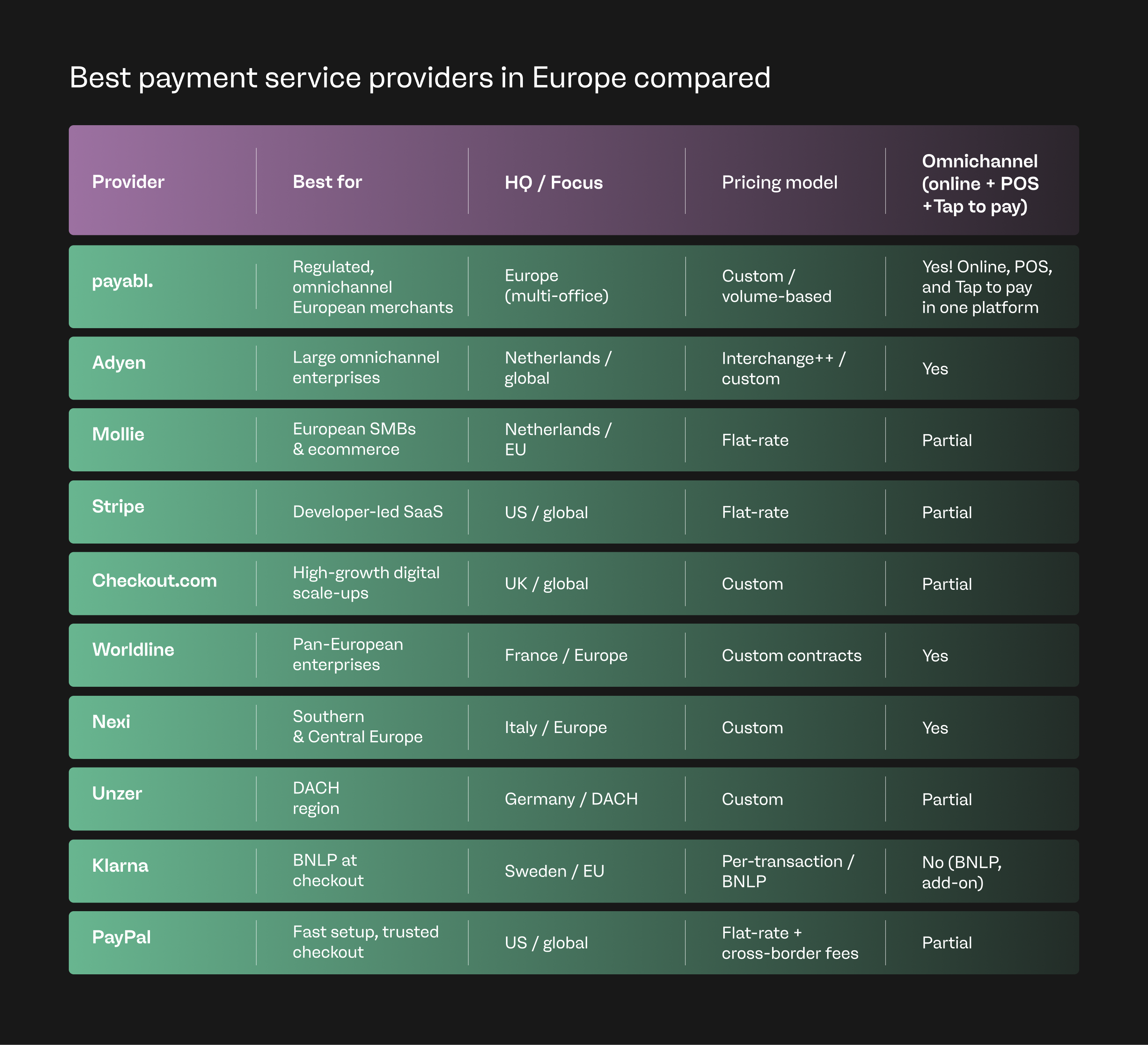
Best payment service providers in Europe compared
| Provider | Best for | HQ / focus | Pricing model | Omnichannel (online + POS + Tap to pay) |
| payabl. | Regulated, omnichannel European merchants | Europe (multi-office) | Custom / volume-based | Yes! Online, POS, and Tap to pay in one platform |
| Adyen | Large omnichannel enterprises | Netherlands / global | Interchange++ / custom | Yes |
| Mollie | European SMBs & ecommerce | Netherlands / EU | Flat-rate | Partial |
| Stripe | Developer-led SaaS | US / global | Flat-rate | Partial |
| Checkout.com | High-growth digital scale-ups | UK / global | Custom | Partial |
| Worldline | Pan-European enterprises | France / Europe | Custom contracts | Yes |
| Nexi | Southern & Central Europe | Italy / EU | Custom | Yes |
| Unzer | DACH region | Germany / DACH | Custom | Partial |
| Klarna | BNPL at checkout | Sweden / EU | Per-transaction / BNPL | No (BNPL add-on) |
| PayPal | Fast setup, trusted checkout | US / global | Flat-rate + cross-border fees | Partial |
How much do payment service providers in Europe cost?
European payment service providers usually charge per transaction, using either flat-rate or interchange-plus pricing. Flat rates commonly sit around 1.4% plus a fixed fee for EEA consumer cards, rising for non-EEA and commercial cards, while interchange-plus separates the card scheme fee from the provider's markup for more transparency at volume.
The real cost is broader than the percentage: currency conversion, chargebacks, cross-border fees, and declined transactions all move the total. A PSP that lifts approval rates by even a point can outweigh a slightly higher headline fee.
Why omnichannel matters when choosing a European PSP
Picture a Berlin coffee roaster that sells online, at a shop counter, and at weekend markets. If the website, the till, and the market phone reader all run on different providers, the owner ends up with three logins, three fee schedules, and three settlement timelines, like one café supplied by three wholesalers who never speak to each other.
An omnichannel European PSP pulls online checkout, POS, and Tap to pay into a single view, so revenue, refunds, and disputes reconcile in one place. For a subscription CFO, that single source of truth is what turns payments from a cost centre into a forecastable part of cash flow.
The best payment service provider in Europe is the one that scales with your business, not against it
Choosing among the best payment service providers in Europe is a long-term infrastructure decision, not a line-item on a pricing page. The PSPs that win are the ones that protect approval rates, satisfy EU regulation, cover the payment methods your customers actually use, and unify every sales channel you run.
For merchants trading across Europe and the UK, payabl. brings that together as a regulated institution and Visa and Mastercard principal member, pairing online acquiring, POS, and Tap to pay with 300+ payment methods and multi-currency accounts.
Compare on regulation, reach, and reliability, and the best payment service provider in Europe will scale with your business, not against it.
Ready to unify online, POS, and Tap to pay under one regulated European partner? Talk to payabl. through the contact form to scope the setup for your business.
FAQ: best payment service providers in Europe
Who are the best payment service providers in Europe?
The best payment service providers in Europe include payabl., Adyen, Mollie, Stripe, Checkout.com, Worldline, Nexi, Unzer, Klarna, and PayPal. For merchants wanting online checkout, POS, and Tap to pay from one regulated European PSP, payabl. is a strong choice: a licensed European payments institution and Visa and Mastercard principal member with 300+ payment methods and multi-currency accounts.
What is a payment service provider (PSP)?
A payment service provider is a company that lets a merchant accept and manage payments across channels, handling the gateway, acquiring, fraud screening, currency conversion, and settlement in one relationship. In Europe, the best PSPs also hold the right EU licence.
How much do European payment service providers charge?
Most charge per transaction using flat-rate or interchange-plus pricing. Flat rates for EEA consumer cards often start around 1.4% plus a fixed fee and rise for non-EEA or commercial cards. Total cost also depends on currency conversion, chargebacks, cross-border fees, and approval rates.
Which European PSP is best for ecommerce and subscriptions?
Ecommerce merchants should prioritise high approval rates, broad local payment method coverage, and fraud protection, while SaaS and subscription businesses need reliable recurring billing and dispute management. payabl. supports recurring payments and disputes alongside omnichannel acceptance across Europe.
What is the difference between a payment service provider and a payment gateway?
A payment gateway securely captures and encrypts payment details at checkout, while a payment service provider delivers the full stack: gateway, acquiring, fraud tools, settlement, and reporting. Full PSPs like payabl. combine all of these under one regulated relationship.