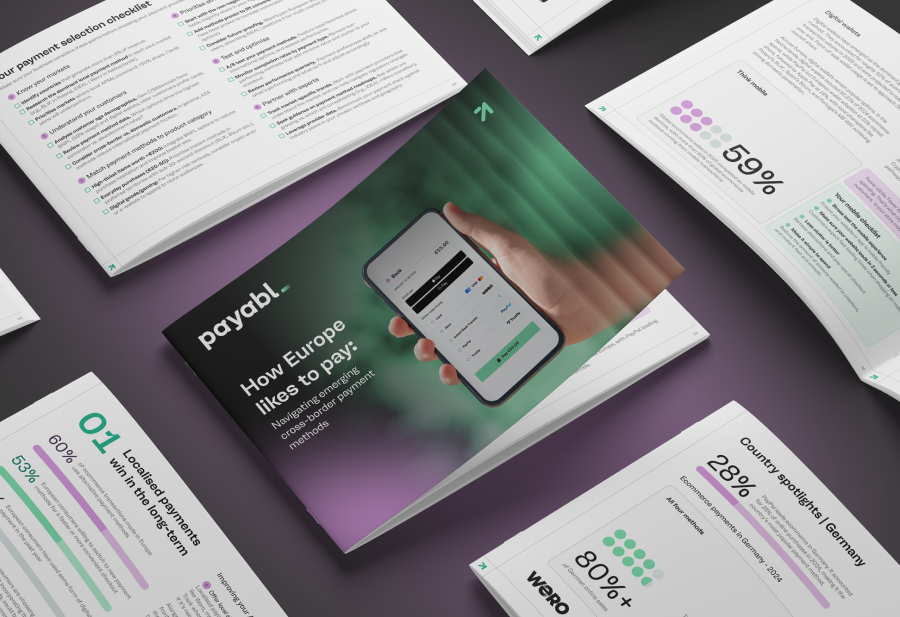
The way consumers across Europe pay is changing quickly, with most merchants not having enough time to react. Most are still playing catch-up and being left behind by their competition. The trend across is clear: cards are still significant for European ecommerce, but their market share is shifting.
Digital wallets, account-to-account transfers, and Buy Now, Pay Later options are all eating into market share — leaving the merchants who haven't adapted their payment strategies feeling the cost in lower conversion rates and more abandoned carts.
This is what our new payments report is designed to address. Following on from our State of European Checkouts and 2025 edition of How Europe Likes to Pay, How Europe likes to pay: Navigating emerging cross-border payment methods offers practical, actionable advice for merchants looking to understand where the market is heading and how to position their checkout experience accordingly.
Looking at the market trends and areas for growth, we’re seeing a shift towards faster, simpler methods for customers to pay. Customers are shying away from manual PAN and card number entry, and towards payment methods that reduce friction and hasten the checkout process.
Cards remain dominant, but are losing share
The data from the report reveals an interesting trend in Europe: cards remain the largest single payment category in European ecommerce, holding 43% market share in 2024.
However, that dominance is under pressure from alternative and localised payment methods. Digital wallets surged to 31% of European ecommerce transactions in the same period and are forecast to reach 37% by 2030. Account-to-account payments now command 15% of the market, with particularly strong performance in the Netherlands, Poland, and Spain.
The trend is even more pronounced in physical retail. At point-of-sale, digital wallets are expected to climb from 27% to 40% of in-store payments by 2030, mostly driven by Apple Pay, Google Pay, and local A2A contactless solutions. Even in markets loyal to card payments like the UK and France, bank-backed wallets and A2A schemes are growing quickly enough to disrupt the market.
A2A payments are scaling fast
Account-to-account payments from providers like Wero are no longer a niche alternative. Global A2A transaction volumes are projected to climb from 60 billion in 2024 to 186 billion by 2029, with transaction values expected to rise from $1.7 trillion to $5.7 trillion over the same period.
In Europe, the numbers are already stark. Poland's BLIK processes over 140 million monthly transactions. iDEAL | Wero, which dominates the Netherlands, has surpassed 111 million. For merchants, one of the more compelling aspects of A2A is the cost structure and potential savings for merchants.
Solutions like Variable Recurring Payments offer transaction fees averaging just 4 cents, compared to card fees that typically run around 3.5%. This offers a meaningful difference for businesses operating at scale.
BNPL and digital wallets heading in one direction
The global Buy Now, Pay Later (BNPL) market reached $492.8 billion in 2024 and is forecast to grow at 13.7% annually, reaching $911.8 billion by 2030. Adoption is strongest among younger shoppers; in the UK, 63% of millennials and 56% of Gen Z have used BNPL.
The data shows that ecommerce platforms that have integrated BNPL consistently report higher average order values and stronger repeat purchase rates, while one in four consumers now cite cost-of-living pressures as a direct reason for using these options more.
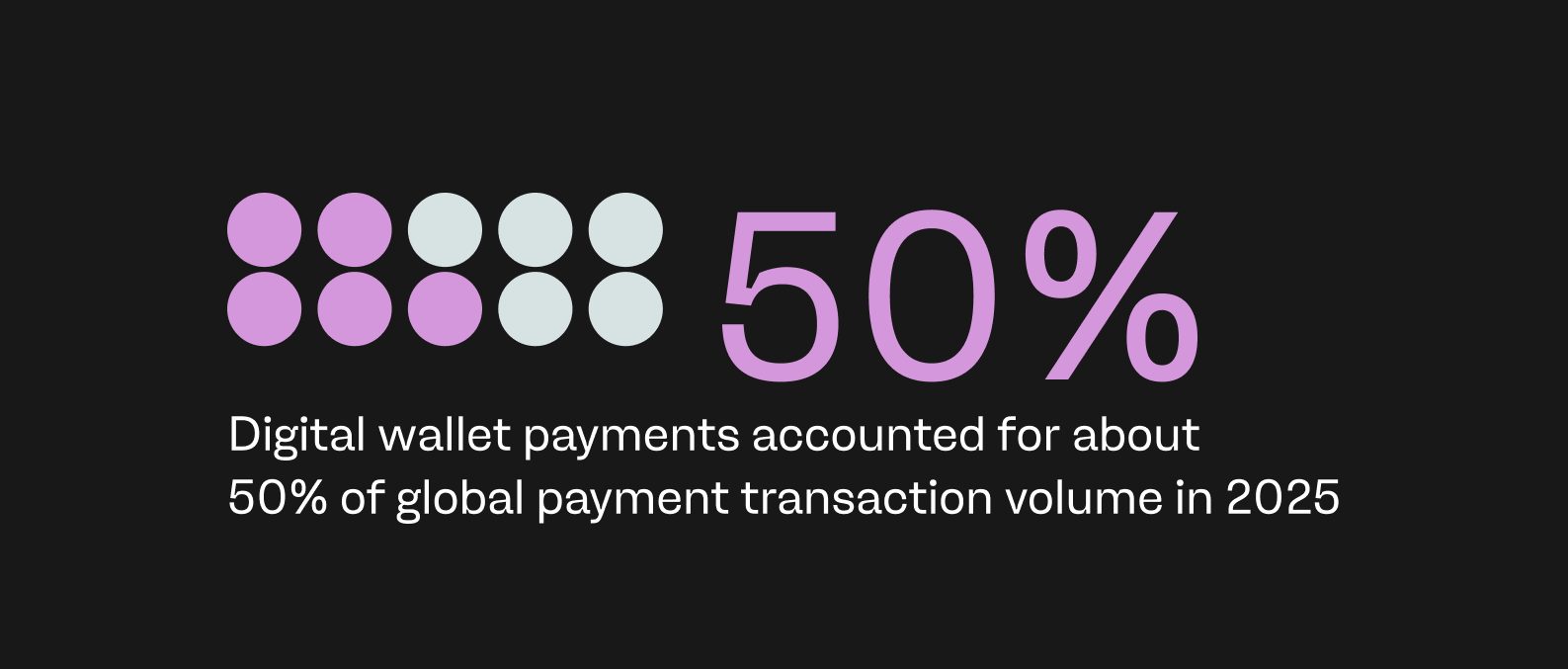
Digital wallets tell a similar story. They accounted for roughly 50% of global ecommerce transaction volume in 2025, and in the Netherlands, they already secured 52.23% of ecommerce spend. Elsewhere, PayPal leads European wallet adoption at 51% market share, followed by Apple Pay at 19%, with domestic players like Spain's Bizum and Portugal's MB Way holding strong positions in their home markets.
Europe's payment infrastructure is changing
The infrastructure underpinning European payments is going through its most significant structural change in years. The European Payments Institute launched Wero, which has already onboarded 50 million users, and has absorbed iDEAL's 1.5 billion annual transactions as part of a migration running through 2026 to 2028.
The EuroPA alliance is moving in the same direction. In early 2026, the European Payments Institute signed a memorandum of understanding with Bancomat in Italy, Bizum in Spain, SIBS-MB WAY in Portugal, and Vipps MobilePay in the Nordics. The goal is to build interoperable, cross-border payment infrastructure across Europe.
For merchants operating across multiple European markets, this matters. The fragmented local schemes that once required separate integrations are gradually being connected. This gives merchants opportunity and motive to find a payment method that works across Europe or in their operating territories.
Mobile is no longer optional
Another trend showing prominence is consumers shopping on mobile devices, and its impact on global ecommerce. Data from the report shows that 59% of global ecommerce sales in 2025 were completed on mobile devices, with more than 63% of global ecommerce revenue now coming from mobile transactions.
If your checkout isn't built around a mobile-first experience, you're creating friction at exactly the moment a customer is ready to spend. Trends show that customers want speed and simplicity when shopping, which can be delivered with a mobile-first strategy. A mobile checklist is available in our report to help you adapt to this important change.
Assessing the bigger picture for merchants
The payments market is fundamentally changing. The market shows that the merchants that can adapt and respond to these trends can position themselves ahead of the competition, and dampen lost revenue and cart abandonment.
Customers in Europe increasingly expect to pay with methods they trust. Whether that's a local wallet, an A2A transfer, or a BNPL option at checkout, when that option isn't there, many of them simply don't complete the purchase.
Whether you're a merchant looking to reduce cart abandonment, lower transaction costs, or reach new customer segments with expansion, the data reveals something that needs to be considered by European merchants: a card-only checkout is no longer sufficient.
Review your payments strategy
For merchants, it means that picking the right payment options for your checkout has never been more important. Our report walks you through specific strategies, country-specific data and trends, and practical checklists throughout to help you make informed decisions about which payment methods belong in your checkout.
Get the full report to build a checkout strategy that keeps pace with your competition, and where your customers already are.
Download How Europe likes to pay: Navigating emerging cross-border payment methods to help build the right payment strategy for your business.