
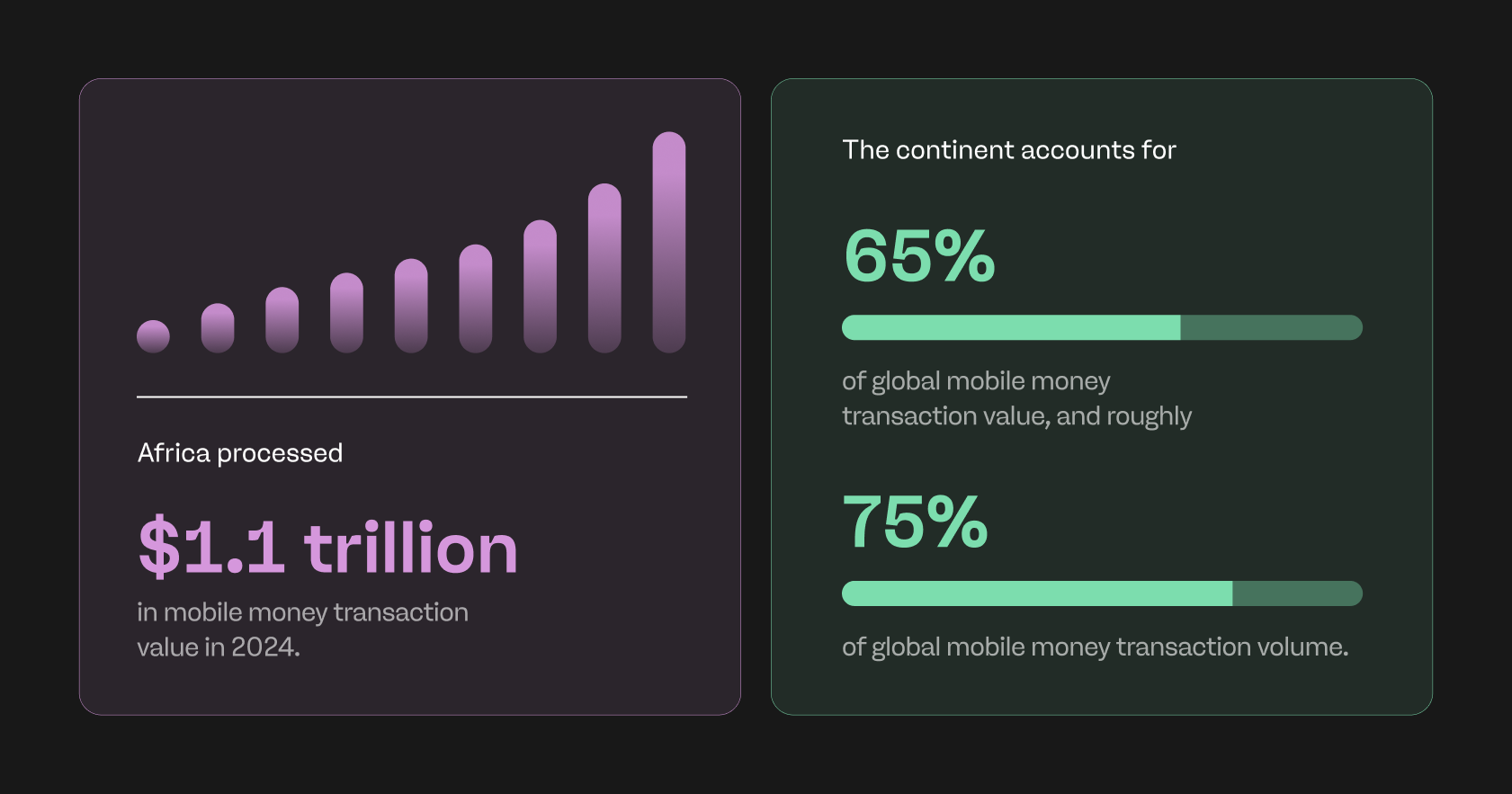
Africa processed $1.1 trillion in mobile money transaction value in 2024, according to the GSMA State of the Industry Report 2025. The continent accounts for 65% of global mobile money transaction value, and roughly 75% of global mobile money transaction volume. Sub-Saharan Africa alone holds more than 1.1 billion registered mobile money accounts.
These numbers make Africa one of the most commercially significant payments regions in the world. They also make potential expansion into Africa a carefully considered decision.
Merchants expanding into African markets tend to treat the continent as a single payments environment, but it isn't. Payment behaviour, infrastructure and regulation differ greatly from one country to the next, and in many cases, from one local city to the next. A strategy that works in Nigeria may convert poorly in Tanzania, and fail entirely in Madagascar.
How people pay varies by country and payment rail
African payments span mobile money wallets, bank transfers, USSD-based services, card payments and in-store options. The mix changes depending on where you operate.
In Nigeria for example, bank transfers and USSD remain major digital payment channels alongside card payments and wallets. Paga, a Nigerian payments platform, processed €13.3 billion in 2025, with its consumer model covering app, web, USSD and agent-assisted cash access. This reflects how Nigerian consumers move between multiple rails depending on the transaction context.
Tanzania tells a different story. The country processed 6.41 billion mobile payment transactions worth €42.5 billion in 2024, with transaction value growing 28.54% year-on-year. Mobile money is the mainstream infrastructure there, with 63.21 million active subscriptions and 1.48 million agents nationwide.
Cameroon, meanwhile, recorded 31 million mobile money accounts and 2.73 billion transactions in 2024. It represents 65.1% of all mobile money accounts in the CEMAC region. Mobile money is the dominant payment service type in Central Africa by volume.
The data shows that each country operates on different rails, and a single integration point or payment method won't accurately cover them all.
Mobile money is the primary payment instrument
The World Bank Global Findex 2025 reports that Sub-Saharan Africa remains the region with the largest share of adults who hold only a mobile money account, with around 40% of adults across the continent's four subregions (West, East, Central, Southern) having one. The GSMA further reported that mobile money payments contributed $190 billion to Sub-Saharan African GDP in 2023.
For merchants, mobile money acceptance ensures consumers who may not use cards or traditional bank transfers as their primary payment method can be reached effectively. Like country variances, the specific mobile money services, transaction limits, currencies and settlement arrangements differ by market.
In Tanzania, M-Pesa (Vodacom) had 11.5 million customers and more than 470,000 merchant acceptance points in 2025, and In Zambia, 12.33 million active mobile money accounts processed 2.99 billion transactions in 2024. For merchants selling into African markets, the takeaway is clear: mobile money options are the primary way a large share of consumers store and spend money.
By offering only card or bank-transfer options at checkout when considering Africa means excluding a large proportion of the continent. The country-level data above shows mobile money’s impact across Africa — meaning any checkout strategy that doesn't include it will see higher abandons and lost conversions.
A decision framework for merchants entering African markets
Before committing to a payments strategy in any African market, merchants should evaluate these factors:
Customer access
How do your target customers pay day by day? Mobile wallet, bank transfer, or card? The answer varies by country, income segment and device type. Find your target market.
Market coverage
Which payment methods have the widest local acceptance? A provider with millions of users continent-wide could have limited reach in your specific target market or country.
Transaction type
Are you processing recurring payments, one-off purchases or subscriptions? Not every local payment method supports every transaction model, so ensure you choose one that fits your needs.
Merchant payment maturity
Some markets have established merchant-payment ecosystems with hundreds of thousands of acceptance points. Find a method that supports the acceptance points your strategy requires.
Integration route
Regulatory requirements, settlement currencies and compliance shape what you need to integrate. Consider market-by-market application to ensure you meet all the criteria to go live
Where payabl fits.
Your route into Africa’s payment growth means building payment acceptance country by country, matched to local behaviour, local infrastructure and local regulations.
payabl. offers six African payment methods across six countries, each selected for the specific market it serves:
- Paga: wallet, bank-transfer, USSD and agent access across Nigeria
- M-Pesa: merchant payments and wallet services in Tanzania
- MTN Mobile Money (MoMo): mobile wallet acceptance across multiple African markets
- Airtel Money: wallet payments in Uganda, Tanzania, Congo-Brazzaville and Madagascar
- Zamtel Money: wallet, agent and card-linked payment options in Zambia
- MVola: mobile money, savings, credit and remittance services in Madagascar
Merchants add these methods through payabl. checkout, with one integration. Each method is configured for the country it operates in. Get local currencies, local payment flows and local settlements.
Go live in Africa with payabl.
FAQ
Is mobile money the same across every African country?
No. Each market runs on different providers, rails and infrastructure. Some run on mobile money as the dominant rail, while some work across bank transfers, USSD, cards and wallets. Treating Africa as one payments environment misses how consumers actually pay in each country.
Why does mobile money acceptance matter for merchants expanding into Africa?
Around 40% of adults across Sub-Saharan Africa hold only a mobile money account, according to the World Bank Global Findex 2025. Checkout pages that only offer cards or bank transfers cut off a large share of consumers before they can pay.
How does payabl. support merchants expanding into African markets?
payabl. checkout connects six payment methods across six countries: Paga, M-Pesa, MTN Mobile Money, Airtel Money, Zamtel Money and MVola through one integration. Each method is set up for its local currency, payment flow and settlement process.