Most UK businesses didn't choose to run their money through five different systems. It happens one vendor at a time, with payment providers, business accounts and card issuance added as the business grows. Each addition solved a problem in isolation, but together they're contributing to unchecked operational drag on the business.
This is financial fragmentation. It presents a measurable growth constraint and is beyond operational inconvenience according to Juniper Research. And as businesses expand across markets and payment methods, these disconnected systems slow decision-making, reduce visibility, and make scale harder to manage, according to a whitepaper from payabl. and Juniper Research: Solving Financial Fragmentation for Modern Businesses.
For UK merchants considering their payment infrastructure this year, understanding fragmentation and what unified alternatives looks like should be a serious strategic consideration.
Why disconnected systems create more work than they save
Every additional provider a business introduces brings new logins, separate reporting formats and unique data silos. Juniper Research identifies four areas where this shows up hardest for merchants: visibility, liquidity, reconciliation, and market complexity. None of these sit in isolation, with market complexity a major driver of the other three.
Reconciliation is where the cost becomes apparent. In disconnected ecosystems, it requires manual matching across different providers and currencies according to Juniper Research. Even in a heavily manual environment, month-end reconciliation can take a financial controller up to 10 days to process — a cost the report estimates at €49,000 a year for an SMB, €244,000 for a mid-market company, and €732,000 for a large corporate (based on average financial controller wages in Germany).
Split liquidity across multiple partners dilutes access to working capital and delays settlement too, Juniper Research notes. Compliance overheads multiply this, with regional obligations that can't be reused across markets. More partners in the mix also means auditing gets harder, raising the risk of missing something when it goes wrong.
The cost of fragmentation for UK businesses
The financial case against fragmentation is beyond hours lost to spreadsheets. Juniper Research breaks the cost into four categories: time, direct cost, risk, and opportunity. On the cost side, the average business faces FX charges of between 1% and 3%, with more complex provider ecosystems pushing that towards the higher end.
The risk factor compounds this. Disconnected, disjointed systems create more manual work, which creates more room for error. This translates directly into compliance exposure, Juniper Research states. Opportunity cost is the one most businesses underestimate. Fragmented systems restrict growth and ambition for businesses, delaying expansion and limiting payment innovation.
Quantifiable results are found when moving to more unified models. Businesses moving to a unified financial operating model could cut reconciliation spend by €39,000 a year for an SMB, €195,000 for a mid-market business, or €585,000 for a large corporate, Juniper Research found.
The need for unified infrastructure
Juniper Research is specific on unifying financial infrastructure: systems need to more than connect — they need to integrate into a single platform that removes the manual burden carried by finance and payments teams.
This requires many things in the same place: payment acceptance, business accounts, card issuing, reconciliation, and reporting all working as one ecosystem. The value for businesses is reducing the number of disconnected layers they have to manage day to day.
This is the shift UK merchants are experiencing with modern infrastructure. Cross-border trading, multiple payment methods, and the requirements of authorised payment institutions in the EU mean that picking separate providers one at a time is no longer a viable long-term strategy.
payabl.one: bringing it together in one place
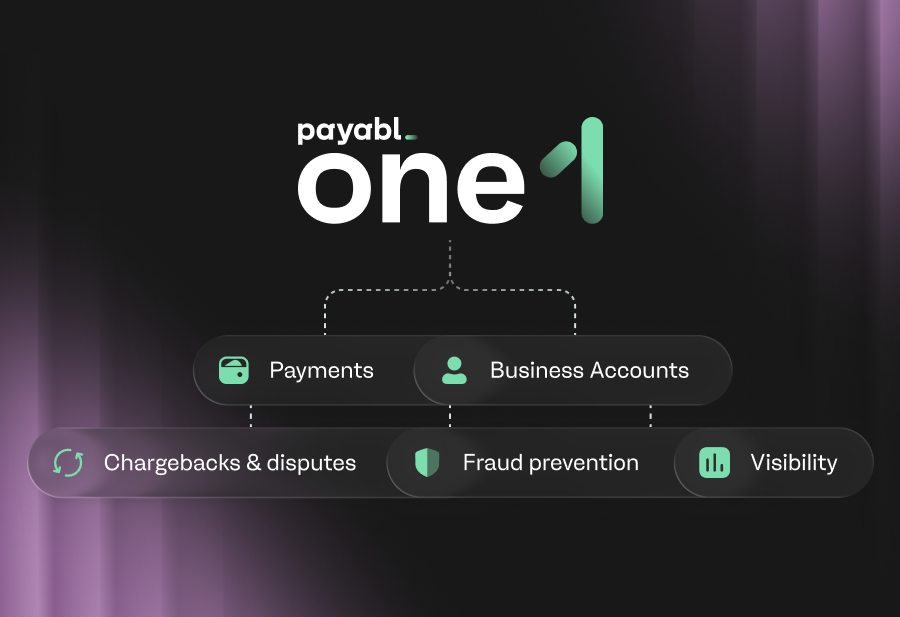
This is where payabl.one fits for modern businesses. It's a single platform connecting payment acceptance, business accounts, and insights. Merchants can run online and in-store payments plus handle cross-border transactions without needing separate providers.
Payment acceptance
Online payments, in-store terminals, and cross-border transactions from one setup, with access to over 300 local and alternative payment methods.
Business accounts
Multi-currency accounts with real FX rates across more than 60 currencies, multi-currency IBANs, and direct access to business funds.
Chargebacks and disputes
Pre-dispute automation, real-time chargeback data, and structured alert workflows in one place.
Fraud prevention
AI-driven fraud detection, flagging suspicious activity in real time, backed by PCI DSS compliance including tokenisation and end-to-end encryption.
Visibility
One dashboard to track, monitor, and analyse payments, accounts, and settlements. Live updates on balances and performance.
Ugne Buraciene, Group CEO of payabl., iterates the need for unity: “managing a patchwork of separate vendors for acquiring, business accounts, and card issuing creates operational friction and critical blind spots for fraud — and payabl.one exists to collapse that complexity into a single operating layer, giving businesses total financial clarity from one dashboard.”
For UK businesses still running operations across separate providers, the cost of continuing to run disconnected systems or move to one platform built to remove it is a serious consideration.
Reduce fragmentation costs and unify your operations with payabl.one.