

A payment form is the front door of an online business. Leave it unlocked, even by accident, and it does not matter how good the product behind it is: fraudsters will walk straight through. For developers, building secure online payment forms is not a checkbox at the end of a project. It is the architecture that decides whether a business processes revenue safely or becomes a statistic in next year's fraud report.
Global ecommerce fraud losses hit an estimated $48 billion in 2025, a 16% jump from the year before, and card-not-present fraud alone is projected to reach $28.1 billion in 2026. Most of that fraud does not happen because a company lacked ambition to be secure. It happens because a payment form stored a card number it should never have touched, skipped authentication it should have enforced, or ran a third-party script nobody audited.
This guide breaks down exactly what best practices developers should follow to create secure online payment forms and reduce the risk of card fraud, from field-level design to tokenization, PCI DSS 4.0.1 compliance, and 3D Secure 2 authentication. Think of it as the blueprint for a vault, not just a checkout button.
What best practices should developers follow to create secure online payment forms and reduce the risk of card fraud?
Developers should follow six core practices: never let raw card data touch their own servers (use tokenization and hosted fields instead), enforce HTTPS and strict Content Security Policy everywhere, validate and sanitize every input field, implement 3D Secure 2 for strong customer authentication, monitor and authorize every script running on the payment page per PCI DSS 4.0.1, and layer in real-time fraud detection such as velocity checks and device fingerprinting. Together, these practices remove the attack surface fraudsters rely on, from skimming scripts to stolen card testing.
Each of these deserves its own explanation, because skipping any one of them is like locking the front door and leaving a window open.
1. Keep raw card data out of your own servers
The single biggest reduction in fraud risk and compliance burden comes from never letting your own servers see, store, or transmit a full card number (PAN), CVV, or expiry date in the clear. Instead, use tokenization: the card number is replaced with a randomly generated token that has no value if it is intercepted, similar to swapping a house key for a one-time access code that only works for a single delivery and expires right after.
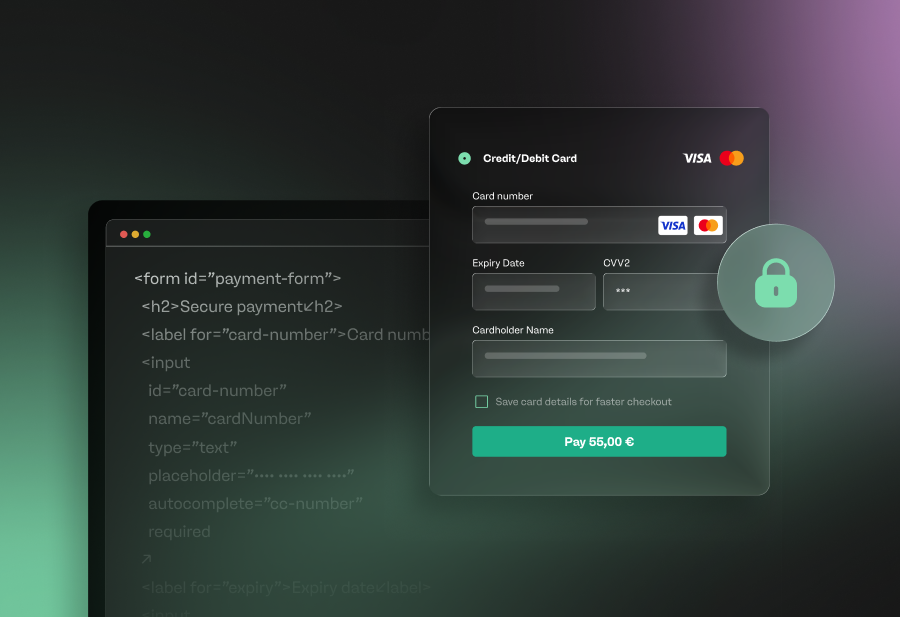
In practice, this means using hosted payment fields or an iframe-based card element provided by your payment provider, so the sensitive data goes directly from the customer's browser to the provider's PCI-compliant environment, bypassing your servers entirely. This is the fastest way to shrink your PCI DSS scope, because if your systems never touch cardholder data, most of the compliance burden shifts to your payment partner.
Tokenization is the process of replacing a card number with a non-sensitive token, so that even if a payment form or database is breached, there is no usable card data for fraudsters to steal.
2. Enforce HTTPS, strict CSP, and subresource integrity everywhere
Every page that renders a payment form, and every page in the checkout flow that leads to it, must run exclusively over HTTPS with HSTS enabled. But transport encryption alone is not enough. A growing share of payment fraud comes from e-skimming (also called Magecart-style attacks), where malicious JavaScript injected into a checkout page silently copies card details as a customer types them.
To close this gap, developers should implement a strict Content Security Policy (CSP) that whitelists only the scripts the payment page actually needs, and use Subresource Integrity (SRI) hashes on every third-party script, from analytics pixels to chat widgets. This directly addresses PCI DSS 4.0.1 Requirements 6.4.3 and 11.6.1, which became mandatory on 31 March 2025 and require merchants to inventory, authorize, and monitor every script that runs on a payment page, and to detect unauthorized changes to that page as they happen.
PCI DSS Requirement 6.4.3 requires developers to maintain an authorized inventory of every script running on a payment page, while Requirement 11.6.1 requires a mechanism that detects and alerts on unauthorized changes to that page's scripts and content.
3. Validate, sanitize, and never trust client-side input
Every field in a payment form, card number, expiry date, name, billing address, postal code, needs both client-side validation (for a fast, friendly user experience) and server-side or provider-side validation (because client-side checks can always be bypassed). Use the Luhn algorithm to catch malformed card numbers before submission, enforce correct formatting with input masks, and restrict the CVV field to reject anything that is not three or four digits.
Equally important: never log full card numbers or CVV values, not in application logs, not in error-tracking tools, not in support tickets. A CVV should never be stored after authorization, even in encrypted form. Treat it the way a bank treats a vault combination: used once, for its single purpose, and never written down anywhere else.
4. Implement 3D Secure 2 for strong customer authentication
3D Secure 2 (3DS2) adds a layer of identity verification, backed by biometrics, one-time passcodes, or risk-based authentication, that shifts fraud liability away from the merchant in most card-not-present disputes. Unlike the clunky pop-up redirects of the original 3D Secure, 3DS2 is designed to run frictionlessly in the background for low-risk transactions, and step up to active verification only when the risk score demands it.
Developers should integrate 3DS2 through their payment provider's SDK and pass as much contextual data as possible (device fingerprint, browser details, shipping and billing history) because richer data signals mean more transactions qualify for frictionless, low-drop-off authentication. This matters commercially too: recent analysis shows merchant demand for frictionless 3DS exemptions has grown to 78%, precisely because every added step in checkout risks losing a legitimate customer.
5. Monitor the payment page itself, not just the transaction
Fraud prevention does not stop once the form is built. Payment pages change constantly: new tracking pixels get added, third-party widgets get updated, and marketing teams inject new scripts without always looping in security. Developers should deploy client-side monitoring that continuously inventories every script, flags unauthorized changes, and alerts the team the moment unexpected code appears on a payment page.
This is the equivalent of a bank installing cameras not just at the vault door but throughout the entire building, because a skimmer does not need to breach the vault if it can intercept the cash on its way there.
6. Layer in real-time fraud detection
Secure code reduces the attack surface, but it does not catch every fraud pattern on its own. Pair your secure form with real-time fraud detection: velocity checks (blocking a card that is tried five times in two minutes), device fingerprinting, IP and geolocation mismatches, and AVS (address verification service) checks. Modern AI-based fraud detection systems now reach 95%+ accuracy, a sharp improvement over legacy rule-based systems that typically caught only 60 to 75% of fraudulent transactions.
The goal is balance. Overly aggressive rules create false declines, which cost merchants far more in lost revenue than the fraud they prevent; by some estimates, false declines cost nine times more annually than actual fraud losses. A secure payment form should feel, to a legitimate customer, like it is not even there. It should only create friction for the fraudster trying to force the door.
Common mistakes developers make with payment form security
- Storing card data "just in case." Even temporary storage of a PAN or CVV, cached for debugging, logged for analytics, kept in a database "to make refunds easier," creates liability with no upside. If a provider's tokenization already handles refunds, there is no reason to touch the raw number at all.
- Treating PCI DSS as a one-time audit. PCI DSS 4.0.1 (and its script-monitoring requirements) is a continuous obligation, not an annual checkbox. Scripts and dependencies change weekly; monitoring needs to match that pace.
- Over-indexing on fraud rules and under-indexing on UX. A payment form with ten mandatory fields and three authentication steps will cut fraud and cut conversion. The best-performing forms are secure by architecture (tokenization, CSP, 3DS2) rather than by friction.
- Ignoring card-present and omnichannel consistency. Businesses that sell both online and in person need fraud logic and authentication standards that work the same way across online checkout, point of sale, and Tap to pay, not three disconnected systems with three different risk profiles.
How payabl. supports secure payment form development
For businesses building or rebuilding their payment flow, payabl. provides the infrastructure layer that makes most of these best practices default behavior rather than custom engineering work. payabl. is a financial technology provider offering payments and business accounts for businesses of all sizes, enabling merchants to accept online and in-person payments, hold multi-currency business accounts, issue physical and virtual cards, and support 300+ local and alternative payment methods, all built around the omnichannel payment journey of online checkout, point of sale, and Tap to pay.
Developers integrating payabl.'s payment infrastructure benefit from tokenized, PCI-compliant card handling out of the box, built-in support for 3D Secure 2 authentication, and a single integration that covers online and in-person acceptance consistently, which removes the need to reconcile separate fraud rules across channels.
Secure payment forms are a system, not a single feature, and that system is what stops card fraud
A secure online payment form is never one clever trick. It is tokenization removing sensitive data from your servers, strict CSP and script monitoring closing the e-skimming gap, validated and sanitized fields rejecting malformed input, 3D Secure 2 authenticating the customer without adding friction, and real-time fraud detection catching what slips through. Remove any single layer and the whole system weakens, the same way a vault with a reinforced door and an unlocked side window is not actually a vault. Developers who treat these six practices as the default architecture, not an afterthought, are the ones who keep both their fraud rate and their false-decline rate low, which is the real measure of a payment form done right.
Frequently asked questions
What best practices should developers follow to create secure online payment forms and reduce the risk of card fraud?
Developers should avoid letting raw card data touch their own servers by using tokenization and hosted fields, enforce HTTPS with a strict Content Security Policy and Subresource Integrity on every script, validate and sanitize all input fields without ever logging CVV or full card numbers, implement 3D Secure 2 for strong but low-friction customer authentication, continuously monitor the payment page for unauthorized script changes under PCI DSS 4.0.1, and layer in real-time fraud detection such as velocity checks and device fingerprinting.
What is tokenization and why does it matter for payment form security?
Tokenization replaces a card number with a randomly generated, non-sensitive token that has no usable value outside the specific system that issued it. It matters because even if a payment form, database, or server is breached, there is no real card data for a fraudster to steal, and it significantly reduces the scope of PCI DSS compliance a business has to maintain.
Is 3D Secure 2 required for online payment forms?
3D Secure 2 is not universally mandatory everywhere, but it is required under regulations like PSD2's Strong Customer Authentication rules in the European Economic Area, and it is strongly recommended globally because it shifts fraud liability away from the merchant and reduces chargebacks on card-not-present transactions.
What is card-not-present (CNP) fraud and how is it different from card-present fraud?
Card-not-present fraud occurs when a stolen or synthetic card number is used for a transaction where the physical card is never shown, such as an online purchase, and it is harder to prevent because there is no chip, PIN, or signature to verify. It currently accounts for the large majority of total card fraud losses, projected to reach $28.1 billion by 2026, which is why online payment forms carry more fraud-prevention responsibility than in-person terminals.
Do developers need to be PCI DSS compliant if they use a third-party payment provider?
Using a PCI-compliant, tokenized third-party provider significantly reduces the compliance burden because sensitive card data never touches the merchant's own servers, but the business is still responsible for completing the appropriate Self-Assessment Questionnaire (SAQ) and for meeting requirements that apply to the payment page itself, including script inventory and monitoring under PCI DSS 4.0.1 Requirements 6.4.3 and 11.6.1.
What is the biggest mistake developers make when building a payment form?
The most common and costly mistake is storing or logging raw card numbers and CVV values "just in case," even temporarily. This creates compliance liability and a breach target with no real benefit, since tokenization already supports refunds, recurring billing, and customer record-keeping without ever exposing the original card number.