

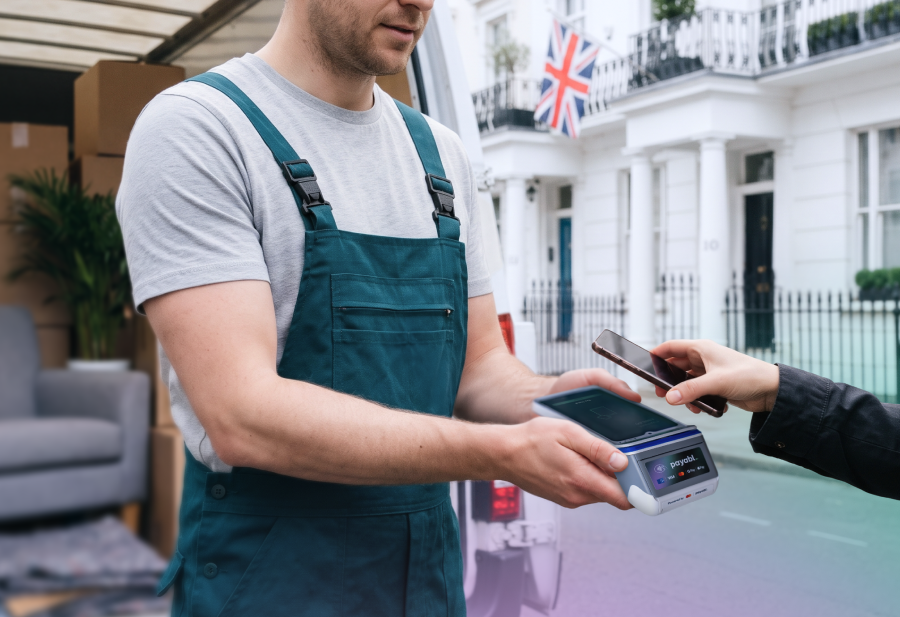
For many UK removal businesses, taking payment still means an awkward pause at the doorstep, a bank transfer that takes three days to clear, or a card reader that loses signal the moment the van turns down a quiet country lane.
This is where a proper POS system UK moving companies can trust comes in. It is not just a till. For a business that works out of a van rather than behind a counter, the right point of sale setup needs to be mobile, reliable, and flexible enough to handle everything from a quick local move to a multi-day relocation with a deposit, a balance, and maybe a damage claim in between.
In this guide, we will walk through what a POS system actually does for a moving company, the features that matter most on the road, what it tends to cost in the UK, and how to choose a setup that will not let you down on moving day.
What is a POS system, and why does a moving company need one?
A point of sale, or POS, system is the combination of hardware and software a business uses to take payments and record the sale. In a shop, that is a till and a card reader. For a moving company, the "till" is often a smartphone or tablet in the cab of the van, paired with a mobile card reader that travels with the crew.
The core job of a POS system is simple: it lets you charge a customer, whether that is by contactless card, Tap to pay, chip and PIN, or a digital wallet like Apple Pay or Google Pay, and it keeps a clean record of that transaction for your accounts. For a moving company specifically, a good POS system UK operators use also needs to handle the quirks of the job: deposits taken in advance, a final balance calculated once the job is actually done, tips for the crew, and sometimes a call-out fee if a job runs long.
The features that actually matter for a mobile moving business
Not every EPOS system UK providers sell is built with a moving company in mind. Many are designed for shops, cafes, or restaurants with a fixed counter and steady Wi-Fi. A removal business needs a different set of priorities.
Reliable connectivity away from the office
Your crew will take payments in driveways, in new-build estates with patchy signal, and occasionally in basement flats where Wi-Fi does not reach. A card machine for mobile business use should work over 4G as a fallback, not just Wi-Fi, so a weak signal does not mean an awkward conversation about bank transfers.
Support for contactless, chip and PIN, and Tap to pay
Customers increasingly expect to pay with a tap of their card or phone rather than entering a PIN. A modern POS system should support Tap to pay as standard, alongside traditional chip and PIN for higher-value transactions where a signature or PIN may still be required under card scheme rules.
Deposits, balances, and flexible invoicing
Most removal jobs are not paid in one go. A customer might put down a deposit to secure the date, then pay the remaining balance once the move is complete. Look for a point of sale system for moving company use that can record a deposit against a job, track what is still owed, and let you take the balance payment on the day without manual spreadsheet juggling.
Multi-currency and multi-method acceptance
If you serve customers relocating internationally, or corporate clients who prefer to pay by bank transfer or a different card scheme, a payment system for service businesses UK should not box you into accepting only one type of card. Look for broad coverage across card schemes and local payment preferences.
Simple reporting for VAT and bookkeeping
At the end of the month, you need to reconcile what came in, by van, by crew, by job type, without hours of manual admin. A decent POS system for small business UK operations will export clean reports that plug straight into your accounting software.
What does a POS system cost for a UK moving company?
Pricing for a mobile POS system UK providers offer typically breaks down into three parts: the hardware, a monthly or annual software fee, and a transaction fee per card payment.
- Hardware: A mobile card reader typically costs anywhere from free (bundled with a contract) to a few hundred pounds for a more robust terminal built for outdoor and van use.
- Software fees: Some providers charge a flat monthly fee, others bundle software into the transaction fee with no separate charge, particularly useful for a seasonal business like removals where volume can swing month to month.
- Transaction fees: These usually sit as a percentage of each card payment, and the rate can vary depending on card type, whether the card is present or not, and your monthly volume.
For a moving company, it is worth asking providers directly how they price remote or card-not-present transactions, since you may occasionally need to charge a deposit over the phone before you have even met the customer.
Choosing between a standalone card reader and a full POS setup
Some smaller removal businesses manage perfectly well with just a mobile card reader linked to an app on a phone. It is quick to set up and cheap to start. Larger operators running multiple vans and crews, however, often outgrow that setup fast. They need visibility across every job, every crew, and every payment in one place, which is where a fuller POS system UK businesses scale into becomes worth the investment.
A useful way to think about it: a single card reader is like a sole trader's toolbox, everything you need for one job, in one bag. A full POS system is more like a fleet management platform, giving the business owner a bird's-eye view of every van, every job, and every payment, all at once. If you are still a one-van operation, start simple. If you are managing three or more crews, a connected system will save you far more admin time than it costs.
Best payment system for removal companies: what to prioritise
When comparing providers, it helps to score each option against the realities of the removal business rather than a generic small business checklist. Ask:
- Does it work reliably outdoors, on 4G, without needing a strong Wi-Fi signal?
- Can it handle deposits and part payments without extra manual work?
- Does it support contactless payments on the go, including Tap to pay and digital wallets?
- What happens if a customer disputes a charge, for example over damaged goods?
- How quickly does the money actually land in your business account?
- Does the provider also offer a business account, so payments and banking sit under one roof rather than two separate logins?
That last point matters more than many business owners realise. A payments provider that also offers a multi-currency business account means your takings, your invoicing, and your day-to-day banking are not scattered across different platforms.
A connected payment setup for the whole customer journey
Removal companies rarely take payment in just one way. A customer might book online and pay a deposit through a link, pay the balance by card on moving day, and occasionally settle an invoice by bank transfer for a larger commercial relocation. The strongest setup is one that covers this entire journey, online checkout for deposits, a mobile card reader or Tap to pay for the day of the move, and a business account that brings it all together, rather than stitching together three separate tools from three separate providers.
This is where payabl. fits into the picture for UK moving companies. As a financial technology provider offering payments and business accounts for businesses of all sizes, payabl. supports accepting online and in-person payments, multi-currency business accounts, virtual and physical cards, and over 300 local and alternative payment methods. For a removal business, that means a deposit taken online, a balance taken on the doorstep, and the funds landing in one account, without juggling separate systems for each stage of the job.
A POS system built around how your crew actually works is the one that will not let you down on moving day
Choosing a POS system UK moving companies can depend on is not about finding the provider with the longest feature list. It is about finding the setup that survives a day on the road: patchy signal, a customer paying a deposit one week and a balance the next, a crew that needs to take payment the moment the last box is off the van. Prioritise reliability over Wi-Fi, flexibility for deposits and balances, and a provider that connects payments to your business account rather than leaving you to reconcile two systems by hand. Get that combination right, and payment becomes the easiest part of moving day, not the part that holds up the van.
Ready to give your crew a payment setup that keeps up with moving day? Get in touch with payabl. to find the right fit for your business.
Frequently asked questions
What is the best POS system for a small moving company in the UK?
The best choice depends on fleet size. A single-van operator often does fine with a mobile card reader linked to an app, while a business running multiple crews benefits from a fuller POS system that tracks jobs, deposits, and payments across the whole fleet in one place.
Can a moving company take contactless and Tap to pay payments without Wi-Fi?
Yes. A mobile POS system with 4G connectivity can process contactless, Tap to pay, and chip and PIN payments without relying on Wi-Fi, which matters for jobs at properties with weak signal.
How do deposits work with a POS system for a moving company?
A good POS system lets you record a deposit against a specific job when the booking is made, track the remaining balance, and collect that balance on the day of the move without manual spreadsheet tracking.
Do I need a separate business account alongside my POS system?
Not necessarily. Some providers combine payment acceptance with a multi-currency business account, so takings from online deposits and in-person card payments land in the same place as your everyday banking.
What does a POS system typically cost for a UK removal business?
Costs usually break down into hardware (sometimes free with a contract), an optional monthly software fee, and a per-transaction card processing fee. Ask providers how they price card-not-present transactions, since deposits are often taken over the phone or online.