
If you run a small business in the UK, you've likely sent a bank transfer and wondered why it took three days to land. You've also seen payouts on a provider's site and weren't sure if it meant something different. They both offer something different, and picking the wrong one costs your business time or money.
Here's what each one actually does, the problems they solve, and which stage of business they suit.
What a bank transfer does
A bank transfer moves money from one account to another using rails like Faster Payments Service (FPS) in the UK or SEPA for euro payments across Europe. FPS processes transfers in near real-time, often within seconds. SEPA Instant does the same for euro transactions, keeping funds on local rails rather than routing them through intermediaries.
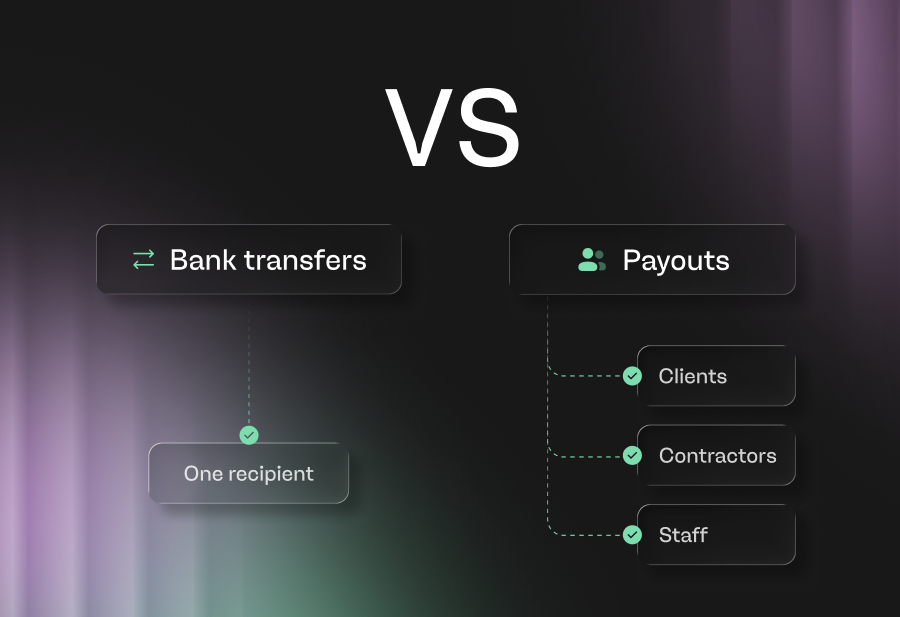
For a small business, a bank transfer suits a single supplier invoice, a one-off contractor payment, or moving money between your own accounts. In almost all circumstances it's one direct payment from sender to recipient.
What payouts do
Payouts are built for larger volumes. Instead of sending one transfer at a time, a payout platform disburses funds to multiple recipients — whether refunds, wages, marketplace settlements — using whichever rail gets the money there fastest. This includes card schemes like Visa Direct and Mastercard Send, which deliver funds to a recipient's debit or credit card in near real-time, plus bank rails like SEPA, SWIFT, and FPS.
The difference comes from structure alongside speed. A payout platform handles hundreds or thousands of transactions in parallel, with confirmation and reconciliation built in. This saves businesses chasing each transfer manually.
The pain points each one solves
Small business owners face persistent frustrations when moving money, the most common being that it's slow, expensive, and opaque.
Standard transfers through a traditional bank can take several working days to clear. This is more evident when transferring cross-border, which leaves cash flow stuck when you need it available now. Fees are often less transparent, and appear as flat charges with FX margins not shown up-front. This means the real cost only shows up after the money's gone. Plus, when something goes wrong, resolving it usually means a phone call and a wait, which causes further delays.
Payouts solve a different problem for businesses: scale. If you're refunding multiple customers per week or paying multiple freelancers every month, executing one transfer at a time wastes hours of time and increases the risk of manual error. A payout platform automates this for UK businesses, confirms each transaction as it completes, and gives you a unified record of what went where. For marketplaces and platforms paying out on a regular basis, payout speed directly affects whether people trust the service enough to keep using it.
Which one your business needs
If you send occasional payments like supplier invoices, paying rent, a contractor fee or anything else, a fast, reliable bank transfer using Faster Payments is enough. You're not dealing with large amounts of volume or regularity, so your business priority is a transfer that clears quickly without hidden costs.
If you pay multiple people regularly, such as refunds at scale, marketplace seller payouts or contractor and gig worker payments, payouts provide the best option. The cost isn't calculated through one slow transfer, but as the accumulated time and risk of manually executing that transfer multiple times a month.
Plenty of growing SMEs in the UK need both options: transfers for day-to-day operations and payouts for the customer/contractor-facing side of the business.
Where this leaves most SMEs
Most small businesses don't start out needing a payout platform. But once you're issuing refunds at scale, paying contractors across borders, or settling with sellers, the standard bank transfer option stops being enough. You need the reliability of transfers and the speed of payouts to manage operations effectively, ideally from one unified platform rather than two providers with two fee structures to track.
That's what a payabl. business account gives you: bank transfers through SEPA, SEPA Instant, and Faster Payments, alongside the Payouts feature for sending funds at volume through Visa Direct, Mastercard Send, and SWIFT. All from one account, with one view of what's moved and when.
See how a payabl. business account handles both.
FAQ
What's the difference between a bank transfer and a payout?
A bank transfer sends money from one account to another, one payment at a time. A payout sends funds to multiple recipients at once, using whichever rail — card schemes or bank transfer — gets the money there fastest.
Are bank transfers free for UK small businesses?
Bank transfers often carry fees that aren't shown up-front, including FX margins on cross-border payments. The real cost of a transfer only becomes clear once it's gone through.
How long does a Faster Payments transfer take?
Faster Payments Service (FPS) processes UK bank transfers in near real-time, often within seconds. Cross-border transfers outside FPS or SEPA Instant can take several working days to clear.
Do small businesses need a payout platform?
Most small businesses start with standard bank transfers and only need a payout platform once they're refunding customers at scale, paying contractors regularly, or settling with marketplace sellers.