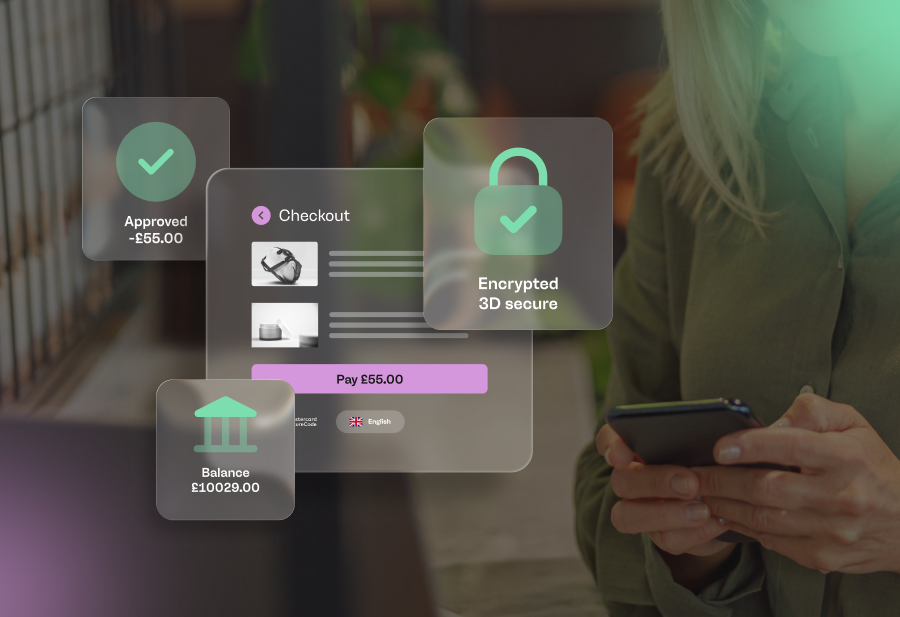
A payment gateway is the technology that securely authorises and transmits a customer's card details from your checkout to the bank so a payment can be approved. If you sell in the UK, choosing the right payment gateway shapes your approval rates, your fees, and how smoothly money reaches your account.
Whether you operate an ecommerce storefront, a subscription-based platform, or an expanding SaaS company, this guide offers a comprehensive look into how UK payment gateways function, their associated costs, their distinction from payment processors, and key evaluation strategies to help you select a secure, compliant provider.
What is a payment gateway? (quick definition)
A payment gateway is the software layer that captures, encrypts, and forwards a shopper's payment details from your website or point of sale to the acquiring bank for authorization.
Think of it as the cashier at a shop door: it checks that the card is valid, that funds exist, and that the transaction is safe before waving it through. Without a gateway, your checkout has no secure way to talk to the banks.
How does a payment gateway work?
A payment gateway works in seconds, moving a transaction through a short chain of checks before your customer sees "payment approved". Picture a relay race where the baton is the payment data: each runner must hand it off cleanly, or the race is lost.
- Capture: The shopper enters card details at your checkout or taps a card at your POS.
- Encryption: The gateway encrypts the data and tokenizes the card so raw details are never exposed.
- Authorization request: The gateway sends the transaction to the acquiring bank and card network (Visa, Mastercard).
- Issuer check: The customer's bank confirms funds, runs fraud and 3D Secure checks, then approves or declines.
- Response: The approval or decline travels back through the gateway to your checkout in real time.
- Settlement: Approved funds are batched and settled into your account, minus fees.
Payment gateway vs payment processor: what is the difference?
The main difference is simple: a payment gateway captures and secures the transaction data, while a payment processor moves the money between the banks. The gateway is the messenger; the processor is the courier. Many UK providers, including payabl., combine both so you manage one relationship instead of stitching together separate vendors.
Gateway vs processor at a glance
| Aspect | Payment gateway | Payment processor |
|---|---|---|
| Main job | Captures and encrypts payment data | Moves funds between banks |
| Merchant sees | The checkout and authorization | Settlement into the account |
| Analogy | The messenger at the door | The courier carrying the cash |
How much does a payment gateway cost in the UK?
Payment gateway fees in the UK usually combine a small per-transaction charge, a percentage of each sale, and sometimes a monthly platform fee. The exact blend depends on your volume, your industry risk, and whether card details are entered online or in person. As a rule of thumb, higher volumes earn lower rates, so it pays to ask providers for pricing modelled on your real numbers.
- Per-transaction fee: a fixed pence amount charged on every payment.
- Percentage fee: a share of each sale, often quoted as a blended or interchange-plus rate.
- Monthly or platform fee: a recurring charge for access, reporting, and support.
- Optional costs: chargeback fees, cross-border and currency-conversion charges, and premium fraud tools.
For subscription and SaaS merchants, watch for how a gateway handles recurring billing and failed-payment retries, because even a small lift in recovered payments protects monthly recurring revenue and reduces involuntary churn.
Get in touch with our team and we will map out the numbers for your business.
How to choose the best payment gateway UK providers offer
The best payment gateway for your UK business is the one that maximizes approved payments while keeping costs, risk, and integration effort low. Rather than chasing a single "best" name, score each option against the criteria below, the way you would interview candidates for a key role instead of hiring on a job title alone.
- Approval rates: strong local acquiring and smart routing that lift how many good payments get through.
- Fees and transparency: clear UK pricing with no surprise charges buried in the contract.
- Security and compliance: PCI DSS Level 1, tokenization, 3D Secure 2, and strong fraud screening.
- Payment methods: cards, digital wallets, and local options your UK and international customers expect.
- Integrations: ready connectors for your ecommerce platform, plus a clean API for custom builds.
- Omnichannel reach: one provider for online checkout, POS, and Tap to pay if you sell across channels.
- Support and settlement: responsive UK-friendly support and predictable payout timing for healthy cash flow.
Is a UK payment gateway secure?
A reputable UK payment gateway is built around layered security so that card data is protected at every step. The essentials to demand are PCI DSS compliance, encryption, tokenization, and 3D Secure 2 authentication under the UK's Strong Customer Authentication rules. Together these act like a bank vault with several locks: even if one barrier is tested, the others keep the money and the data safe.
Why merchants choose payabl. as their UK payment gateway
payabl. gives UK merchants a single provider for the whole payment journey: online checkout, POS, and Tap to pay. That omnichannel reach means an ecommerce owner, a subscription service, or a SaaS finance team can accept payments online and in person without juggling multiple vendors. The result is fewer integrations to maintain, a clearer view of every transaction, and a partner focused on lifting approval rates and protecting revenue.
If you are comparing payment gateway providers in the UK, the fastest next step is to tell us about your volumes and channels so we can model pricing and approval improvements for your business.
The right payment gateway UK merchants choose is the one that turns more checkouts into revenue
Choosing a payment gateway in the UK is not about picking the most famous logo; it is about matching a secure, well-priced, well-integrated provider to how your business actually sells. When you weigh approval rates, fees, security, payment methods, and omnichannel reach together, the decision becomes clear rather than overwhelming.
For ecommerce owners and finance leaders alike, the gateway you select quietly decides how much of your hard-won demand converts into settled cash. Get that choice right and every part of your business, from conversion to cash flow, gets easier.
The best payment gateway in the UK is one that successfully converts a greater percentage of your checkouts into revenue.
Frequently asked questions
What is a payment gateway in the UK?
A payment gateway in the UK is the technology that securely captures and transmits a customer's card details from your checkout to the bank for authorisation, so a payment can be approved and settled. This process is specifically designed to support secure online and in-person card payments within the UK payments ecosystem.
What is the difference between a payment gateway and a payment processor?
A payment gateway captures and encrypts the transaction data, while a payment processor moves the money between the banks. Many UK providers combine both in one platform.
How much does a payment gateway cost in the UK?
UK payment gateway costs usually combine a per-transaction fee, a percentage of each sale, and sometimes a monthly fee. Rates depend on your volume, industry, and whether payments are online or in person.
Which payment gateway is best for a UK ecommerce business?
The best payment gateway for a UK ecommerce business is the one with strong approval rates, transparent fees, robust security, the payment methods your customers use, and easy integration with your platform.
Is a UK payment gateway secure?
Yes, a reputable UK payment gateway uses PCI DSS compliance, encryption, tokenization, and 3D Secure 2 authentication to protect card data and meet Strong Customer Authentication rules.