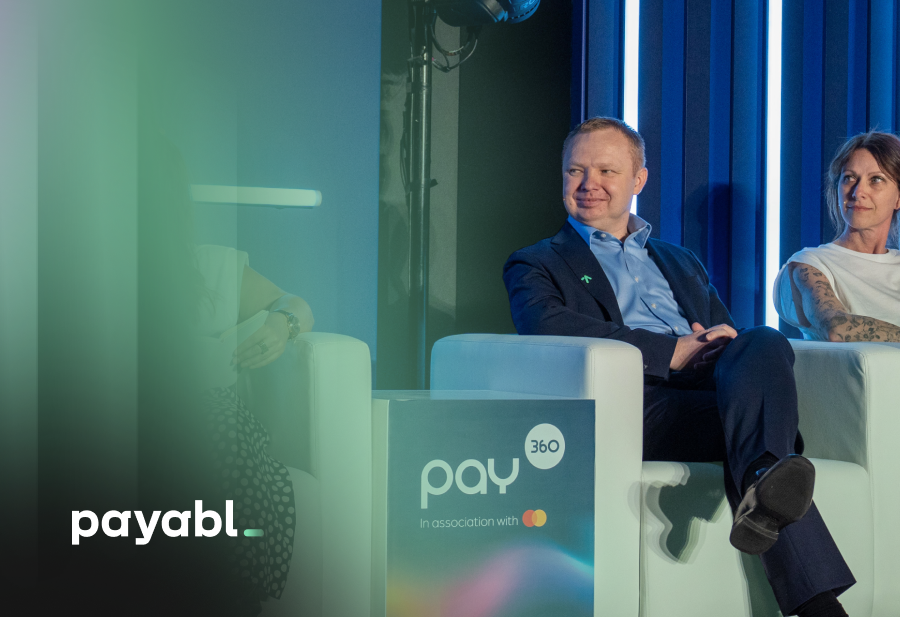
Pay360 brought the payabl. team back onto the stage just days after MPE Berlin, this time with a product launch in tow. Our UK CEO, Kristaps Zips, and Chief Product Officer, Breno Oliveira, took to the stage at ExCeL London to keep the conversation moving on payments data, digital identity, and what it takes to simplify merchant infrastructure.
What we did at Pay360
Breno opened the day with a keynote at the Merchant Transact Conference, revisiting the "USB-C moment" idea he first presented in Berlin. Breno expanded on his vision that payments urgently need a unified data standard to support the next phase of ecommerce growth.
Later in the afternoon, he sat down with Financial IT at the payabl. booth for an in-depth video interview covering our product roadmap, and what the industry needs to do to make account-to-account (A2A) payments genuinely usable for merchants.
Kristaps featured on the Big Picture Conference stage for a panel on digital identity, a relevant topic in UK payments right now. Alongside compliance leaders from Pockit and Starling Bank, Kristaps spoke about the findings from our Fraud in Europe report, and what the data tells us about merchant and consumer attitudes toward digital IDs.
An important product launch was also featured at Pay360. The event marked the launch of Tap to pay by payabl., with a live product demo that let attendees see the technology in action, right at our booth. Attendees even got the opportunity to purchase a doughnut for one penny (£0.01) using our technology!
Takeaways from Breno's keynote on payments data
The argument Breno made on stage during his keynote presentation, Payment’s USB-C moment: unified data for an agentic future, was straightforward: AI is only as useful as the data behind it, and right now, that data is fragmented across card, A2A, and POS systems with no shared context. This gap is where AI struggles to cope. It’s not because the technology isn't capable, but because it's working with disconnected signals instead of as a complete picture.
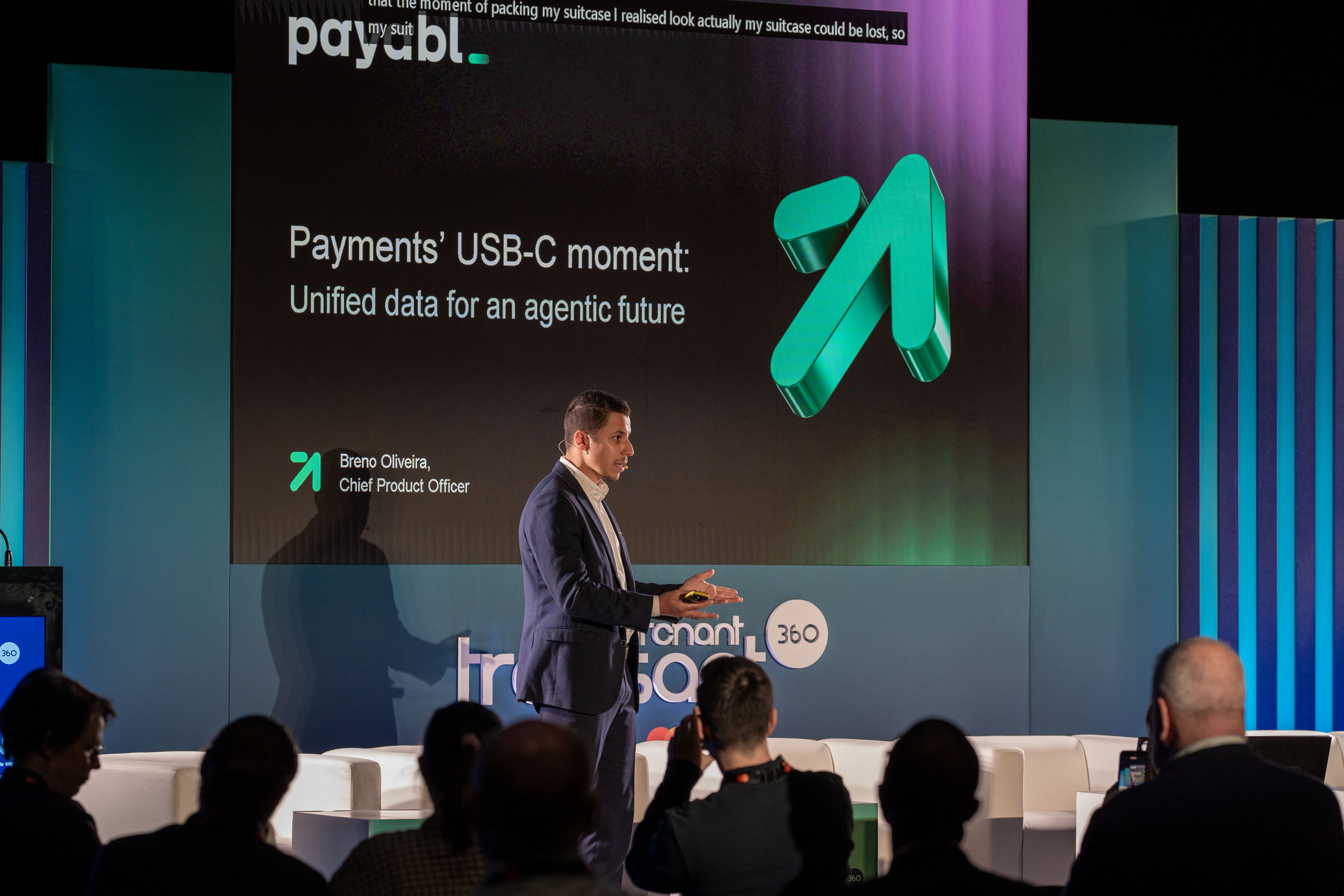
What the industry needs, according to Breno, is a unified layer across all rails. The analogy Breno used was the ‘USB-C’ standard, a single interface that works regardless of the device or the context. Applied in a payments context, it means one consistent data environment where merchants can see, analyze, and act on their entire transaction flow in real time. The shift from reactive actions to real-time decisioning is where the real operational gains can be made.
How we help merchants manage complexity
A core problem we kept encountering and talking about at Pay360 was payment fragmentation. We found that modern merchants are managing online payments, in-store payments, and business accounts across entirely separate systems. This means data sits in silos. Nothing is connected properly, and the manual work required to bridge those gaps slows down decision-making and eats into margins.
payabl.one was built to change that. It brings acquiring, business accounts, and financial tools into one platform with a single dashboard. With this, merchants get a clear, connected view of how money is moving through their business. Tap to pay extends that same platform into in-person payments, turning any smartphone into a card terminal without the need for additional hardware.
Takeaways from Kristaps's digital identity panel
The digital identity panel, Trust, Ownership, and Real-Time Verification: Time for a digital identity, was one of the more nuanced conversations at Pay360, and the data from our Fraud in Europe report provided a foundation for the conversation.
On the surface, business appetite for digital IDs is high: 81% of businesses said they would adopt them if it helped reduce fraud. However, scepticism exists alongside this. 79% believe fraudsters will simply adapt, while nearly half of merchants worry that adding digital ID checks to checkout will slow down the experience and increase cart abandonment.
Consumers told a more encouraging story. 49% said they were comfortable using digital IDs for online purchases, rising to 64% among Gen Z, and 59% said they would still use them even if it added some friction.

The gap between merchant caution and consumer openness was one of the more interesting points to emerge from the panel. Kristaps positioned payabl.'s role clearly throughout as a platform that helps merchants navigate these compliance requirements, without having to build the infrastructure themselves. As a result, the regulatory burden doesn't translate directly into a worse checkout experience.
The panel also touched on wider structural questions. They questioned who owns digital identity governance, how liability is decided when third-party verification fails, and whether the EU's eIDAS 2.0 framework offers a useful model for the UK to base its approach on.
Launching Tap to pay
The Tap to pay product demo running throughout Pay360 gave the conversations on stage some foundation. We showed how payabl. is removing friction for merchants, with live payments taken at the booth using only a smartphone, with no additional hardware setup required.

Another broader point that exemplified Pay360 for payabl. was the conversation about where in-person payments are heading. Contactless has become the default, mobile wallets are growing quickly, and consumer expectations around speed and simplicity have shifted permanently.
Hardware-dependent terminals have struggled to keep pace with this trend, particularly for businesses operating across multiple locations or on the move. Solutions like Tap to pay help merchants fit their payment acceptance around how their business actually operates, rather than making them reliant on fixed, limited-mobility hardware that can hinder revenue growth.
Discover how merchants are accepting contactless payments from anywhere without buying or managing dedicated hardware.
Learn more about our Tap to pay solution.