
A mobile POS is a smartphone, tablet, or handheld device that accepts card and digital wallet payments without a fixed till. For European retailers, the shift to mobile point of sale is no longer experimental. Mobile and portable POS units in Europe are growing at roughly 13% a year, more than double the pace of fixed checkout systems, as contactless adoption, staff-led selling, and queue-busting all push payment acceptance off the counter and onto the shop floor.
Mobile POS exists precisely to close the gap between "we need to take payments" and "we cannot afford a full checkout counter for every corner of the shop."
This guide explains what mobile POS means for European retail in 2027, how it compares to SoftPOS and traditional terminals, what regulations are shaping the market, and where Tap to pay fits as a no-hardware option for retailers who want to start accepting contactless payments from an Android phone.
What is mobile POS, and how is it different from SoftPOS?
Mobile POS (mPOS) is any point-of-sale setup built around a portable device, typically a smartphone, tablet, or handheld terminal, rather than a fixed counter till. It usually pairs a card reader or built-in NFC chip with a payments app, letting a staff member take a sale anywhere in the store, at an event, or on delivery.
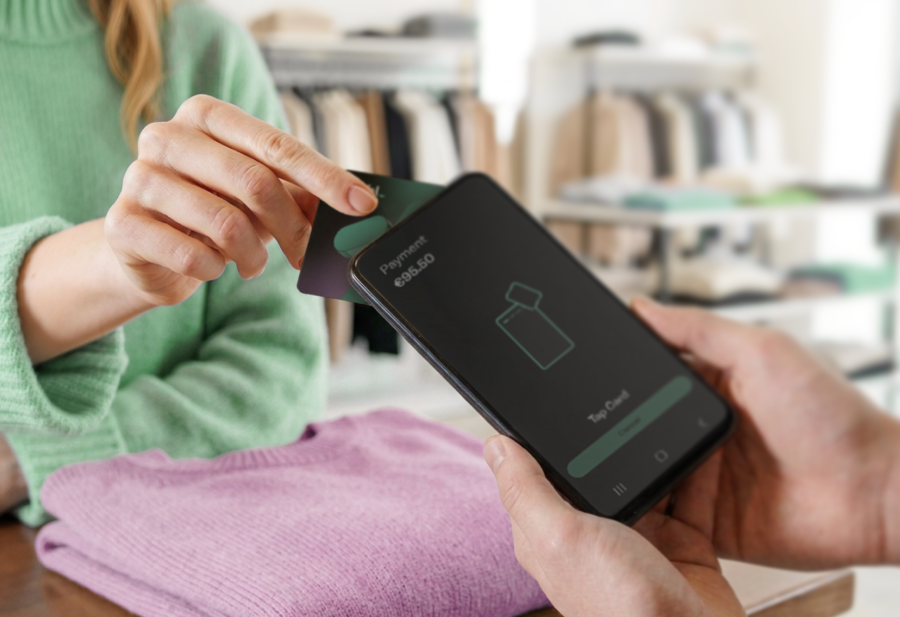
SoftPOS, sometimes called Tap on Phone, is a specific type of mobile POS. It removes the card reader entirely and turns the NFC chip already inside a compatible smartphone into the payment terminal itself. A retailer downloads an app, taps the customer's card or phone against their own device, and the transaction processes like any other contactless payment. No reader, no pairing, no extra battery to charge.
Think of the relationship the way you would think of vans and bicycle couriers. Both are mobile POS, both move payment acceptance away from a fixed point, but SoftPOS strips the setup down to the one thing that matters: a phone that is already in the retailer's pocket. That is the category Tap to pay by payabl. sits in.
Why European retailers are moving checkout off the counter
Three forces are converging on European retail at the same time, and together they explain why mobile POS adoption is accelerating rather than plateauing.
Contactless payments have become the default, not the exception
Contactless already accounts for the majority of in-person European card payments, and the European POS terminal market's contactless segment is forecast to grow at roughly 12.65% a year through 2031, outpacing contact-based terminals. Shoppers now expect to tap, whether that is a card, a phone, or a smartwatch, and a retailer without contactless acceptance at every point of contact is asking customers to queue for a till that may not even be nearby.
Regulation is pushing retailers toward updateable, software-based terminals
From January 2026, Italy requires point-of-sale systems to integrate with fiscal registers for real-time VAT reporting, a rule that is forcing merchants across the country to replace non-compliant hardware. At the EU level, the European Central Bank's 2026 digital euro workstream explicitly recognises software-based acceptance (SoftPOS) on off-the-shelf devices alongside traditional hardware terminals, and the draft Payment Services Package (PSD3/PSR) points toward clearer rights for payment providers to use a merchant's existing mobile device for payment acceptance. The direction of travel is consistent: regulators increasingly favour certified, updateable platforms, often Android-based, that can absorb rule changes without a full hardware swap every time a scheme or fiscal mandate shifts.
Omnichannel selling demands payment acceptance everywhere, not just at the till
Retail is no longer a single counter with a queue. A merchant might sell through an online store, a market stall, a pop-up, and a delivery van, often in the same week. Mobile POS is what lets a single business accept payments consistently across all of those touchpoints, which matters as much to a CFO reconciling revenue across channels as it does to the shop assistant ringing up the sale.
Mobile POS options for European retailers compared
Not every mobile POS setup suits every retailer. The table below compares the main categories a European retailer is likely to evaluate in 2027.
| Setup | How it works | Upfront hardware cost | Best suited to |
| Traditional fixed terminal | Wired or Wi-Fi terminal at a counter | Terminal purchase or rental | High-volume stores with a stable checkout point |
| Handheld mobile terminal | Portable device with built-in card reader | Device purchase or rental | Table service, queue-busting, warehouse-style stores |
| SoftPOS / Tap to pay | Payment app turns an existing NFC Android phone into a terminal | None, uses the retailer's own phone | Pop-ups, markets, mobile traders, SMEs testing new channels |
| Tablet POS with card reader add-on | Tablet running till software, paired with a separate card reader | Tablet plus reader | Boutiques and hospitality wanting a full till interface |
For a retailer who already has a compatible Android phone, SoftPOS is the only option on this table with no additional hardware to buy, charge, or maintain, which is why it is the fastest-growing segment of the European mobile POS market.
Tap to pay by payabl.: mobile POS without the hardware
Tap to pay by payabl. is a SoftPOS solution that turns a compatible Android device into a secure contactless payment terminal. A retailer downloads the app, verifies their merchant account, and starts accepting Visa, Mastercard, and digital wallet payments directly on their own phone, with no card reader to buy, rent, or charge.
For a European retailer weighing up mobile POS options, Tap to pay by payabl. answers the three pressures outlined above in one move:
- Contactless by default. Every transaction is tap-based, built on Android's native security with bank-grade encryption, and card data is encrypted in transit and never stored on the device.
- No hardware refresh cycle. Because the terminal is software running on a phone the retailer already owns, there is nothing to replace when a scheme or security standard changes, which sidesteps the hardware replacement costs that fixed-terminal retailers face under rules like Italy's fiscal integration mandate.
- Built for omnichannel selling. A retailer can start with Tap to pay at a market stall or pop-up, then add online checkout or a business account as the business grows, without switching payment providers.
There are no setup fees and no monthly fees; the model is pay-as-you-transact, which matters to a seasonal retailer who does not want to carry fixed costs through a quiet month, and to a finance leader who would rather see payment costs scale with revenue than sit on the balance sheet as a fixed overhead.
What to check before choosing a mobile POS provider
A merchant comparing providers should look past the headline features and check the following:
- Device compatibility. Confirm which Android versions and NFC chipsets are supported, and whether iOS is on the roadmap if the business issues iPhones to staff.
- Settlement speed. Ask how quickly funds reach the business account, since cash flow matters as much as the sale itself.
- Fee transparency. Compare the all-in transaction fee, not just the headline rate, and confirm there are no hidden monthly minimums.
- Multi-currency and multi-market support. A retailer trading across several European countries should confirm the provider supports local and alternative payment methods, not only card schemes.
- Compliance credentials. Check for PCI compliance and alignment with emerging standards such as PCI MPoC, which govern software-based payment acceptance.
Mobile POS is now the default way European retailers take payments on the move
Mobile POS has moved from a nice-to-have for market traders to the default checkout model for any European retailer that sells beyond a single fixed counter. Contactless adoption, fiscal regulation, and omnichannel selling are pulling in the same direction, and SoftPOS options like Tap to pay by payabl. remove the last excuse for not accepting a card: the cost and hassle of extra hardware. A retailer that can take a payment anywhere a customer is standing will keep more sales than one that makes the customer find the till. That is the real measure of a mobile POS strategy in 2027: payments follow the retailer, not the other way around.