Recurring revenue makes planning easier because it turns unpredictable sales into steadier income. When a business can accept recurring payments, it reduces the scramble between invoices, follow-ups, and last-minute shortfalls, which protects cash flow and creates room to grow. It also makes buying simpler for merchants and their customers because the payment happens on a clear schedule with less manual work. The benefits include:
- More predictable income for better planning
- Fewer late payments and less time spent chasing invoices
- Easier scaling with subscription-style offers and retainers
- Smoother customer experience with less friction at checkout
- Clearer forecasting and budgeting month to month
What are recurring payments?
Recurring payments let a merchant charge on a set schedule without re-entering payment details each time. They work best when a product or service repeats, the amount follows a predictable pattern, or the merchant wants to spread cost over time with clear terms.
Definition and common use cases
Recurring payments are automated charges that happen on a predefined cadence, usually managed through a payment processor and tied to an agreed plan.
Merchants use them for subscriptions (software, meal plans, streaming), memberships (gyms, clubs), and retainers (agencies, consultants) where access or service continues over time. Installments also fit when a purchase gets split into multiple charges with a start date, end date, and total number of payments.
In all cases, the goal stays the same: reduce manual follow-up while keeping customer transactions consistent and trackable. Many setups also generate recurring invoices alongside the charge so records stay clean for both sides.
Types of recurring billing models
| Billing model | How it works | Best for | Example |
| Fixed subscription | Same amount every cycle | Simple plans with stable pricing | €49 per month |
| Usage-based | Amount changes based on consumption | Metered services | €0.05 per API call |
| Tiered | Price changes by usage band | Scaling plans with thresholds | 0–1k, 1k–10k, 10k+ units |
| Hybrid | Base fee plus usage or add-ons | Mixed predictability and flexibility | €29 base + overage fees |
Subscription payments often start with a fixed or tiered model, then evolve into hybrid as offerings expand.
Typical billing cycles and frequency
Most merchants choose monthly or annual billing because it matches how many people budget and renew services. Monthly billing lowers the barrier to start, while annual billing can reduce churn and simplify administration when the value stays consistent.
Quarterly billing works well for services delivered in seasons or for business-to-business contracts that review performance on a cadence. Yearly billing fits memberships, renewals, and policies where the relationship runs long-term by default.
Custom cycles also exist, such as every two weeks, every 28 days, or on a specific day of the month, as long as the schedule and terms stay clear.
Why recurring payments matter for your business
Recurring payments help merchants turn one-time sales into a steady operating rhythm. With the right payment processing setup, merchants can bill on a recurring basis, reduce surprises, and keep revenue tied to ongoing value instead of constant re-selling.
Predictable cash flow and financial stability
Predictable cash flow makes it easier to plan payroll, inventory, and growth investments without guessing what next month will look like.
Recurring payments create a baseline of expected revenue that smooths out seasonal dips and slow weeks. That stability also supports better forecasting because finance teams can model renewals and churn rather than starting from zero every cycle.
When merchants know what’s coming in, they can make decisions earlier and avoid reactive cost-cutting. Over time, that consistency can improve margins by reducing emergency spending and short-notice financing.
Increased customer retention and lifetime value
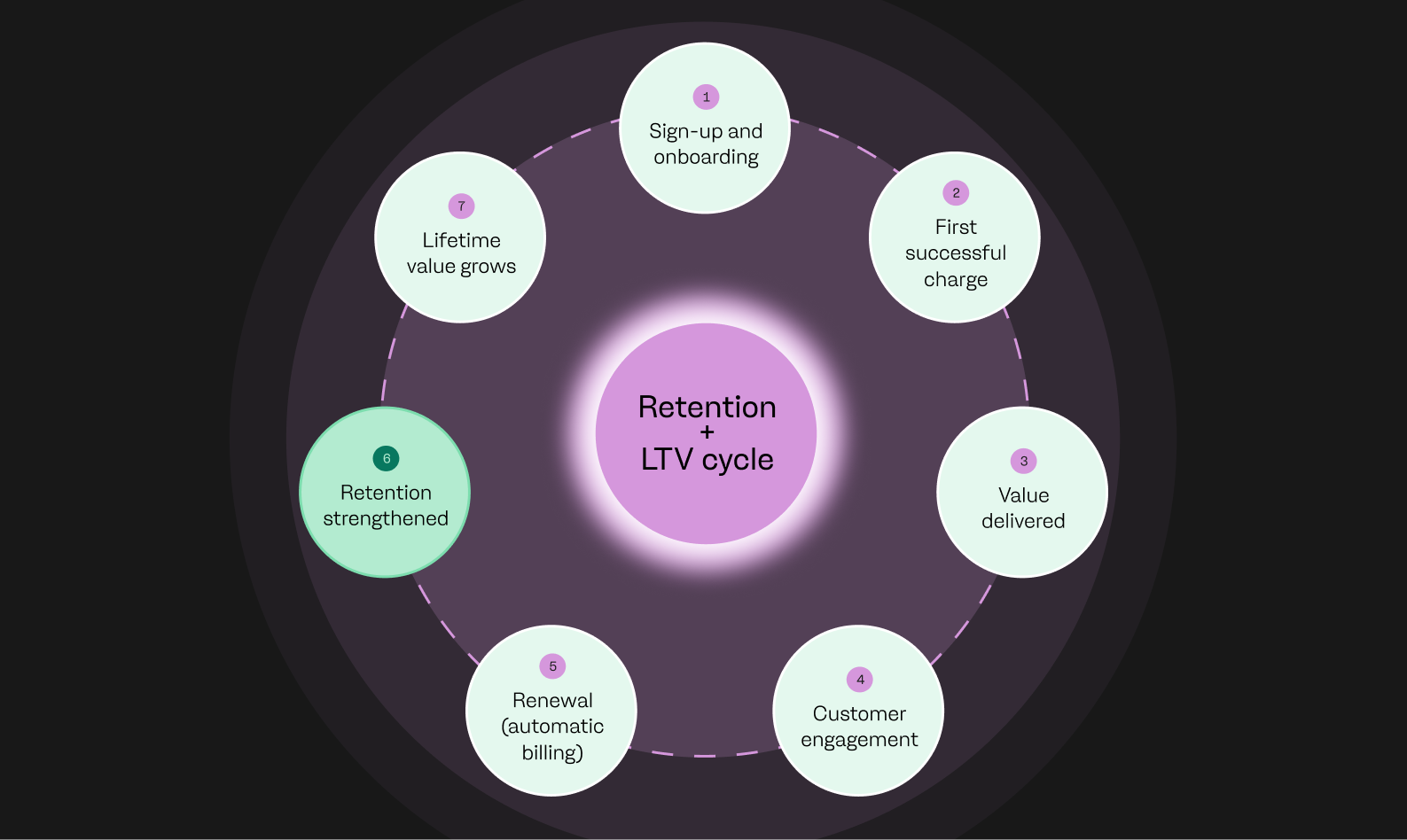
Recurring payments support customer retention because they remove the need for customers to re-purchase or re-authorise every time value is delivered.
Automatic payments keep the relationship active as long as service continues and expectations are met. That continuity often increases lifetime value because customers maintain longer subscriptions when friction stays low. It also opens room for upsells and plan changes that build on trust instead of forcing a new checkout each time.
When renewal is built into the experience, retention becomes a product outcome, not a constant marketing task.
Reduced administrative overhead and fewer late payments
Automating billing cuts down on manual tasks like sending reminders, chasing approvals, and reconciling missed charges. Automatic payments reduce late or missed payments because the charge runs on schedule instead of waiting for someone to open an invoice and act.
Teams spend less time following up and more time improving service, onboarding, or support. It also reduces errors that come from re-keying amounts and dates across multiple systems.
For merchants that still issue invoices, automation can pair charges with billing records so finance workflows stay consistent.
Better customer experience and convenience
Customers often prefer a simple, repeatable checkout that doesn’t require re-entering details each month. By securely storing a customer’s credit card and using it on a set schedule, the experience feels seamless and reliable.
That convenience can reduce support tickets relating to missed renewals, manual payments, or confusing due dates. It also helps customers budget because they know when charges are occurring and what they cover.
When the payment experience stays smooth, customers focus on the value delivered instead of the mechanics of paying.
Business types who using recurring payments:
Recurring payments fit any business that delivers ongoing value on a set schedule. When merchants pair a recurring payment plan with recurring billing solutions, they can simplify the billing process, reduce friction for customers, and align records with customer relationship management tools.
Subscription-based services
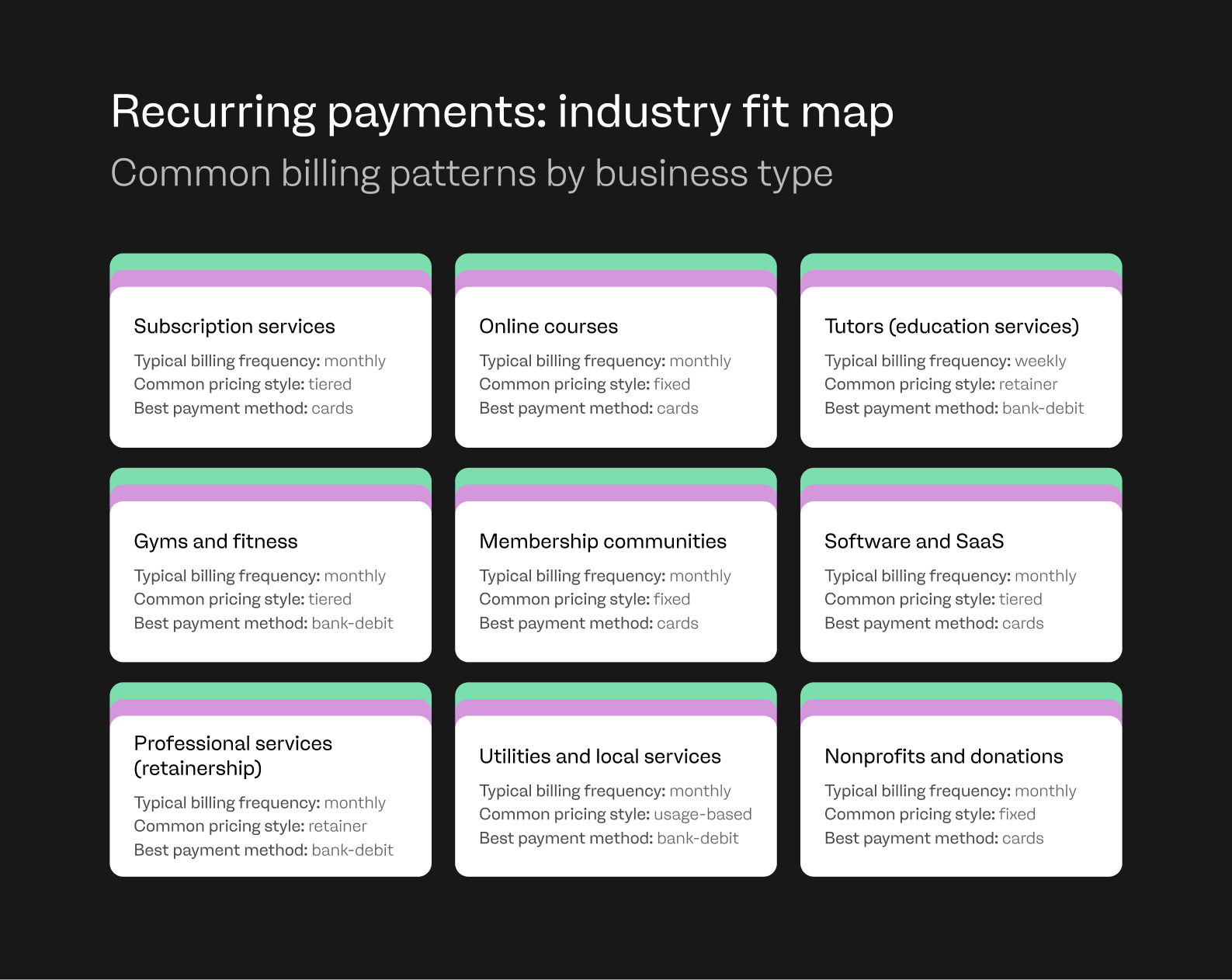
Subscription services businesses rely on predictable delivery. Recurring payments align revenue with access and renewal dates. Monthly fees work well for software, memberships, and subscription boxes because customers understand the tradeoff between cost and convenience.
A consistent billing process also helps support teams resolve account questions faster because charges follow a clear schedule. Many merchants use recurring billing solutions to manage upgrades, downgrades, and proration without creating manual work.
When billing stays consistent, retention improves because customers don’t need to re-enter payment details every cycle.
Online courses
Online courses often use recurring payments for ongoing access, cohort-based learning, or membership libraries that update over time. A recurring payment plan can bundle lessons, live sessions, and community access into a single recurring charge that is easy to understand.
Monthly fees can lower the upfront barrier for students while still supporting stable revenue for the course creator. Integrations with customer relationship management systems help track enrollment status, progress, and renewals in one place. A clean billing process also reduces disputes by keeping terms, access dates, and receipts consistent.
Tutors
Tutors use recurring payments to bill weekly or monthly packages without chasing payments after every session. A recurring payment plan can cover a set number of hours, ongoing availability, or an agreed retainer for the month.
Monthly fees are common for steady schedules. Some tutors offer flexible packages that renew unless changed. Recurring billing solutions help automate receipts and keep payment history organized for families and bookkeeping.
When the billing process runs smoothly, tutors can focus on outcomes instead of admin.
Gyms and fitnesses
Gyms and fitness businesses are classic fits for recurring payments because access is ongoing and there's continuous value delivery.
Monthly fees are easy for members to budget, supporting stable staffing and facility planning. A recurring payment plan can also support add-ons like personal training, class packs, or premium access tiers.
Many gyms connect recurring billing solutions with customer relationship management tools to manage membership status, freezes, and reactivations. When the billing process is consistent, members experience fewer interruptions and staff handle fewer front-desk payment issues.
Membership communities and associations
Recurring payments work well for communities that charge for access to events, resources, or member-only spaces. Billing frequency stays predictable, which reduces missed renewals and makes budgeting easier for members.
Online payments also remove friction for sign-ups and renewals, especially when members join from different locations. Recurring billing software helps manage tiers, upgrades, and pauses without manual tracking. For organisations with ongoing services like coaching calls or monthly workshops, automation keeps access and billing aligned.
Managed service providers and IT support
IT providers often deliver ongoing services like monitoring, updates, security checks, software-as-a-service, and help-desk coverage. Recurring payments match that value because billing runs on a consistent cadence instead of ad-hoc invoices.
Billing frequency is tailorable, aligning with monthly retainers, quarterly reviews, or plan-based support levels. Online payments make it easier for clients to approve and maintain a plan without administrative back-and-forth. Recurring billing software also supports add-ons, overages, and plan changes while keeping records clean.
Cleaning and home maintenance services
Routine cleaning, lawn care, and maintenance packages are ongoing services that benefit from predictable billing. Recurring payments reduce payment chasing because charges follow the preset billing frequency. Online payments make it simple for customers to keep service active without remembering due dates. Recurring billing software can also handle schedule shifts and service pauses while keeping charges consistent.
When billing matches the service cadence, customer confusion drops and re-booking becomes more natural.
Retainer-based professional services
Consultants and agencies often provide ongoing services through monthly retainers, advisory access, or support bundles. Recurring payments keep that arrangement stable because the billing frequency is clear and automatic. Online payments reduce friction for approvals and help clients stay current without extra steps. Recurring billing software supports renewals, scope changes, and tier upgrades without rebuilding invoices each cycle.
When the payment flow stays consistent, both sides can focus on outcomes instead of admin.
Payment methods and tools: what businesses need to know
Recurring revenue works best when merchants offer multiple payment methods that match how customers prefer to pay. The right mix can reduce friction, improve approval rates, and protect customer data while keeping billing consistent across regions.
Payment methods overview
Merchants can support multiple payment methods by combining card rails, bank-based options, and flexible payment experiences.
Credit card payments and debit cards have wide adoption and are often the fastest to launch, especially for subscriptions and memberships. Bank transfers and bank pull methods (such as ACH in the US) can lower costs and reduce certain card-related declines because funds come from a customer’s bank account. In Europe, SEPA Direct Debit is a common bank-debit option for recurring billing because it supports automated collection through standardised rails.
Digital wallets like Google Pay can speed up checkout on mobile and reduce data entry, which can improve conversion for sign-ups. Invoicing and billing software can automate recurring charges and receipts, while payment links help merchants collect payment quickly without building a full checkout flow.
Pros and cons of each payment method
Choosing the best mix depends on cost, reliability, customer habits, and where customers are located.
Card rails are convenient but can face higher fees and more failures due to card expirations or fraud checks. Bank-debit and bank-transfer options can be cost-effective, but setup and confirmation times may vary by region and can require more customer education. Digital wallets can reduce friction on mobile, but availability and adoption differ across countries. Invoicing tools are useful for B2B and high-touch services, but they rely on timely customer action unless paired with automation.
A practical approach is to offer a small set of options that cover the most common preferences, then expand based on real decline and churn data.
| Payment method | Cost | Global reach | Best suited for |
| Credit/debit cards | Medium to high | High | Subscriptions, memberships, one-time |
| Bank debit / pull (ACH, SEPA Direct Debit) | Low to medium | Medium to high (region-dependent) | Subscriptions, memberships |
| Bank transfers (push) | Low | Medium | One-time, invoices, high-value |
| Digital wallets (like Google Pay) | Medium | Medium to high (depends on country) | One-time, sign-ups, mobile-first |
| Invoicing / billing software | Medium | High | One-time, B2B, subscriptions with automation |
| Payment links | Medium | High | One-time, quick collection |
Types of payment solutions
A full-service gateway can combine checkout, tokenisation, and routing so merchants can accept cards and wallets in one place. Invoicing and billing platforms focus on billing workflows like invoices, reminders, proration, and receipts, which is useful for service businesses.
Bank-debit processors specialize in pulling funds from a customer’s bank account and can be a strong fit where ACH or SEPA Direct Debit adoption is high. White-label payment APIs let platforms embed payments into their product while controlling the user experience and data flow. Self-hosted solutions give merchants more control but require more engineering and security work, while managed solutions reduce operational load and speed up launch.
The best choice depends on whether the merchant needs simple checkout, full subscription management, or a platform-grade payments layer.
What to check when selecting a processor
When evaluating recurring payments services, start with security practices that protect customer data and support tokenisation and fraud controls. Confirm compliance coverage that matches the business model and service regions, including requirements involving card networks and local rules.
Check multi-currency support and settlement options if the business serves international customers or prices in more than one currency. Review for access to various payment methods so merchants can offer multiple payment methods without stitching together separate providers.
For subscription management, look for plan tools, retries, dunning, proration, and clear reporting on failures and churn drivers. Finally, validate integration capabilities, including APIs, webhooks, and compatibility with accounting, analytics, and CRM tools so billing stays connected to operations.
Steps to implement recurring payments: a practical guide
A recurring setup works best when merchants treat it like a product flow, not a finance add-on. The goal is to accept recurring payments in a way that fits the offer, protects customers, and runs reliably inside a real payment system.
Use the steps below as a practical checklist for how to setup recurring payments in a way that fits your business.
Step 1: Evaluate your business model — is recurring billing a fit?
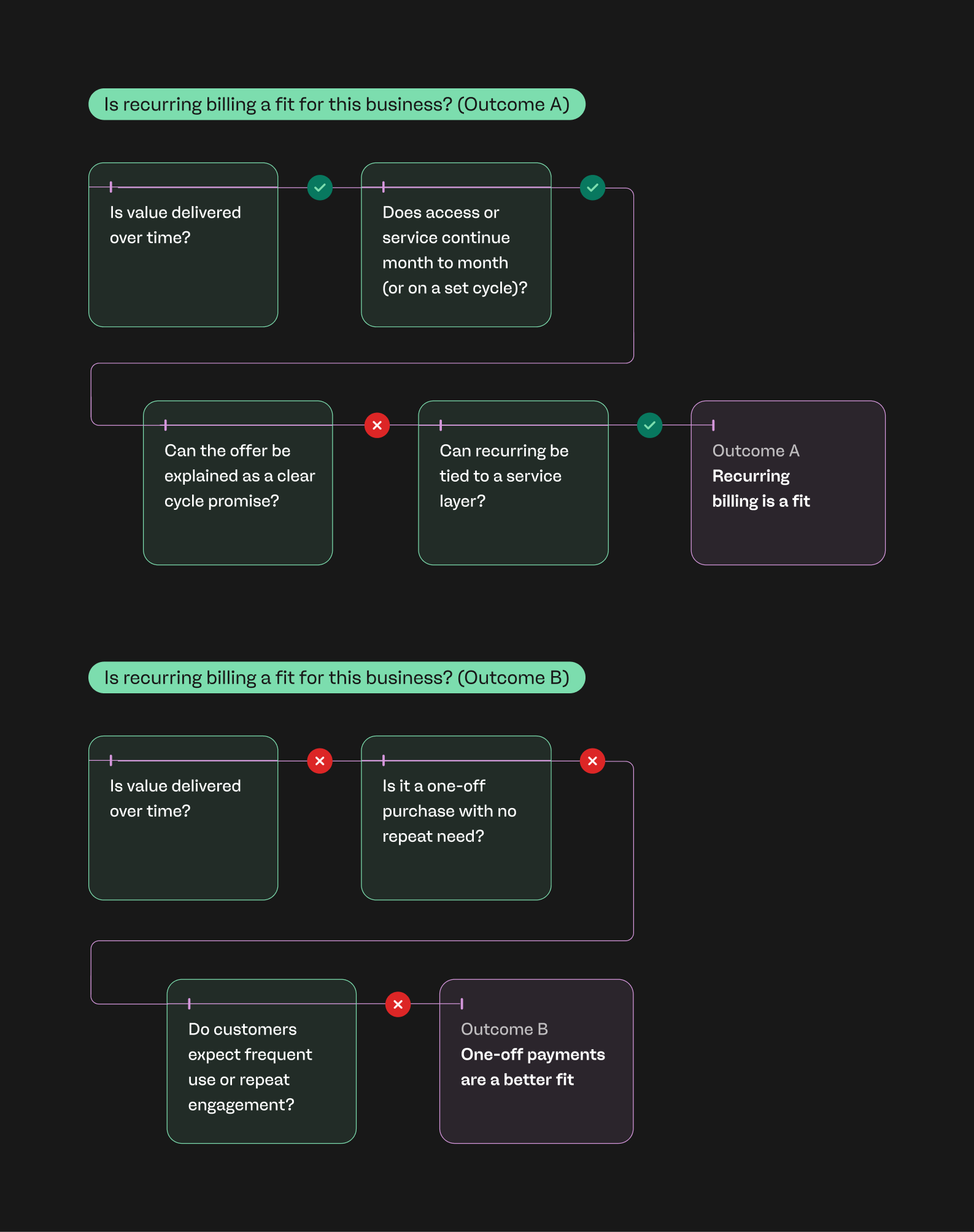
Recurring billing fits best when merchants deliver value over time, support is ongoing, or access continues month to month. If the product is a one-off purchase with no repeats necessary, recurring is potentially inappropriate unless it supports services like maintenance, membership, or updates.
Subscription plans work when customers can clearly understand what they keep getting each cycle and what happens if they cancel. Merchants should also consider churn risk, support capacity, and how frequently customers expect to use the service. To accept recurring payments successfully, merchants need a clear promise that renews, not just a convenient way to charge.
Step 2: Choose the right pricing and billing model
A strong pricing model makes recurring charges feel fair, predictable, and easy to maintain.
Flat pricing works when value is consistent, while tiered pricing helps match different customer needs without custom quoting. Usage-based pricing fits when consumption varies, but it requires clear measurement and communication so customers trust the bill. Free trials and introductory discounts can reduce adoption friction, but terms should be simple so the first full charge does not feel like a surprise.
The best subscription plans keep pricing aligned with the value customers actually experience during the cycle.
Step 3: Select payment gateway or processor suitable for your needs and region
Start by mapping customers' locations and popular payment methods. Then choose a payment gateway and payment processor that support those requirements.
Many payment processors offer similar core capabilities, so the difference often shows up in authorization performance, settlement options, local payment support, and subscription tooling. Merchants should also confirm whether they need a separate merchant account or whether the provider offers an all-in-one setup.
If the business sells internationally, look closely at currencies, local payment methods, and how disputes are handled. The right provider supports recurring payment processing without forcing merchants to bolt on multiple tools to get basic features.
If you want to streamline setup across regions and payment methods, evaluate payabl. checkout as your payment gateway. It brings payment processing, local payment support, and automated collection into one place, so merchants can launch recurring payment processing without stitching together extra tools.
Step 4: Get customer consent and securely collect payment data
Recurring billing requires explicit customer consent, clear terms, and a simple way for customers to manage their preferred payment method. Merchants should collect and store payment credentials using PCI-compliant flows. Avoid storing raw card information in internal systems. Tokenisation allows the payment gateway or payment processor to store sensitive data and payment information while the merchant keeps a secure token for billing.
If merchants offer card payments, make sure the checkout supports strong authentication when appropriate. When collecting debit card details, confirm that the flow uses secure fields or hosted payment pages so sensitive data never touches merchant servers.
Step 5: Configure billing schedule, automation, reminders, and notifications
Define the schedule in plain terms: bill date, billing frequency, what happens on renewal, and customers notification processes. Automation should include receipts, renewal confirmations, and advance reminders when appropriate, especially for annual renewals. Notifications should also cover changes to price, plan, or terms so charges don't surprise customers.
Merchants can reduce churn by offering plan management options like pause, downgrade, or switch billing dates when feasible. A good payment system also supports clear internal alerts so support teams can act before a customer gets frustrated.
Step 6: Launch and test the flow (signup → first payment → recurring cycle)
Before launch, test the full journey end to end, including sign-up, the first successful charge, and the next renewal event. Validate edge cases like mid-cycle upgrades, cancellations near renewal, tax calculation changes, and invoice receipts. Confirm that plan status updates correctly inside reporting and customer records, not just inside the payment tool.
Merchants should also simulate a real retry sequence so the team understands how messaging and timing work. Once the flow is stable, roll out in stages and monitor results across regions and payment methods.
Step 7: Monitor payments, handle failures, manage subscriptions, cancellations, and refunds
Ongoing management is where recurring programs succeed or fail. Merchants should track approvals, churn, and support volume from the start.
Failed payments need a defined retry strategy, clear messaging, and an easy way for customers to update their preferred payment method. Use dunning emails or in-app prompts that explain what happened and what customers should do next, without blame or confusion.
Subscription plans should include straightforward cancellation and refund policies, with consistent handling across support, finance, and reporting. Over time, monitoring helps merchants improve recurring payment processing by identifying patterns tied to regions, payment methods, billing dates, and customer cohorts.
Best practices for accepting recurring payments
For website
Recurring payments work best on custom sites when the checkout flow prioritises renewals, not just the first sale. Define how you’ll set up recurring payments and manage recurring payments when plans change, including variable recurring payments if pricing can fluctuate.
Pick a recurring payment service that connects a payment processor to your merchant account. Then, process recurring payments as an automated payment while still giving customers a clear way to accept payments. Keep receipts and reconciliation consistent with invoicing software, and treat retries plus messaging as part of customer satisfaction.
For WordPress (WooCommerce)
Use payabl. checkout’s WooCommerce plugin so checkout stays native to WordPress while you centralise configuration in payabl. settings. Enable the payment channels you need, run test mode, then switch to live credentials after confirming the end-to-end flow. Keep the renewal UX clean by using clear plan terms, a visible billing date, and a self-serve update path for saved payment details.
Accepting international recurring payments
Start with the markets that matter most. Offer locally relevant methods alongside cards to reduce friction at signup and renewal. Confirm multi-currency pricing and settlement needs. Determine how declines differ by region so your retry strategy matches local realities. Keep compliance, authentication flows, and reporting standardised so finance and support don't manage “one-off” regional processes.
Accepting recurring payments with credit card
Treat cards as a lifecycle, not a one-time credential. Optimise first-charge conversion. Reduce renewal failures with secure tokenisation and saved-card experiences. Make authentication steps predictable where required. Keep a simple path for customers to update card details before the next renewal. Track decline reasons and tighten retries plus reminders for revenue recovery without creating unnecessary friction.
Choosing the right solution for your business: decision framework
If this is your first time building automatic billing, keep the decision simple. Match your billing behavior (fixed, variable, or usage-based) to the payment rails your customers already trust. Check how well the tooling fits your billing system and reporting needs.
Use this quick framework for how to choose a recurring payments provider without overcomplicating the situation. For deeper dives, see our related guides on SEPA DD, payment business accounts, and payouts.
Key criterias
- Billing fit: subscriptions, installment payments, or pay-as-you-go, plus whether you need free trials, discounts, and proration.
- Payment method fit: cards vs bank-debit, and how “variable” your charges are (fixed amount vs usage-based changes).
- Operational fit: reporting, reconciliation, and how cleanly it connects to accounting software.
- Reliability: retries, notifications, and how failures are handled across payment types and regions.
- Expansion: multi-currency, local payment methods, and how easy it is to add more rails later with the same payment provider.
Decision matrix / checklist
| If your business needs… | Prioritise | Quick checklist |
| Predictable, fixed subscriptions | Card + bank-debit options, strong subscription controls | Supports plan changes, proration, receipts, and clear customer comms |
| Pay-as-you-go or usage-based | Variable amount support, accurate metering hooks | Usage capture → invoice preview → charge execution is automated and auditable |
| Free trials and promo logic | Trial-to-paid conversion, clear consent, retries | Trial end notices, first paid charge test, dunning paths |
| High reliability and lower churn | Retry logic, mandate management, notifications | Smart retries, pre-notifications, and visibility into failure reasons |
| Clean reconciliation | Unified reporting, exportability | Settlement reporting aligns with accounting software workflows |
How we can help you
payabl. supports merchant-initiated manual recurring payments through a subscription-focused payment gateway that can flex around variables like billing frequency and usage-based billing, while keeping mandate management and pre-notifications in place for compliant collection.
Pros:
- Predictable cash flow support through unified reporting.
- Configurable collection dates.
- Fewer failed payments via built-in mandate management.
- Low-cost processing options with no interchange fees for alternative payments.
- Fast deployment and low-code integration paths.
- Smart retry logic designed to recover revenue without creating extra manual work.
Cons to plan for:
- You still need clear customer consent and lifecycle ops (updates, cancellations, refunds).
- Some payment methods are region-dependent, so method mix and rollout order matter.
If you want to map your pricing, rails, and reporting into a single setup, talk to us about payabl. recurring payments services.
Conclusion & next steps
Recurring billing can turn one-time buyers into long-term revenue when the offer is clear and the billing flow is reliable. The biggest advantages come from steadier forecasting, fewer manual follow-ups, and a smoother experience for customers when payments run on schedule.
The best practices in this guide keep the setup simple. Choose the right methods for your market. Collect consent securely. Automate reminders and retries. Monitor outcomes so failed payments do not become churn.
The decision framework helps merchants match a recurring payment model to how value is delivered, how often customers expect to pay, and what tools the team can actually maintain.
Next steps:
- Map your product to a billing style (subscription, usage-based, or installments) and define a clear payment cycle.
- Confirm which payment methods your customers prefer by region, then shortlist solutions that support them.
- Run a quick “gateway and billing system fit” review (pricing, integrations, retries, reporting, and compliance).
- Contact payabl. to discuss recurring payment options and see what a working setup looks like for your use case.
Ready to learn more? Here’s some helpful information:
- What is a recurring payment: benefits and limitations
- What is an automated payment system?
- Why is everyone talking about VRPs?
Frequently asked questions (FAQ)
What is the best payment cycle for recurring billing?
The best payment cycle depends on how often customers get value and how predictable the service is. Monthly billing tends to reduce commitment friction, while annual billing can improve retention when the offering is stable and clearly valuable. A shorter cycle can reveal churn sooner, but it also increases the number of renewals that can fail, so retries and reminders matter more. Start with the cycle customers already expect in your category, then adjust based on churn, support load, and pricing feedback.
Can a recurring payment model support flexible payment options?
Yes, a recurring payment model can include flexible payment options such as monthly and annual billing, plan tiers, add-ons, and upgrades. The key is to keep plan rules simple and transparent so customers understand when charges change and why. If you offer annual discounts, make renewal timing and reminders clear so customers are not surprised. For usage-based pricing, set expectations with a usage summary and an easy way to monitor spend before the next renewal.
How do merchants reduce failed payments in a recurring payment model?
Failed payments usually come from expired cards, insufficient funds, authentication issues, or customer confusion about the charge. Reduce failures by automating retries, sending clear notifications, and offering an easy self-serve path for customers to update their payment method. Track decline reasons by payment type and region so retries happen at sensible times rather than blindly repeating attempts. When customers understand the value and the schedule, retention improves and support tickets drop.