

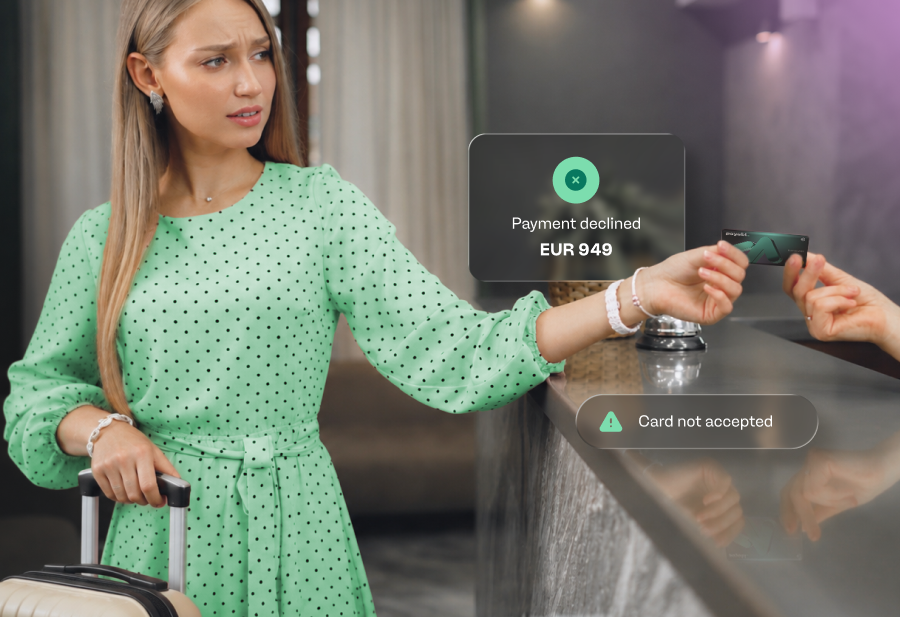
Card acceptance, the ability to successfully process a card payment from attempt to approval, is quietly one of the biggest leaks in European ecommerce and point-of-sale revenue. Industry estimates suggest that up to 14% of online card payments in Europe fail, compared with a 95%+ success rate for account-to-account methods such as open banking or direct debit. For a retailer processing 50,000 transactions a month, that gap can represent thousands of lost sales before a single marketing euro is even considered wasted.
This article explains why card acceptance is such a persistent problem for European retailers, what is driving the decline rate, and what merchants can do about it across every channel, online checkout, in-store point of sale, and Tap to pay.
What does "card acceptance" actually mean?
Card acceptance is the percentage of attempted card payments that are successfully authorised and completed, out of all card payments a retailer tries to process. It is the mirror image of the decline rate: if 100 customers try to pay by card and 86 succeed, the card acceptance rate is 86%.
A healthy card acceptance rate for European retailers typically sits between 85% and 95%, depending on sector, average order value, and customer base. Anything meaningfully below that is a signal that something structural, not just occasional customer error, is costing real revenue.
Why do card payments fail so often in Europe?
European card acceptance is lower than many retailers expect because several regulatory, technical, and behavioural factors stack on top of each other. No single cause explains the whole problem; it is the combination that makes European card acceptance genuinely harder than in markets like the United States.
1. Strong Customer Authentication (SCA) creates friction
Since PSD2 came into force, most online card payments within the European Economic Area must pass through Strong Customer Authentication, typically a 3D Secure step that asks the cardholder to confirm their identity with a password, biometric scan, or one-time code. SCA exists to reduce fraud, and it works, but it also introduces a new point where a legitimate payment can be abandoned or soft-declined.
A soft decline happens when an issuing bank rejects a transaction specifically because it was not routed through SCA, asking the merchant to retry with authentication. If a retailer's checkout is not built to recognise and automatically resubmit these soft declines, that sale is lost entirely, even though the customer genuinely wanted to pay.
2. Cross-border payment routing adds points of failure
Europe is not one payment market; it is 27-plus national markets connected by cross-border rails. When a shopper in Poland buys from a retailer processing payments through an acquirer in Ireland, the transaction may pass through multiple intermediary banks, currency conversion steps, and compliance checks before it reaches the issuing bank for approval. Each handoff is a chance for the payment to be rejected on technical grounds that have nothing to do with the customer's ability to pay.
This is one of the main reasons why card payments get declined in Europe for merchants selling across multiple countries, even when the card itself is valid and well-funded.
3. Fraud prevention rules are tuned conservatively
With ecommerce fraud losses running into billions of euros annually, issuing banks apply increasingly cautious risk models. The side effect is a rise in "false declines," genuine transactions blocked because they resemble fraud patterns on paper. A customer buying from a new device, a new country, or making an unusually large purchase can be flagged and declined even though the purchase is entirely legitimate.
4. Card details go stale faster than retailers update them
Cards typically carry a validity window of around three years, and that clock runs out constantly across a large customer base. For subscription retailers and SaaS businesses billing customers monthly, an expired or reissued card can silently break recurring revenue unless the retailer uses tools like automatic card updater services or tokenisation to keep payment credentials current.
5. One acquiring relationship cannot absorb Europe's complexity
Many retailers still rely on a single acquiring bank or a single payment processor to handle every market, every currency, and every card scheme. That setup works until a retailer expands beyond its home market. A single point of acquiring means a single point of failure: if that acquirer has a weaker relationship with issuing banks in a particular country, or does not support local card scheme nuances, acceptance rates in that market suffer across the board.
The real cost of poor card acceptance
A declined card is never just one lost transaction. The downstream effects compound:
- Lost revenue at the point of sale. Each failed payment is a sale that may never be recaptured, since most customers do not retry a failed checkout.
- Involuntary churn for subscription businesses. A failed recurring payment can silently cancel a subscription the customer intended to keep.
- Higher customer acquisition cost. Marketing spend that brought the customer to checkout is wasted if the payment itself fails.
- Reputational damage. Repeated declines make customers assume the retailer's checkout, or the retailer itself, is untrustworthy.
Industry research has put the global cost of failed payments at well over $100 billion a year in lost sales, higher acquisition costs, and administrative overhead. European retailers carry a disproportionate share of that cost because of the regulatory and cross-border factors above.
How European retailers can improve card acceptance
Improving card acceptance is rarely about a single fix. It is about reducing friction at every stage of the payment journey, online, in-store, and on mobile, without opening the door to fraud.
Optimise for SCA instead of fighting it
Rather than treating Strong Customer Authentication as an obstacle, retailers should use the exemptions built into PSD2, such as low-value transaction exemptions and trusted beneficiary lists, where appropriate, and ensure their payment setup automatically retries soft declines with authentication instead of simply losing the sale.
Work with a payment partner that has local acquiring strength
A payment provider with strong acquiring relationships across multiple European markets can route transactions more intelligently, improving the odds that an issuing bank recognises and approves the payment on the first attempt. This is one of the clearest levers available to merchants who want a genuinely better card payment authorisation rate across the EU, rather than relying on hope and retries.
Keep payment credentials fresh
Automatic card updater services and tokenisation reduce the number of declines caused simply by expired or reissued cards, which is particularly valuable for subscription and SaaS retailers with recurring billing.
Diversify beyond cards alone
Offering local payment methods alongside cards, bank transfers, digital wallets, and country-specific options gives customers an alternative route to pay when a card transaction does fail, and reduces a retailer's overall dependence on card networks for revenue.
Unify the channel, don't fragment it
A customer who taps their phone in-store, checks out online, or uses Tap to pay at a pop-up stand should hit the same reliable acceptance infrastructure every time. Retailers who treat online checkout, point of sale, and Tap to pay as separate systems often duplicate the very friction points that cause declines, simply in three places instead of one. An omnichannel approach, where online, in-person, and Tap to pay payments run through the same underlying infrastructure, closes many of these gaps at once.
This is where payabl. fits into the picture. payabl. supports the full omnichannel payment journey, online checkout, point of sale, and Tap to pay, alongside multi-currency business accounts and 300+ local and alternative payment methods, giving European retailers a single, coordinated setup instead of a patchwork of disconnected providers. Retailers who want to see how a unified approach affects their own acceptance rates can get in touch with the payabl. team through the contact form.
Card acceptance will keep separating resilient retailers from the rest
European card acceptance is not a problem that fixes itself as fraud rules tighten and cross-border commerce grows. Retailers who treat declines as an unavoidable cost of doing business in Europe will keep losing revenue quietly, transaction by transaction, while competitors who invest in smarter authentication handling, stronger acquiring relationships, and a genuinely omnichannel payment setup will keep converting the sales everyone else is losing. The retailers who master card acceptance today are the ones who will scale across Europe tomorrow.
Frequently asked questions
What is a good card acceptance rate for European retailers?
A healthy card acceptance rate for most European retailers falls between 85% and 95%. Rates below this range usually point to a fixable issue, such as poor SCA handling, weak acquiring relationships, or outdated card details on file.
Why do so many card payments get declined in Europe specifically?
European card payments face more decline triggers than many other regions because of mandatory Strong Customer Authentication under PSD2, frequent cross-border routing between different national banking systems, and conservative fraud models used by issuing banks. Together, these factors create more points where a legitimate payment can fail.
Does Strong Customer Authentication (SCA) cause payment declines?
SCA itself does not decline payments; it requires additional verification. However, a "soft decline" occurs when a transaction is rejected because it was not routed through SCA. Retailers whose checkout does not automatically retry with authentication can lose sales that were never actually fraudulent.
How can a retailer improve its card acceptance rate across multiple European countries?
Retailers can improve cross-border card acceptance by working with a payment provider that has strong local acquiring relationships in each market, keeping stored card details current through card updater services, and offering local payment methods as an alternative when a card payment fails.
Is card acceptance different for online checkout versus in-store payments?
Yes. Online card acceptance is affected more heavily by SCA, 3D Secure, and cross-border routing, while in-store and Tap to pay acceptance depends more on terminal reliability, network connectivity, and local card scheme support. Retailers using a unified omnichannel payment setup, such as payabl.'s combined online, POS, and Tap to pay infrastructure, can address both sets of challenges through a single provider relationship.