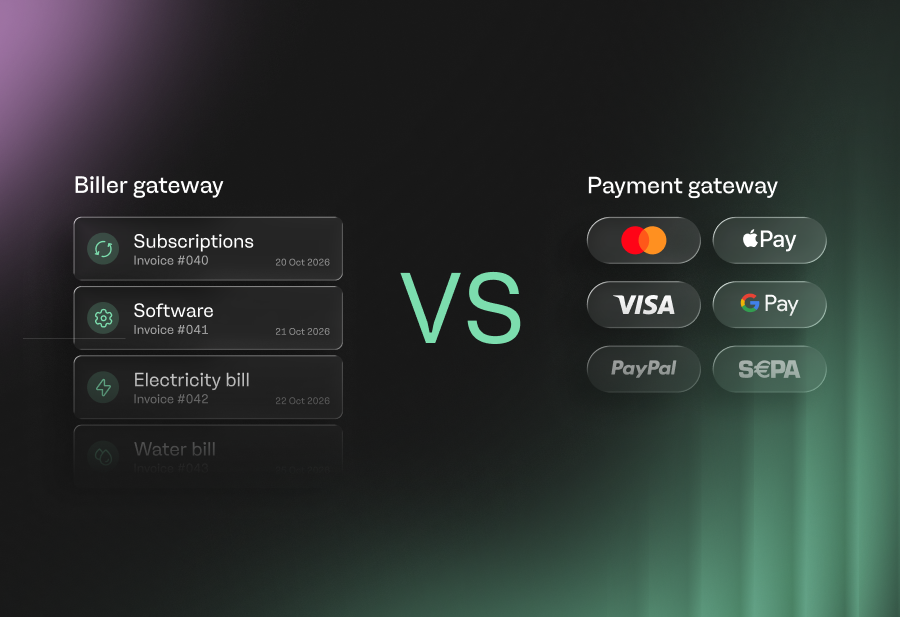
If you run a subscription business, a utility, or any company that sends recurring invoices, you have probably seen the term "biller gateway" floating around in vendor pitches and wondered how it differs from the "payment gateway" everyone else talks about. The short answer: a biller gateway is a payment gateway's specialised cousin, built specifically for collecting money from known, recurring customers (bills, invoices, subscriptions), while a payment gateway is the broader, general-purpose infrastructure that authorises any card-not-present transaction, from a one-off ecommerce checkout to a recurring charge.
This matters for merchants because choosing the wrong type of infrastructure, or assuming the two are interchangeable, can mean paying for features you do not need, or missing features your billing model depends on, such as automated dunning, invoice reconciliation, or multi-channel bill presentment.
What is a biller gateway?
A biller gateway is payment infrastructure built around the relationship between a biller (the company issuing an invoice or bill) and a known customer who owes a specific, identifiable amount. Instead of processing an anonymous one-time transaction at checkout, a biller gateway is designed around an existing account: it presents the bill, accepts payment against that bill, and reconciles the payment back to the customer's record.
In practice, a biller gateway typically supports:
- Bill presentment across channels (web, email, SMS, IVR, agent-assisted)
- Matching incoming payments to a specific invoice or account number
- Recurring and scheduled payments (autopay)
- Multiple payment methods for the same biller relationship (card, ACH, direct debit, digital wallets)
- Dunning and retry logic for failed recurring charges
- Reporting built around accounts receivable, not just transaction volume
This is the model used across utilities, insurance premiums, loan repayments, subscription software, and membership billing, anywhere a business already knows who owes what, and needs an efficient, low-friction way to collect it.
What is a payment gateway?
A payment gateway is the technology layer that securely captures payment details (most often card data) at the point of sale, whether that is an online checkout page, a virtual terminal, or a card-present POS transaction, and passes that information to the payment processor and acquiring bank for authorisation.
A payment gateway does not need to know who the customer is beyond what is required to authorise the transaction. It is built to handle the full variety of commerce: one-off purchases, cart checkouts, in-person Tap to pay transactions, and yes, recurring billing too, if the merchant builds that logic on top of it.
The core job of a payment gateway is narrower and more universal: securely capture, encrypt, and transmit payment data for authorisation, across any sales scenario a merchant runs.
Biller gateway vs payment gateway: the main differences
| Biller gateway | Payment gateway | |
| Built around | A known customer account and an existing bill or invoice | Any transaction, known or anonymous customer |
| Typical use case | Utilities, subscriptions, insurance, loan repayments, membership dues | Ecommerce checkout, POS, in-person, one-off and recurring sales |
| Core strength | Bill presentment, reconciliation, dunning, recurring collection | Broad payment method support, checkout flexibility, universal authorisation |
| Customer relationship | Pre-existing, identifiable (account or invoice number) | Can be first-time or anonymous |
| Reporting focus | Accounts receivable, collection rates, failed-payment recovery | Transaction volume, conversion rate, approval rate |
The main difference between a biller gateway and a payment gateway is scope: a biller gateway is purpose-built for collecting against an existing bill from a known customer, while a payment gateway is the general infrastructure for authorising any payment, whether or not a prior relationship or invoice exists.
In reality, the two are not always separate products. Many modern payment gateways, including payabl.'s, support both models: traditional checkout and card-present acceptance, alongside structured recurring billing and invoice-based collection. The distinction is more about the use case you are solving for than two entirely separate categories of technology.
Do you need a biller gateway, a payment gateway, or both?
Ask yourself three questions:
Do you already know who owes you money before the payment happens? If you send invoices, bills, or recurring charges to an existing customer base, biller-gateway functionality, such as bill presentment and reconciliation, will save your finance team real time.
Do you sell to new or anonymous customers at the point of transaction? If customers discover you, add items to a cart, or walk up to a terminal without a pre-existing account, you need standard payment gateway functionality.
Do you do both? Most subscription businesses and many ecommerce brands with membership tiers do. A SaaS company might take a one-off setup fee at signup (payment gateway behaviour) and then bill monthly against an account (biller gateway behaviour). In this case, you want a payment partner whose gateway handles both without forcing you to stitch together two separate systems.
This is exactly where payabl. fits. payabl.'s payment gateway supports the full omnichannel payment journey, online checkout, point of sale, and Tap to pay, so a merchant is not left managing a separate "biller" tool and a separate "ecommerce" tool. Whether you are collecting a recurring subscription fee or processing a first-time card payment at checkout, it runs through one integration, one dashboard, and one reconciliation view.
How a biller gateway and a payment gateway work together
The two are not rivals. In a well-built payment stack, the payment gateway is the engine that authorises and secures the transaction, and biller-specific logic (bill presentment, recurring scheduling, dunning) sits on top of it.
A simple way to picture the flow:
- The biller issues an invoice or schedules a recurring charge against a customer account.
- The payment gateway captures the payment details (stored card, direct debit mandate, or new entry) and securely transmits them for authorisation.
- The processor and acquiring bank approve or decline the transaction.
- The result is reconciled back against the original invoice or account, closing the loop for the biller's finance team.
A CFO at a subscription business does not need to choose a "biller gateway" and a "payment gateway" as two separate line items. The better question is whether the payment gateway you choose has robust recurring-billing and reconciliation capability built in, or whether you will need to bolt on a separate biller-side tool to cover the gap.
Merchants are not choosing between two systems; they are choosing one that does both well
A biller gateway and a payment gateway solve overlapping problems from different starting points: one starts from the bill, the other starts from the transaction. For most merchants, especially subscription businesses, SaaS companies, and any business with both one-off and recurring revenue, the practical answer is not picking one over the other. It is choosing a payment gateway robust enough to handle recurring, invoice-based billing natively, so you never have to manage two disconnected systems in the first place. A payment gateway that does both well is not a compromise; it is the setup every growing merchant eventually needs.
Frequently asked questions
Is a biller gateway the same as a payment gateway?
No. A biller gateway is a specialised form of payment infrastructure built around collecting against a known customer account or invoice, while a payment gateway is the broader technology that authorises any card-not-present or card-present transaction, including but not limited to recurring billing.
What is the main difference between a biller gateway and a payment gateway?
The main difference is scope and starting point. A biller gateway starts from an existing bill or account and focuses on presentment, reconciliation, and recurring collection. A payment gateway starts from the transaction itself and focuses on securely capturing and authorising payment data across any sales scenario.
Can one payment gateway handle both billing and standard checkout?
Yes. Many modern payment gateways, including payabl.'s, combine standard checkout and point-of-sale acceptance with recurring billing and reconciliation features, so merchants do not need to run two separate systems.
Which businesses typically need a biller gateway?
Utilities, insurers, lenders, subscription software companies, membership organisations, and any business that issues recurring invoices to known customers typically benefit most from biller-gateway functionality such as bill presentment and dunning management.
Does payabl. support biller-style recurring billing?
payabl.'s payment gateway supports the full omnichannel payment journey, including online checkout, point of sale, and Tap to pay, giving merchants with both one-off and recurring revenue a single integration rather than separate tools for each use case.