
A card terminal is the physical device that lets a shop or hospitality business accept chip and PIN, contactless, and digital wallet payments in person. Choosing the best one for your business comes down to three things: your monthly card turnover, how your team actually works the floor, and whether the terminal plugs into the rest of your payment setup or sits on its own island.
Think of a card terminal the way you'd think of a till in a busy kitchen. A single, standalone tool that only slices onions is fine for a small operation, but a restaurant running breakfast through dinner needs a tool that works alongside the ovens, the printer, and the till roll without anyone having to think about it. The best card terminal for a UK shop or hospitality venue in 2026 is the one that fits how your business actually takes money, not just the one with the lowest headline rate.
What makes a card terminal the "best" one for your business?
The best card machine for small business use balances four factors:
- Transaction rate – the percentage taken per sale, typically 0.99% to 1.95% in the UK market.
- Contract terms – pay-as-you-go with no lock-in, or a fixed 12 to 18-month contract.
- Hardware cost – a one-off purchase from around £19, or a monthly rental.
- Fit for your channel mix – a contactless-only reader for a market stall, a chip and PIN terminal for retail, or a connected POS system for hospitality.
Best card terminals UK: fees and features compared
| Provider | In-person rate | Monthly fee | Entry hardware | Contract |
| Square | 1.75% (all cards) | £0 | £19 (Reader) | None |
| SumUp (PAYG) | 1.69% | £0 | £25 (Solo Lite) | None |
| SumUp (Plus) | 0.99% | £19 | £25 (Solo Lite) | None, monthly |
| PayPal Zettle | 1.75% | £0 | £29 (Card Reader) | None |
| Dojo | 1.2% blended (under £100K/year turnover) | £0 (Essential) | From £149 or £15/month rental | Not published |
| Tide (Sell In Person) | 0.89% + 3p | £17.99 + VAT | £39 + VAT (Reader) | Monthly |
| Stripe Terminal | 1.4% + 10p | £0 | Partner hardware | None |
| Worldpay Simplicity | 1.50% (Visa/Mastercard) | £0 for 12 months, then last published £17.50 | Not published | 18 months |
| payabl. | Custom, quote-based | Included in merchant account | NEXGO N6, N86 or N96 terminals | Flexible, tailored to business size |
Rates and terms verified against provider-published data as of late 2026.
A SumUp or Square reader costs almost nothing upfront, which is why they dominate for market stalls and sole traders doing under £2,500 a month. But the same flat rate that feels painless at low volume gets expensive fast. At £10,000 a month in card turnover, Square's 1.75% flat rate costs £2,100 a year, roughly £713 more than a subscription plan like Tide Sell In Person at the same volume. Dojo's 1.2% blended rate is the cheapest published option between £2,500 and £8,000 a month, at £720 a year on £5,000 of monthly turnover.
Best card terminals for retail shops
A retail shop juggling footfall spikes, queues at the till, and the odd high-value sale needs a chip and PIN terminal, not a contactless-only reader, because contactless caps out at £100 per inserted card. For shops doing £5,000 to £15,000 a month, Dojo and Tide's Sell In Person plan currently offer the lowest published annual cost, while Square and SumUp PAYG remain the simplest no-contract entry points for smaller or seasonal shops.
If your shop also sells online, a terminal that reports into the same dashboard as your website checkout saves hours of manual reconciliation every month, which is where an omnichannel setup like payabl.'s starts to matter more than the headline rate alone.
Best card terminals for hospitality
Hospitality is a different animal entirely. A pub, café, or restaurant needs a terminal that can walk to the table, split a bill three ways, add a tip without an awkward pause, and still work when the Wi-Fi drops at peak Saturday service. Dojo's Go Max and Pocket terminals, and Square Terminal, are built for exactly this, with table-side split-bill and tip handling as standard features.
For hospitality venues with international tourist trade, card mix matters as much as the base rate: Stripe's 2.9% + 10p rate on non-EEA cards adds 1.5 percentage points over its standard 1.4% + 10p rate, which on £1,000 a month of overseas card spend works out to roughly £180 extra a year. Square, by contrast, charges no chargeback fee at all, a real saving for venues with a higher dispute rate.
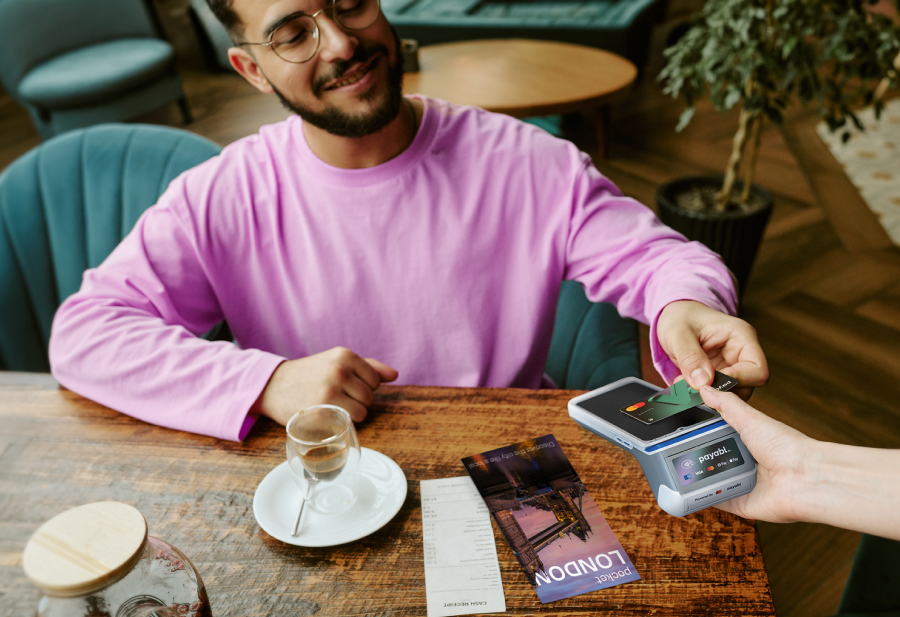
payabl.'s in-store POS terminals (the NEXGO N96, N86, and N6) add built-in printers, long battery life, and Wi-Fi plus cellular connectivity, so a terminal keeps working even if the venue's internet falters, and they connect directly into payabl.'s in-store POS terminals, giving next-day settlement and a single dashboard for every till in the building.
Tap to Pay: the terminal that fits in your pocket
Not every business needs a dedicated machine at all. Tap to Pay by payabl. turns an Android phone into a secure contactless terminal, with no card reader to buy, charge, or lose behind the bar. For a pop-up stall, a market trader, or a hospitality venue that wants a backup terminal for its busiest night without buying another machine, this is the lowest-friction way to accept Visa, Mastercard, and digital wallet payments in person.
Why an omnichannel terminal beats a standalone one
Most comparison tables stop at rate and hardware cost. But a shop or restaurant rarely takes payments through just one channel anymore: there's the till, the website, the phone order, and increasingly a QR code on the table. Running each of those through a different provider is like having a separate till roll for every day of the week; technically it works, but reconciling it at month-end is a headache nobody asked for.
This is the gap payabl.one dashboard is built to close. One merchant account, one dashboard, and one reconciliation view across online checkout, in-store POS terminals, and Tap to Pay, with next-day settlement and support from a dedicated client manager rather than a chatbot. For a CFO trying to close the books at month-end, or a shop owner who would rather be on the floor than toggling between three different provider portals, that consolidation is often worth more than shaving a few basis points off the headline rate.
The right terminal is the one built around how your business actually takes payments
The best card terminal for a UK shop or hospitality business in 2026 is not the one with the lowest rate on paper; it is the one that matches your transaction volume, survives a busy Saturday night, and connects to the rest of how you take money, in person and online. Get those three things right, and the terminal stops being a cost to manage and starts being infrastructure you don't have to think about again.