


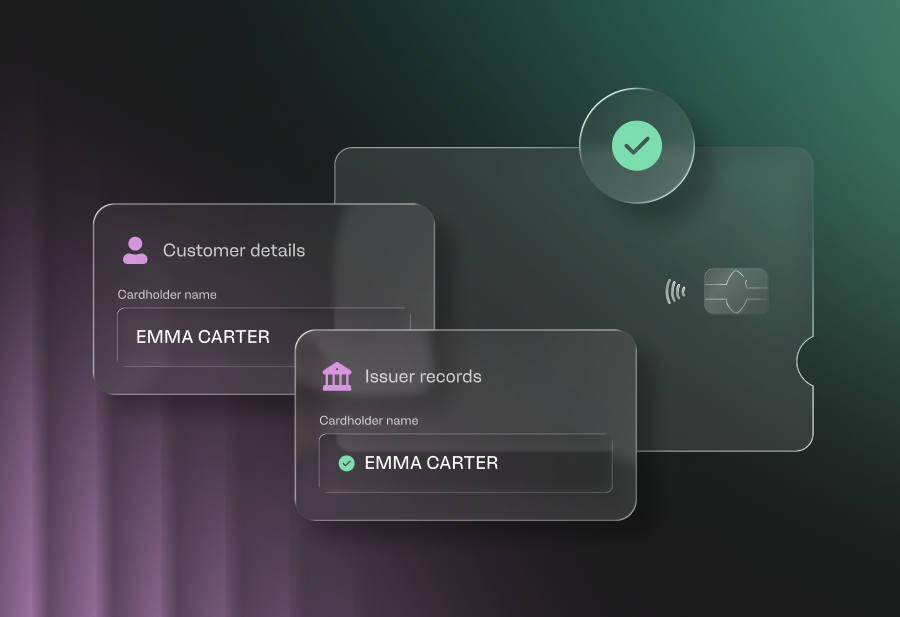
A mismatched cardholder name rarely appears in isolation. It usually comes with a stolen card number, a synthetic identity, or an account takeover attempt. And by the time a merchant spots it, the payment has often already gone through. Account Name Validation (ANV) moves the check one step earlier for merchants. It confirms whether the name submitted by a customer matches the name the card issuer holds on file, before the money moves.
For merchants running payments across the UK and EU, it’s another tool to help deter and prevent fraud. Visa and Mastercard have each introduced name validation requirements and monitoring expectations across European markets, with ANV the mechanism that lets merchants respond to them directly.
What ANV checks
ANV compares the cardholder name a customer enters against the name the issuing bank has recorded against that card. The check runs separately from a financial transaction as a standalone, zero-amount request, so merchants can validate a name without moving funds or exposing themselves to a real payment outcome if the check fails.
Merchants can request the result inside a live authorisation. An embedded service option returns the name validation outcome alongside the usual authorisation response, meaning merchants set rules on the outcome and decide automatically whether to continue.
ANV connects to three separate scheme services, each run by the respective card network:
- Visa: Account Name Inquiry (ANI)
- Mastercard: Name Validation Service (NVS)
- American Express: Advanced Account Verification (AAV)
A merchant using ANV doesn't need three separate integrations to cover three schemes. One integration into payabl.'s authorisation flow handles the request regardless of which network issued the card.
Outcome-based decision making
Every ANV check returns one result from a small set of outcomes: Match, Partial Match or No Match. In cases where the issuer doesn't support or doesn't perform the check, it reports that a Name match was not performed or Name match wasn't supported. These results are available through the merchant's dashboard and the API response, feeding directly into existing fraud rules or manual review queues.
A Partial Match deserves particular attention in risk workflows. It should be treated like a No Match as it causes legitimate customers to hit unnecessary friction. It points to a minor discrepancy like a middle name, hyphenated surname or transliteration error rather than outright fraud. Merchants running the embedded service option can add this nuance into their rules instead of applying single pass/fail thresholds.
What the Visa and Mastercard requirements mean
Visa's name validation requirements and monitoring expectations apply across the US, Canada, Europe, LAC, AP, and CEMEA regions. Mastercard's apply across the US, Canada, and Europe, with Türkiye currently excluded. American Express supports name validation, but hasn't mandated it.
The practical detail for European merchants is that the underlying mandate language sits at scheme and issuer level, with exact obligations depending on the programme and the merchant's region. What ANV gives merchants is the mechanism to respond to those requirements where they apply.
This is whether the driver is a direct mandate, a scheme monitoring programme, or simply good practice ahead of a requirement tightening further. As such, merchants that apply name validation practices now are better positioned for future developments, regardless of how a given scheme's enforcement timeline progresses.
How ANV complements AVS rather than replacing it
Address Verification Service (AVS) and ANV solve similar problems, but to different extents. AVS checks the billing address submitted at checkout against the address the issuer holds on file, while ANV checks the name. A merchant using both gets two independent identity signals from the same card, rather than the same signal checked twice.
That distinction matters for merchants. An address can be outdated for legitimate reasons and not indicate fraud, such as someone moving recently or using a work address instead of a home one. A name mismatch often indicates something different. Name changes happen far less often, and a hard mismatch between the submitted name and the issuer's record provides a stronger fraud signal than an address mismatch alone.
Running ANV alongside AVS gives risk teams two separate data points to consider rather than forcing a single address check to carry out identity verification.
Where ANV helps most
Onboarding
When a merchant collects a card during account opening or registration, ANV confirms the cardholder name matches issuer records before that card is stored or used again. This catches synthetic identities and card data at the first touch point with your business rather than after the first fraudulent transaction.
Payouts
Before sending funds to a card via a payout tool, ANV confirms the recipient name matches the cardholder on file. This reduces the risk of misdirected funds and mistaken payouts, which are far harder to reverse than a declined payment.
Checkout
For recurring payment setups, high-value purchases, or transactions in risk-sensitive categories, ANV adds an identity check at the point a card is tokenised or payment is authorised. Combined with the embedded service option, a merchant can apply configured rules so that only a ‘Match’ or acceptable ‘Partial Match’ proceeds automatically, while weaker results go to manual review.
The same principle holds across all three: ANV gives merchants a clear, scheme-verified answer to a question that would otherwise require guesswork or a costly dispute process to resolve.
Getting started
ANV runs on infrastructure merchants are likely already using. It uses a standard authorisation API call, with the amount set to zero and the cardholder's first and last name populated.
Speak to your account manager about enabling ANV on your account.
FAQ
What is account name validation (ANV)?
Account name validation checks whether the cardholder name a customer submits matches the name the card issuer holds on file. Run it as a standalone, zero-amount check or inside a normal authorisation through the embedded service option.
Do Visa and Mastercard require name validation?
Visa and Mastercard have introduced name validation requirements and monitoring expectations in specific regions. Visa covers the US, Canada, Europe, LAC, AP, and CEMEA. Mastercard covers the US, Canada, and Europe, excluding Türkiye.
How is ANV different from AVS?
AVS checks the billing address a customer submits. ANV checks the cardholder name. Use both and you get two independent identity signals from the same card. Names change far less often than addresses, so a name mismatch is a stronger fraud signal than an address mismatch on its own.