


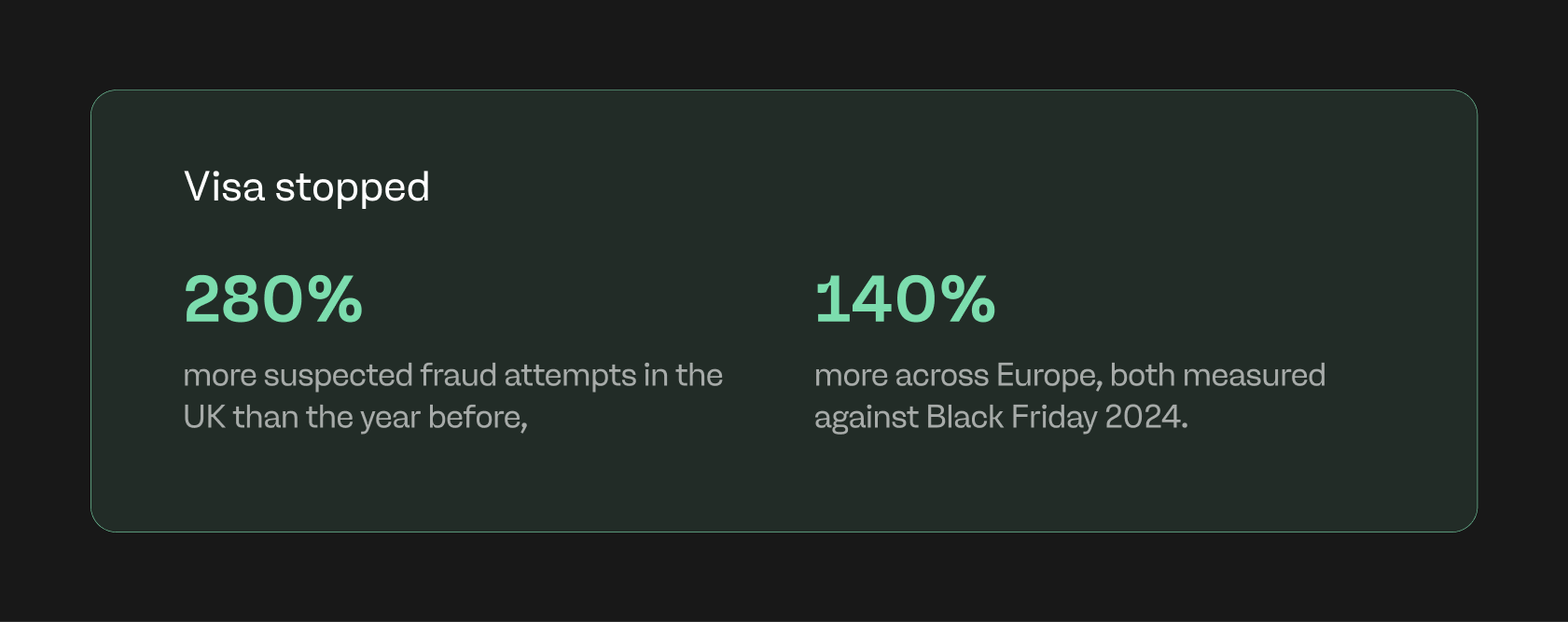
Black Friday 2025 saw a sharp rise in fraud attempts. Visa stopped 280% more suspected fraud attempts in the UK than the year before, and 140% more across Europe, both measured against Black Friday 2024 (Visa Europe via Finextra, Dec 2025). That single day of trading set the tone for how 2026 needs to be approached.
Volume is rising, attack methods are changing, and the systems that flag risky merchants have been rebuilt around a different set of rules. Here's what last year's Black Friday tells you about 2026, and what you need to put in place before it arrives.
Fraud losses are climbing, not easing
The first finding is that fraud spikes didn't stop when Black Friday did. The UK's National Cyber Security Centre reported in November 2025 that shoppers lost £11.8 million to online shopping fraud over the 2024 festive season (1 November 2024 to 31 January 2025). Over the full year, UK remote purchase card fraud, where criminals use stolen card details to buy online, rose 3% to £423.5 million in 2025. Case numbers rose 13% to 3.2 million, and are now growing faster than losses. Criminals are making more attempts at lower values, so each attempt is harder to spot.
Selling cross-border raises the risk. Card fraud runs around 17 times higher when the payment recipient sits outside the EEA, where Strong Customer Authentication isn't a legal requirement, according to the joint EBA–ECB report on payment fraud (EBA–ECB, December 2025). Card fraud on EU and EEA-issued cards reached €1.329 billion in 2024, up 29% year on year. This is a faster rise than credit transfer fraud, which grew 16% to around €2.2 billion (EBA–ECB, December 2025).
If your Black Friday growth plan leans on selling into new European markets you haven’t touched before, your fraud controls need to prioritise risk-based rules for cross-border transactions while also strengthening domestic checkout setups.
The attacks have changed shape
Visa's own threat intelligence identified a shift from opportunistic fraud to more organised operations. "Criminals are no longer working as opportunistic individuals. They're operating like tech startups, building reusable infrastructure and deploying systematic, industrial-scale operations that challenge conventional defences," said Paul Fabara, Chief Risk and Client Services Officer at Visa, in the company's Fall 2025 Biannual Threats Report (Visa via Payments Dive, November 2025).
The same report points to five patterns worth watching ahead of 2026:
- Fraud schemes that are built to scale
- Stolen card data held back deliberately to avoid early detection
- Fake merchant sites and fake compliance processes
- Legacy detection tools falling behind
- Gaps opening up at third parties in the payment chain
That "held back" data point is important for merchants. Mastercard's Recorded Future unit found criminals are building entire fake ecommerce networks while using sham marketing to lure shoppers to fraudulent merchant sites built purely to harvest payment data (Recorded Future via Payments Dive, November 2025). Criminals don't always use stolen card details immediately. They surface later, often during the next high-volume event. This means the fraud hitting your checkout in November 2026 may trace back to a breach that happened months earlier.
Chargebacks are the pain point growing fastest
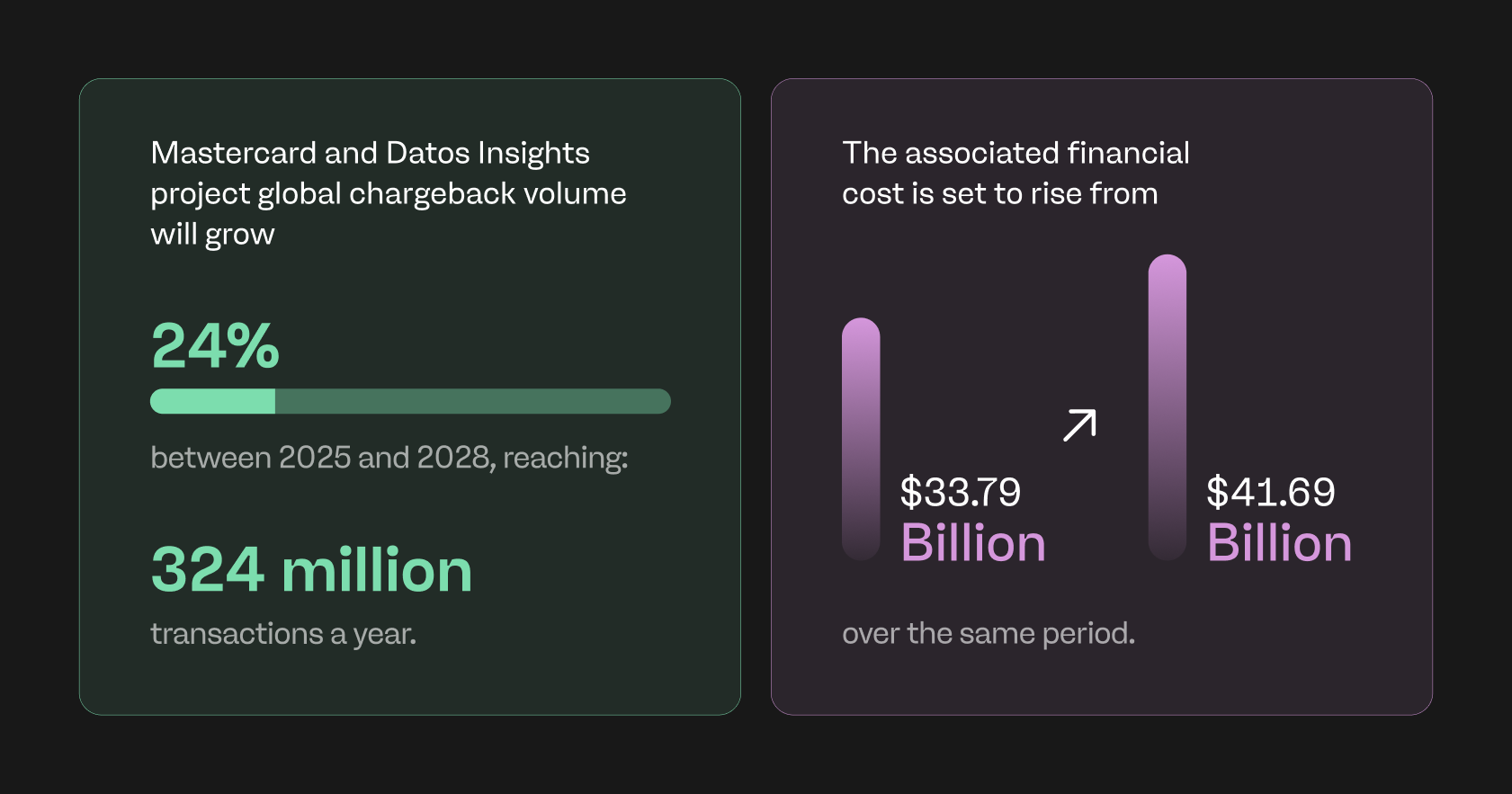
If fraud at checkout is the risk merchants plan for, disputes after the sale are the one most are underprepared for. Mastercard and Datos Insights project global chargeback volume will grow 24% between 2025 and 2028, reaching 324 million transactions a year. The associated financial cost is set to rise from $33.79 billion to $41.69 billion over the same period (Mastercard, 2025 Global Chargebacks Outlook). Mastercard's own research also found merchants flag 45% of their chargebacks as fraudulent, and that digital purchases now account for 63% of merchant transactions. This is the exact payment mix most exposed to disputes according to Mastercard’s 2025 Global Chargebacks Outlook.
Both major schemes responded by rebuilding their respective merchant monitoring schemes. Visa's Acquirer Monitoring Program (VAMP) now folds fraud and dispute activity into a single ratio, and from 1 April 2026, the threshold for merchants flagged as excessive tightened to 1.5%. payabl. responded directly to this change. In August 2026, we expanded our partnership with Visa to bring Rapid Dispute Resolution into payabl.one, giving merchants a way to resolve eligible disputes automatically before they turn into chargebacks.
"In payments, every second counts. Our collaboration with Visa brings merchants faster resolution, fewer chargebacks, and a better experience for their customers. By embedding pre-dispute automation into payabl.one, we're reducing friction where it matters most: after the sale," said Oleg Stefanets, Chief Risk Officer at payabl. Mastercard is making a parallel move with its own Global Merchant Audit Program (GMAP), replacing its current chargeback monitoring framework from April 2027 and tightening thresholds over the years that follow.
Both changes point to the same conclusion for merchants: the dispute data now decides which merchants get flagged by the networks that process their payments.
Checkout friction and refund abuse cost more than merchants realise
Black Friday puts fraud control and conversion rates in direct conflict. payabl.'s Fraud in Europe report found that 43% of merchants said fraud checks slowed down their checkout, and nearly four in ten said multiple verification layers made the process clunkier. A third noted that added friction directly triggered cart abandonment. Shoppers are just as quick to leave. Six in ten consumers said they'd abandon a basket at the first sign of something suspicious, such as poor spelling, low-quality images or excessive data requests.
The fix is checks that shoppers trust. The same research found extra security controls such as two-factor authentication were the strongest single driver of purchase confidence, cited by 33% of consumers. Shoppers accept friction when it visibly protects them but reject it when it feels like an obstacle.
The other side of the problem arrives after the sale. Refund and return fraud topped the list of fraud types merchants faced, cited by 44% (payabl., Fraud in Europe). That covers wardrobing, duplicate-charge claims and other ways of gaming the refund process. Friendly fraud follows the same pattern, with 64% of merchants worldwide reporting a rise in first-party misuse (Merchant Risk Council, 2026 Global eCommerce Payments and Fraud Report). Flash discounts and peak-season return volumes give that misuse more room to grow.
What this means for how you set up for November 2026
Three things separate merchants who get through Black Friday 2026 in good shape from those managing the fallout over the holidays. First, treat cross-border sales growth and fraud exposure as the same decision. Apply risk-based authentication on transactions outside the EEA, and avoid blanket rules that slow down every customer.
Second, build dispute handling into your fraud strategy before the event. With Visa's monitoring thresholds already tighter and Mastercard's own overhaul landing in 2027, a merchant's dispute ratio is a number schemes are watching closely. Third, separate fraud screening from your return and refund policy. Refund abuse and genuine fraud require different responses. Combining them lets real misuse through and turns away paying customers.
payabl.one brings these pieces into one view: dispute and fraud performance are tracked together, with real-time monitoring and AI-powered decision-making included. Merchants get Visa Rapid Dispute Resolution built into payabl.one, letting eligible disputes resolve automatically before they count against scheme monitoring ratios.
A note: payabl.'s next Fraud in Europe report is being released in the coming months. It builds on the fraud and dispute data covered here and in the current edition, with a deeper look at where European merchants are most exposed heading into next year and beyond.
Set your checkout up for Black Friday 2026 — manage potential fraud and disputes with payabl.