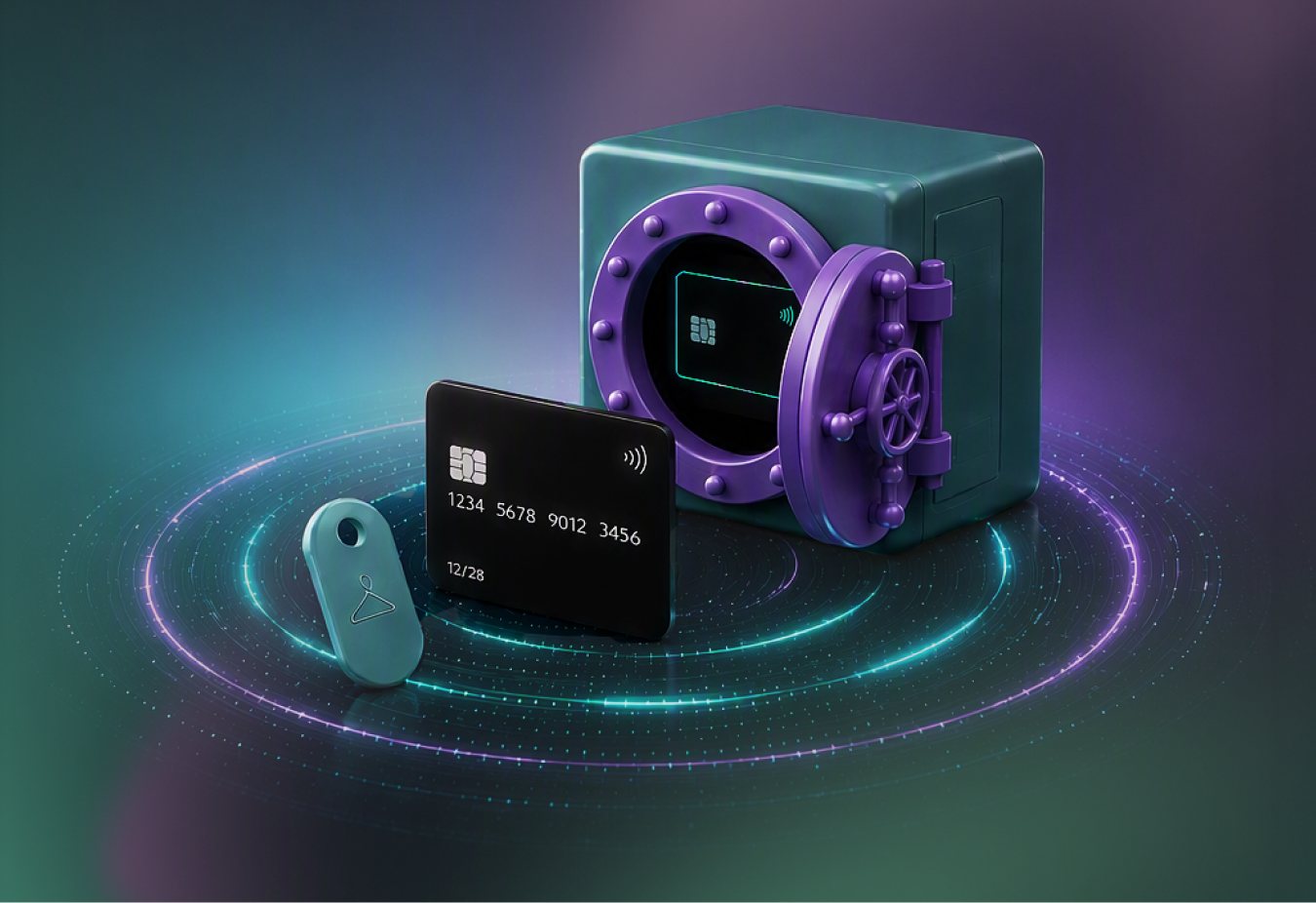
What is payment tokenization?
Payment tokenization is a security method that replaces sensitive card data, such as the primary account number (PAN), with a unique, randomly generated string called a token.
The token carries no exploitable value on its own, so even if it is intercepted it cannot be reverse-engineered back into a usable card number. Think of it like a cloakroom ticket: the ticket is worthless to a thief, yet the venue can always match it back to your coat. For a merchant, that means you can charge a returning customer, run a subscription, or accept a Tap to pay transaction without ever holding the real card details yourself.
How payment tokenization works, step by step
In short: card data goes in, a meaningless token comes out, and the real number is locked in a secure vault that only a trusted provider can unlock.
- Data capture: The customer enters their card details at your checkout or taps at your terminal.
- Tokenization request: The data is sent to a secure token service, run by your payments provider or a token service provider (TSP), rather than being stored on your systems.
- Token generation: The service creates a unique token that stands in for the card. It is random and has no meaning outside that specific payment system.
- Vaulting: The real card data is stored in the provider’s secure vault. Your system keeps only the token.
- Token use: When you charge the customer, you send the token; the provider maps it back to the real card behind the scenes and completes the payment.
- Reuse: For card-on-file and recurring billing, the same token is charged again and again, with no need to re-collect card details.
Payment tokenization vs encryption: what is the difference?
The difference is simple: encryption scrambles data so it can be unscrambled with a key, while tokenization replaces the data with a substitute that has no key and no mathematical link back to the original.
Encryption is like writing a letter in a secret code, anyone with the codebook can read it. tokenization is like swapping the letter for a numbered locker key, the key reveals nothing about what is inside. Most merchants use both: encryption to protect data in transit, tokenization to remove card data from storage entirely and shrink the systems that fall under PCI DSS.
Types of payment tokens: network, merchant, gateway and acquirer
Not all payment tokens are the same. The main difference is who issues the token and how widely it can travel: a network token is issued by the card scheme and works across the payments ecosystem, while a merchant (PCI) token stays inside one merchant’s environment.
| Token type | Issued by | Scope | Best for |
| Network token | Card network (Visa, Mastercard) under the EMVCo standard | Works across merchants; updates automatically on card reissue | Card-on-file, recurring billing, higher approval rates |
| Merchant (PCI) token | Merchant or its payments provider | Valid only inside that one merchant environment | Reducing PCI DSS scope; internal card-on-file |
| Gateway token | Payment gateway | Limited to that gateway/merchant | Quick tokenization within a single gateway setup |
| Acquirer token | Acquiring bank | Limited to the acquirer’s ecosystem | Merchants tied to one acquirer |
Why network tokenization lifts approval rates and cuts fraud
Network tokens do more than hide the card number, they actively make more payments succeed. Because the issuing bank helps approve the token, and because each transaction carries a single-use cryptogram, network tokens are trusted more and are far harder to misuse.
- Higher approval rates: Visa reports a 4.6% lift in authorisation on tokenised card-not-present transactions globally, compared with sending the raw PAN.
- Lower fraud: Visa attributes up to a 28% reduction in fraud to network tokenization.
- Fewer false declines: participating issuers refresh tokens automatically when a card is reissued, so stored-card and subscription payments do not fail when a customer’s card is renewed.
- Less involuntary churn: for a SaaS or subscription CFO, auto-updated credentials mean fewer failed rebills and less revenue quietly leaking each month.
How payment tokenization reduces your PCI DSS scope
Tokenization shrinks PCI DSS scope by removing card data from your environment, but it does not make you compliant on its own.
When a token replaces the PAN, there is simply less sensitive data living on your servers, so fewer systems fall inside the assessment. You still need to know where any cardholder data sits and prove the controls around it meet the standard. Picture it like a shop that stops keeping cash on site and banks everything instead: there is far less to steal and far less to guard, but you still have to run the shop responsibly.
Which merchants benefit most from payment tokenization?
Any merchant that stores a card and charges it more than once gains the most, because stale or reissued credentials are what break repeat payments.
- Ecommerce retailers: Card data never lands in your systems during online checkout, cutting breach risk and smoothing repeat purchases with saved cards.
- Subscription and SaaS businesses: Tokenised card-on-file keeps recurring billing running through card reissues, protecting recurring revenue from involuntary churn.
- In-store and Tap to pay merchants: Every Tap to pay and digital-wallet transaction is already tokenised, so the card number is never exposed at the point of sale.
- Marketplaces and platforms: Tokens travel across acquirers and parties, reducing liability and scaling securely as you add sellers, currencies and markets.
- Travel and hospitality: A card authorised at booking can be captured weeks later; an auto-updated network token stops that delayed charge from failing.
Tap to pay, digital wallets and the future of tokenization
If you already accept Apple Pay, Google Pay or a Tap to pay transaction, you are already accepting tokenised payments.
When a customer adds a card to a wallet, the network issues a token that stands in for the PAN on that device, and every tap or wallet payment after that uses the token, never the real number. The same tokenised credentials now underpin emerging agentic commerce, where AI agents pay on a customer’s behalf using a token scoped tightly to one agent and one set of permissions, so the raw card is never exposed. Building tokenization into your checkout today is how you stay ready for that shift.
Tokenization turns your checkout into a vault, not a target
Payment tokenization is no longer a nice-to-have layer bolted onto checkout; it is the mechanism that lets you accept, store and recharge a card without ever owning the risk that comes with it. By swapping the PAN for a token, you take card data off your systems, shrink your PCI DSS footprint, and, with network tokens, actively win more approvals while losing fewer customers to false declines and expired cards.
Whether the payment happens online, at a terminal, through a wallet or via an AI agent, the same principle protects it: the real card stays locked away, and only a worthless token ever moves. For a merchant weighing fraud, compliance and revenue in the same breath, that is the whole point, tokenization turns your checkout into a vault, not a target.
How payabl. helps you tokenise every payment
payabl. secures the whole omnichannel payment journey, online checkout, POS, and Tap to pay, so card data is tokenised wherever your customers pay.
- Protect card-on-file and recurring billing with tokens that keep charging cleanly through card reissues.
- Reduce PCI DSS scope by keeping raw card data out of your environment.
- Lift approval rates and cut false declines across card-not-present payments.
- Accept 300+ local and alternative payment methods with multi-currency business accounts, all under one provider.
Ready to secure your checkout?
Payment tokenization FAQ
What is payment tokenization in simple terms?
It is swapping a real card number for a random token that has no value on its own, so you can take and repeat payments without storing sensitive card data.
What is the difference between tokenization and encryption?
Encryption scrambles data that can be unscrambled with a key; tokenization replaces the data with a substitute that has no key and cannot be reversed.
What is the difference between a network token and a merchant token?
A network token is issued by the card scheme, works across merchants and updates on card reissue; a merchant (PCI) token stays inside one merchant’s environment.
Does payment tokenization make me PCI compliant?
No. It reduces your PCI DSS scope by removing card data from your systems, but you still need to assess and document your compliance.
Does tokenization improve approval rates?
Yes. Visa reports a 4.6% authorisation lift on tokenised card-not-present transactions and up to 28% less fraud with network tokenization.
Is Tap to pay a tokenised payment?
Yes. Tap to pay and digital-wallet payments already use network tokens, so the real card number is never exposed at the point of sale.