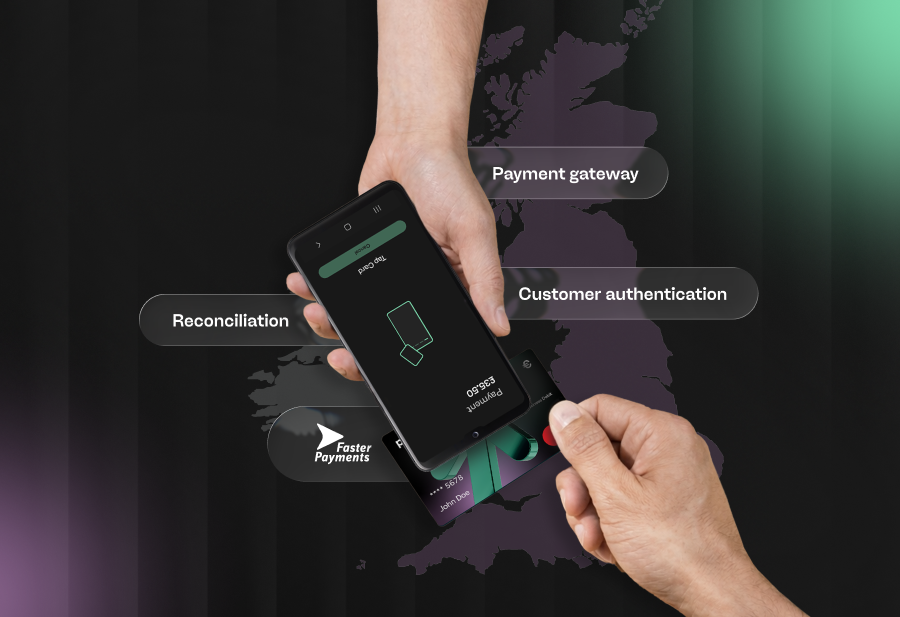
A customer taps a phone against a market stall, and 900 miles of banking machinery springs to life. That invisible sprint, from tap to "approved" to money in your account, is the real job of UK digital payment platforms.
Most guides hand you a ranked list of the best digital payment platforms in the UK and call it done. This field guide does the opposite: it shows you the moving parts, introduces the four kinds of online payment platforms UK merchants actually use, and hands you a scorecard so you choose the right payment gateway for UK with your eyes open.
The four-second journey every payment takes
Quick answer: a UK digital payment platform is the system that carries a single payment through five relay legs, authorisation, authentication, routing, settlement, and reconciliation, in about four seconds, then keeps the receipt so your books balance.
Picture a relay team, not a machine. Each runner has one leg of the track and one baton, your customer’s money:
• Runner 1, the checkout or Tap to pay reader, grabs the card details and starts the sprint.
• Runner 2, Strong Customer Authentication, checks the baton is really theirs (PSD2 SCA).
• Runner 3, the payment gateway, routes the baton to the right card scheme or bank.
• Runner 4, Faster Payments or the card networks, moves the actual funds.
• Runner 5, reconciliation, files the result so finance sees one clean record.
Drop the baton at any leg and you feel it as a declined card, a chargeback, or a Friday-afternoon spreadsheet that will not reconcile. A strong platform simply makes sure the baton never hits the ground.
Three myths that make merchants choose the wrong platform
Myth 1: "The cheapest rate wins."
Reality: a platform with a slightly higher rate but better approval rates can bank more money, because it declines fewer good customers. Cost is what you pay; acceptance is what you keep.
Myth 2: "Online and in-store need separate tools."
Reality: an omnichannel payment platform runs online checkout, POS, and Tap to pay from one account, so the same shopper is one customer, not three disconnected records.
Myth 3: "All UK payment platforms are basically the same."
Reality: they split into four distinct types with very different strengths, which is exactly what the next section maps out.
Meet the four types of UK digital payment platforms
UK digital payment platforms fall into four families, the all-rounder, the specialist, the fee-cutter, and the pocket till. Knowing which one fits your business is more useful than any ranked list.
The all-rounder: the omnichannel platform
Like a Swiss Army knife for revenue, an omnichannel payment platform such as payabl. unifies online checkout, POS, and Tap to pay, with multi-currency accounts and 300+ local and alternative payment methods behind it. Best for merchants who sell in more than one place and want a single provider.
The specialist: the online-only gateway
The sprinter who only runs one race well. A pure UK payment gateway is built for fast web checkout and clean developer integration. Best for online-only stores that never take an in-person payment.
The fee-cutter: account-to-account and Open Banking
The shortcut that skips the toll roads. Account-to-account payments move money bank-to-bank over Faster Payments, trimming card fees. Best for merchants with high average order values who want to lower card costs on invoices or subscriptions.
The pocket till: the mobile card reader
A market trader’s apron with a card slot. Tap to pay and small readers turn a phone into a till with almost no hardware. Best for pop-ups, mobile sellers, and anyone who sells on the move.
The merchant’s scorecard: how to grade any UK payment platform
Instead of a wish list, grade each shortlisted provider from 1 to 5 on the seven factors below, then total the score. The highest number, not the lowest price, points to the best digital payment platform for your business.
| Factor | What to ask | Why it matters |
| Approval rate | What percentage of good payments get approved? | More completed sales from the same traffic |
| True cost | Rate plus scheme, cross-border, and payout fees? | The headline rate hides the real bill |
| Channel coverage | Online, POS, and Tap to pay in one account? | Omnichannel keeps one customer view |
| Payment methods | Cards, wallets, Open Banking supported? | Match how UK customers want to pay |
| Settlement speed | How fast do funds land via Faster Payments? | Cash flow depends on it |
| Compliance | FCA regulated, PSD2 SCA, PCI DSS? | Protects revenue and reputation |
| Scalability | Multi-currency and support as you grow? | Avoids a costly re-platform later |
A 30-second decision path
If you sell online and in person, start with the all-rounder. If you sell online only, the specialist gateway is enough. If your fees hurt on big invoices, add the fee-cutter. If you sell on the move, reach for the pocket till. Most growing UK merchants end up wanting the all-rounder, because it can quietly absorb the other three roles as they scale.
Pick the platform that carries the baton, not just the cheapest ticket
Come back to the relay team. Every UK digital payment platform is really a promise that your customer’s money will cross five legs without the baton ever touching the ground.
Low upfront costs might grab your attention at the starting line, but the truly successful platforms are those that deliver superior approval rates, extensive channel coverage across online checkout, POS, and Tap to pay, rapid Faster Payments settlement, and dependable FCA-grade compliance.
Score your shortlist honestly, weigh acceptance over headline price, and match the platform type to how you actually sell. Do that, and you will not just process payments in the UK, you will pick the platform that carries the baton all the way home.
Frequently asked questions
Q: What are the benefits of using UK-based payment services for students and institutions?
A: UK-based payment services give students and institutions faster, cheaper, and more secure tuition and fee payments. Students pay in GBP without hidden conversion costs, use familiar methods such as Open Banking bank transfers and digital wallets, and are protected by Strong Customer Authentication against fraud.
Institutions gain quicker settlement through Faster Payments, which steadies cash flow, plus automated reconciliation that cuts admin, clearer reporting for finance teams, and FCA-regulated compliance that lowers risk when handling large volumes of tuition payments.
Q: What is the best UK digital payment platform for my business?
A: The best UK digital payment platform is the one that scores highest on approval rate, true cost, channel coverage, and scalability for how you sell, not the one with the lowest headline rate.
For most growing merchants, an omnichannel platform that unifies online checkout, POS, and Tap to pay is the safest long-term choice.
Q: What are the four types of UK payment platforms?
A: UK payment platforms fall into four types: omnichannel all-rounders that combine online, POS, and Tap to pay; online-only gateways for pure ecommerce; account-to-account and Open Banking providers that cut card fees; and mobile card readers for selling on the move.
Q: Do UK digital payment platforms support Tap to pay?
A: Yes. Many UK digital payment platforms support Tap to pay, which turns a compatible smartphone into a contactless card reader, letting merchants accept in-person card payments without buying separate terminal hardware.
Q: Are UK payment platforms regulated?
A: Yes. UK payment platforms are regulated by the Financial Conduct Authority and must follow PSD2 Strong Customer Authentication and PCI DSS security standards, with the Payment Systems Regulator overseeing fair access to UK payment systems.