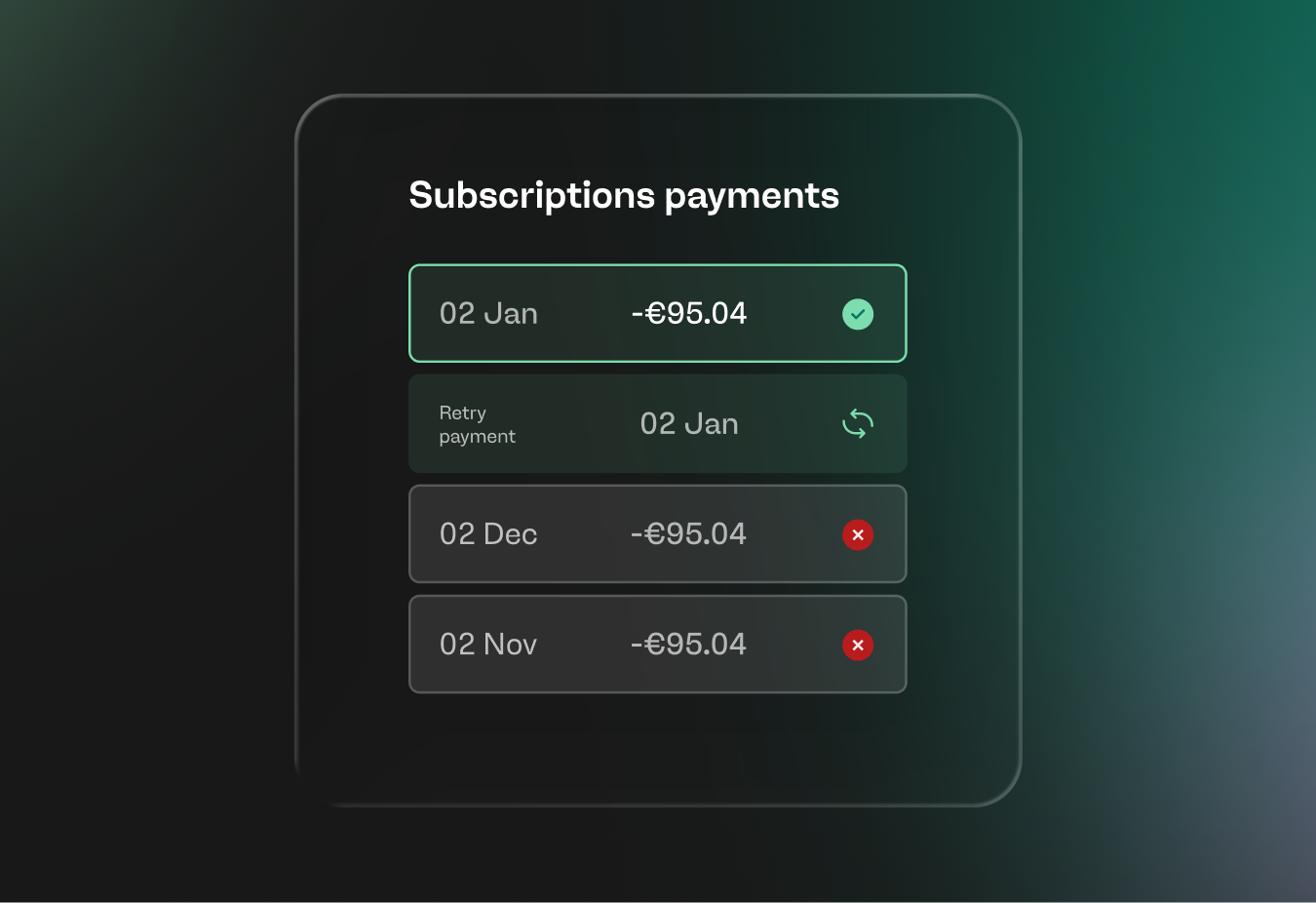
Subscription revenue depends on predictable cash flow. A few failed payments can trigger churn, support tickets, and uncomfortable follow-ups.
A smart strategy builds recovery into the process before a cancellation happens. This guide shows why recurring subscription payments fail and how to reduce revenue loss without adding friction.
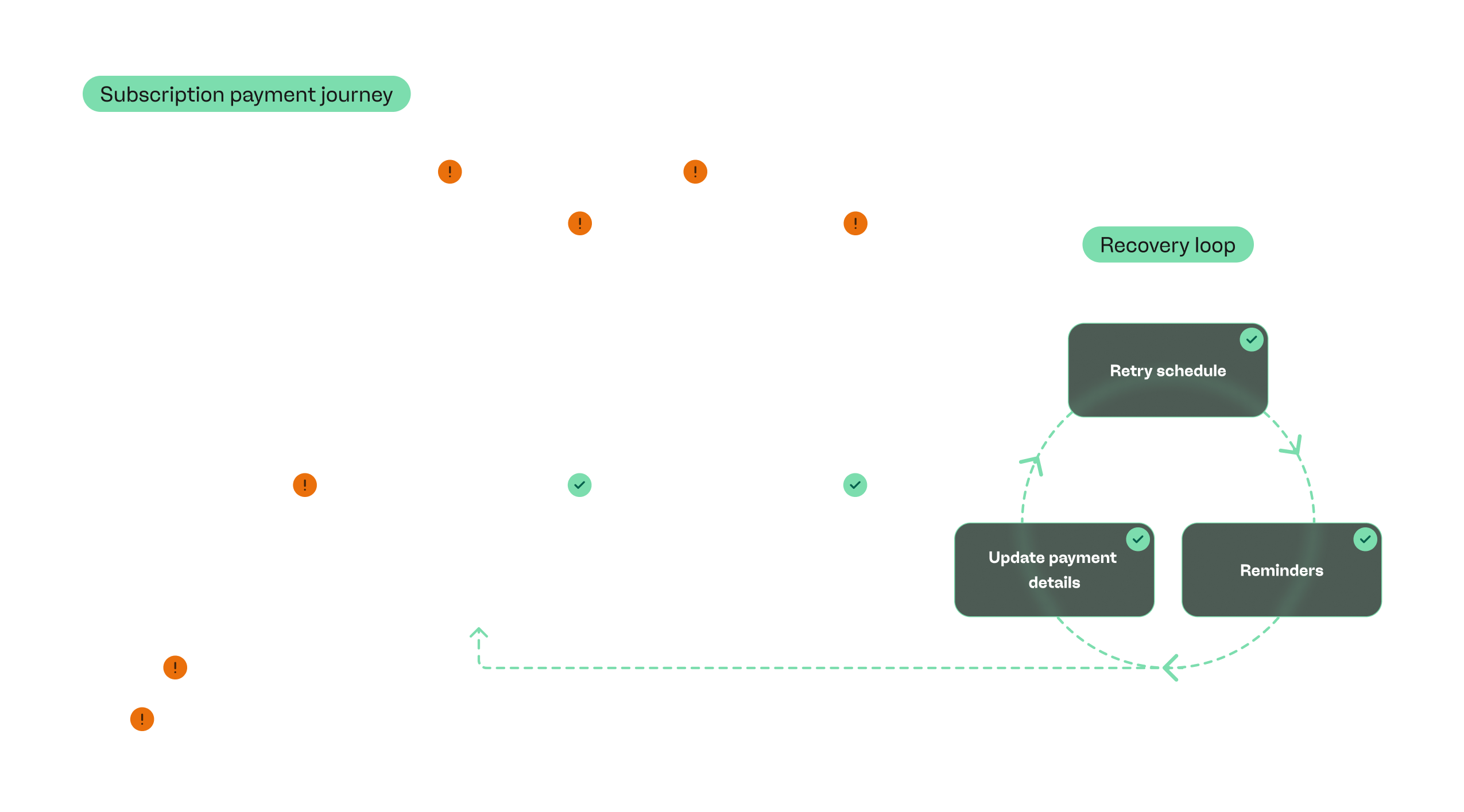
Why subscription payments fail
Most subscription billing problems come from a small set of predictable breakdowns. When you map those breakdowns, you can reduce failed recurring payments and protect retention.
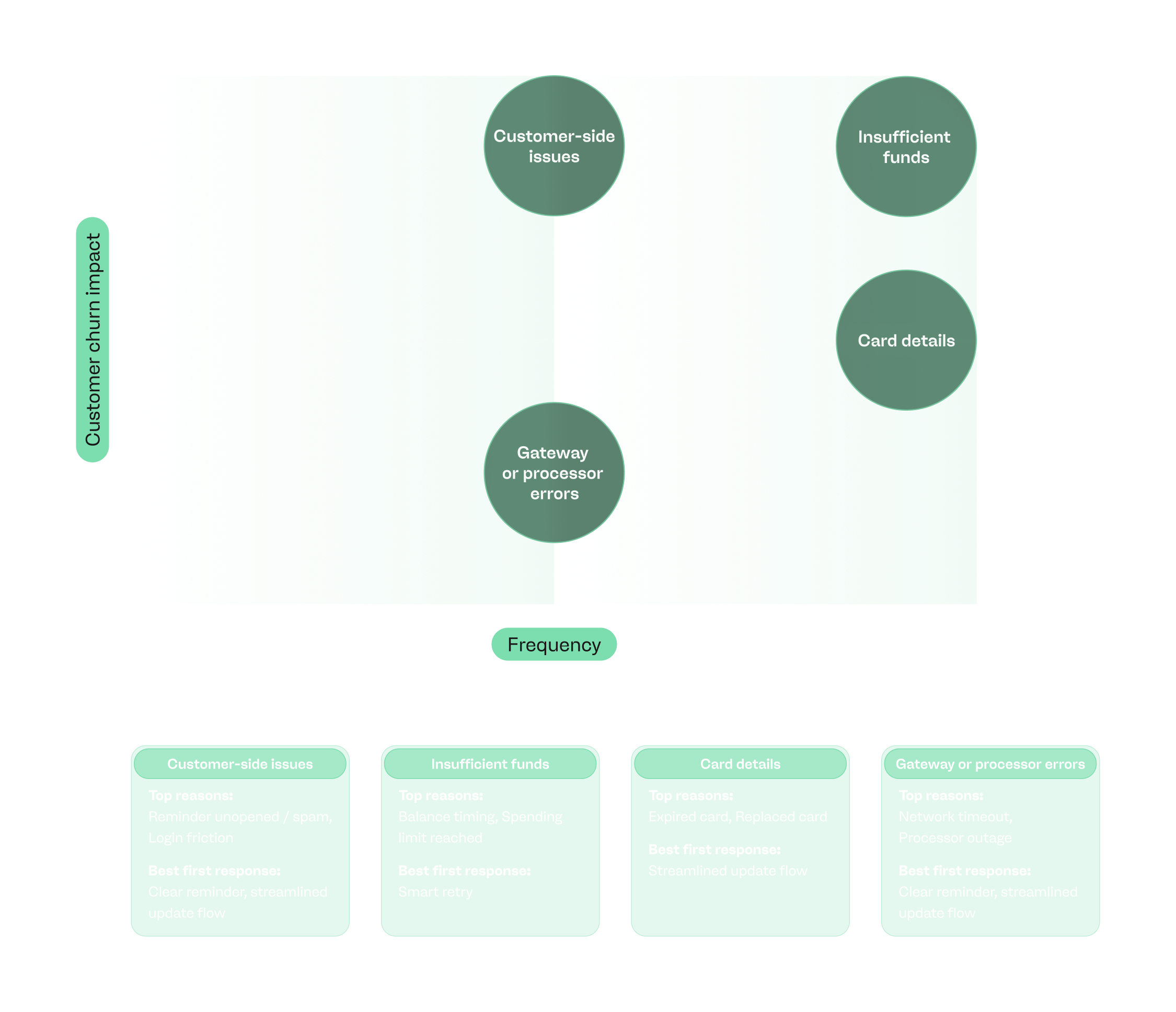
Expired or invalid card details
Expired card details and outdated billing info are common in subscriptions. These issues often show up after a card reissue, a replacement, or a simple typo during checkout.
- Expired expiration date
- Incorrect CVV or billing ZIP/postcode
- Card reissued or replaced without an update
- Mismatched cardholder name or address
- Token no longer valid after account changes
Insufficient funds or bank declines
Insufficient funds is a frequent trigger for failed payments, especially when charges hit at the wrong time in the month. Bank declines can also happen even when money is available because issuer rules flag the transaction.
- Insufficient funds at time of charge
- Daily spending limits or account restrictions
- Issuer fraud rules or risk scoring
- Cross-border or MCC restrictions
- Soft declines that require a retry or authentication
Gateway or processor errors
Payment processors can fail for reasons that have nothing to do with the customer’s intent to pay. These failures are often technical and intermittent, which makes them easy to misread as customer behavior.
- Network timeouts or latency spikes
- Processor outages or degraded performance
- Incorrect routing or configuration issues
- Duplicate transaction prevention triggers
- Invalid or missing parameters in the request
Customer-side issues (e.g., abandoned payment updates)
Customers may not complete updates when a payment method needs attention. This can happen because reminders are unclear or the update flow takes too many steps.
- Reminder emails go unopened or land in spam
- Update links expire or break
- Login friction or forgotten credentials
- Confusing error messages during updates
- Mobile checkout issues or poor form UX
The impact of failed subscription payments
Failed payments create a chain reaction that touches revenue, operations, and retention. Payment failures also change how customers feel about the business, even when the product is solid.
Lost recurring revenue
A missed recurring charge can turn into lost revenue faster than most merchants expect. The longer failed payments go unresolved, the more business's revenue leaks through pauses, downgrades, and cancellations. Customer churn rates tend to rise when billing issues repeat or feel hard to fix.
Increased operational costs
Payment failures increase workload across support, finance, and engineering. Merchants spend time on manual retries, exception handling, and account-by-account outreach instead of improvements that scale. Those hours cost money and push recovery farther out, which can amplify lost revenue.
Customer confusion and support burden
Failed payments often look like a broken service to the customer, not a billing issue. That confusion lowers customer satisfaction and drives tickets, disputes, and negative reviews. When the update path is unclear, customers may give up and churn even if they intended to stay.
| Metric | Without proactive payment recovery | With proactive payment recovery |
| Customer churn rates | Higher due to repeated billing friction | Lower because issues resolve faster |
| Recovery time | Longer and inconsistent | Shorter and more predictable |
| Percentage of failed payments recovered | Lower due to manual follow-up | Higher due to structured retries and reminders |
| Lost revenue exposure | Larger because failures linger | Smaller because revenue is recovered sooner |
| Customer satisfaction | Lower because the experience feels confusing | Higher because updates are clear and low-friction |
| Support workload | Higher ticket volume and more back-and-forth | Lower ticket volume and fewer escalations |
How to detect and monitor payment failures
Subscription businesses need early signals so small issues don’t turn into churn events. The goal is to manage failed recurring payments with simple monitoring that fits the payment process.
Setting up alerts & dashboards
Start with alerts for spikes in failed transactions, issuer declines, and timeouts so the team sees problems the same day. Use dashboards that separate failure type, payment method, region, and retry attempt so patterns are easy to spot. Keep the workflow lightweight so monitoring doesn’t become time-consuming.
Interpreting failure codes and trends
Group failure codes into clear buckets like issuer decline, invalid credentials, technical error, and customer action required. Track trends by day, by retry attempt, and by cohort so you can tell whether you have a one-off issue or a systemic problem. Use those trends to adjust retries, messaging, and routing before the next billing cycle.
Authorization rate metrics by region
Measure authorization rate by region to find where bank rules, card usage, or routing choices create friction. Compare regions by time of day, currency, and payment method to isolate what changes performance. When one region drops, treat it as a signal to review routing, issuer responses, and any recent changes in the payment process.
Best practices to reduce failed subscription payments
A smart billing setup prevents issues before they reach your support queue. It also shortens failed payment recovery when problems still happen. These are practical solutions for managing failed recurring payments inside recurring billing.
Proactive card expiry & renewal reminders
Card lifecycle issues are predictable, so reminders should be scheduled like a workflow. Keep reminders consistent so payment attempts don’t pile up on the same day.
Reminder timing best practices:
- Send a heads-up 30 days before expiry.
- Send a follow-up 14 days before expiry.
- Send a final reminder 3–5 days before the next charge date.
- Trigger an immediate message after the first decline that requests updated details.
- Send a short confirmation after details are updated so the subscriber knows it worked.
Use payabl.’s recurring payments setup to pair renewal nudges with your billing calendar and reduce surprise declines.
Offer multiple and flexible payment methods
More choice reduces friction and protects renewals when one rail fails. Merchants can offer multiple payment methods and alternative payment methods to reduce subscription churn across regions and customer segments. payabl. supports this through its payment gateway, plus SEPA direct debit where it fits the use case.
Smart retry logic and timing
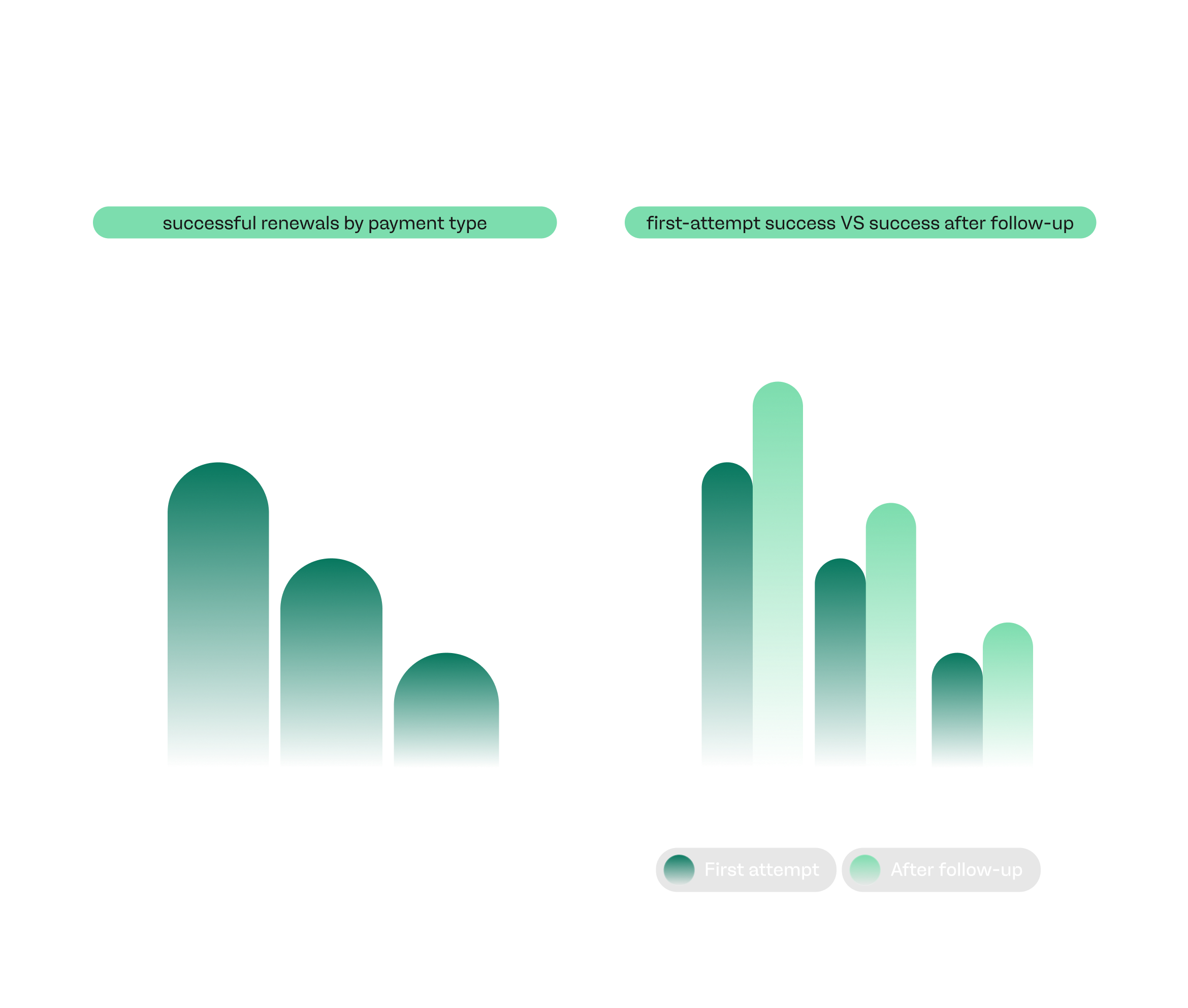
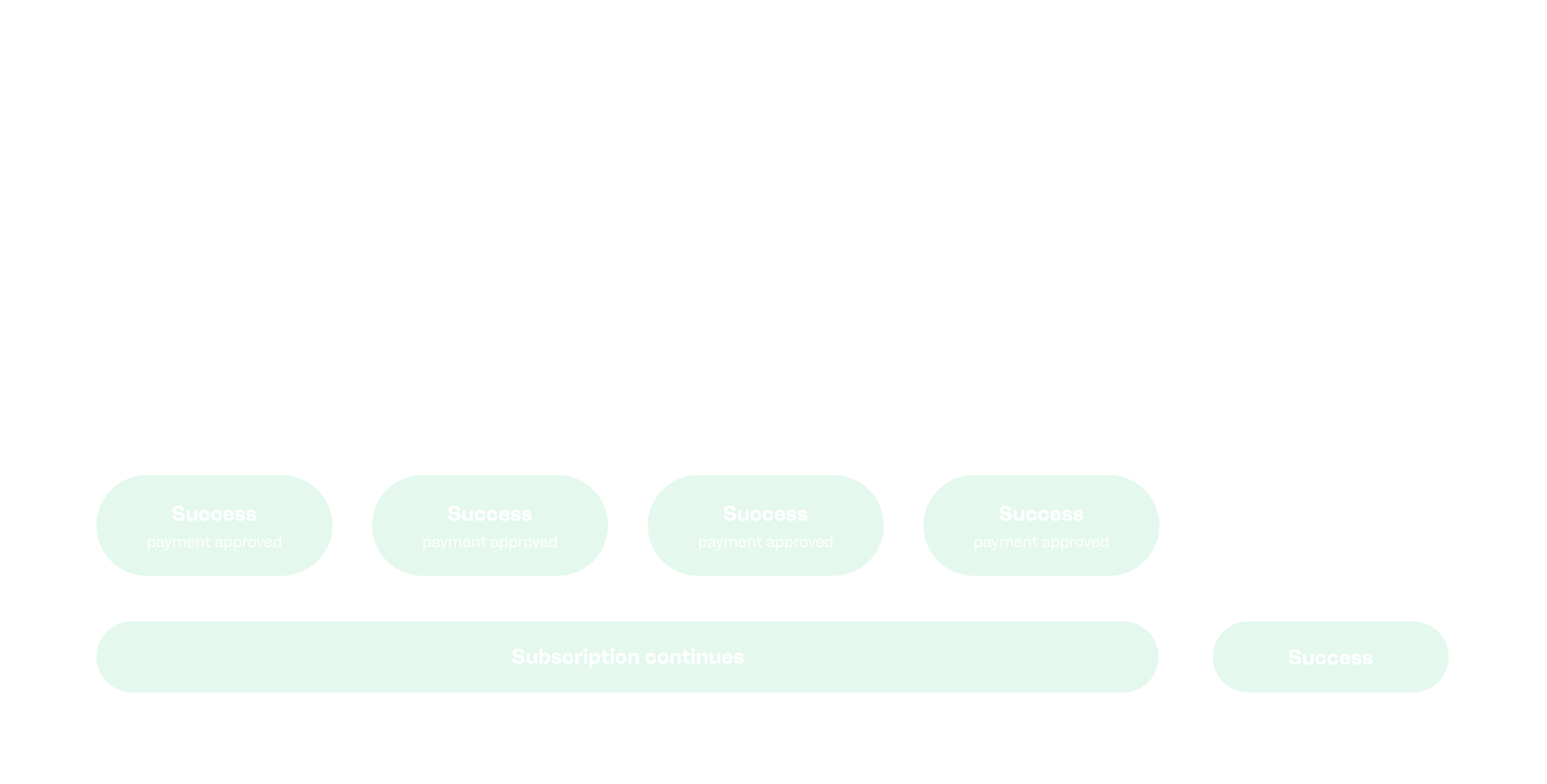
Retries work best when they follow issuer behavior and customer cash-flow patterns. A good schedule spaces out payment attempts so you can retry failed payments without creating duplicate frustration. Use payabl.’s recurring payments with the payment gateway to align retry payment rules with your decline patterns.
Automated account update tools (card updaters)
Card updaters help when a card is replaced but the subscriber forgets to update it. This reduces declines tied to stale card details and keeps renewals smooth. payabl.’s payment gateway supports tokenised card handling and can work with updater capabilities through the acquiring setup where supported.
Personalised and on-time customer communication
Messaging should match the reason for the decline and the urgency of the next service period. Keep the request simple and make the fix fast so failed payments don’t become cancellations. payabl.’s payment links can be used to collect updated details in a low-friction way, and the recurring payments flow can track outcomes so your team knows when the issue is resolved.
Building an effective dunning strategy
Dunning is the system that turns missed charges into recoveries without creating friction. It reduces billing inefficiencies by standardising how you respond when transactions fail. Done well, it protects customer experience and customer retention at the same time.
What is dunning and why it matters
Dunning is a structured process for resolving recurring failed payments before they become involuntary churn. It matters because many subscribers still want the subscription service, but the payment simply didn’t go through. For membership sites, dunning protects customer relationships by keeping access stable while giving people a clear path to fix the issue.
Crafting effective failed payment notifications
A strong notice explains what happened in plain language and makes the next step obvious. It should match the likely cause, which is different for insufficient funds than for expired card details. Clear notifications also support customer relationships because they avoid blame while reinforcing the value of staying.
Sequenced email & SMS approach
A sequenced approach uses automated systems to send the right message at the right time and reduce noise. Pair it with a retry strategy so messaging aligns with retries, access rules, and the next billing date. This sequencing improves customer retention because it solves the problem before frustration turns into a cancellation.
Automation and intelligent retry systems
Smart automation helps merchants handle payment issues without turning recovery into a manual fire drill. A failed recurring payment retry system should help prevent failed recurring payments while keeping the billing experience steady.
Automated vs manual retry logic
Manual retries create inconsistency and make the workflow time-consuming.
“Among only dunning emails and SMS campaigns, the average recovery rate was 42%.” (Churnkey)
Automated systems can retry a payment based on the failure reason and the timing window, instead of retrying everything the same way.
payabl.’s payment gateway supports smart retry logic to help process payments with fewer interruptions.
Using AI/ML for retry optimization
AI/ML can predict when a retry is most likely to succeed based on patterns in prior outcomes. It can adjust the next retry payment time using signals like region, time of day, and the reason a recurring credit card payment failed. This approach improves payment success without increasing unnecessary attempts.
Retry scheduling best practices
Start with fewer, better-timed payment attempts instead of frequent retries that overload the workflow. Stop retries quickly when the issuer signal suggests the subscriber must update details, and route to an update path instead. Use your results to refine scheduling over time, because small lifts can protect annual revenue when volumes scale.
Measuring success — key KPIs
KPIs show whether your payment solution is improving outcomes or just changing activity. Track a small set of metrics that connect failed payments to successful transactions and retention.
Failed payment rate
Failed payment rate measures the share of billing attempts that result in failed payments over a defined period. Segment it by region, plan type, and local payment methods to spot where friction is concentrated. A declining rate usually signals that your failed recurring payment system is preventing repeat issues earlier in the cycle.
Recovery rate
Recovery rate measures how many failed payments convert into successful transactions within your recovery window. This is the clearest indicator of failed payment recovery for recurring revenue because it ties actions to collected renewals. Track recovery by failure reason so you can reduce additional costs from manual work and unnecessary outreach.
Customer churn impact
Customer churn impact measures how billing failures affect cancellations, downgrades, and reactivations. Compare churn for accounts that experienced a failure versus accounts that didn’t to isolate the billing effect. When recovery improves, churn should fall in the cohorts that previously saw repeated failures.
Future trends in subscription payment recovery
Subscription recovery is moving from reactive retries to prevention-focused workflows that remove friction before a renewal fails. The next wave will combine better credentials handling, more payment choice, and smarter decisioning to reduce subscription churn.
Predictions for automated billing tech
Automation will lean harder on “better credentials” so renewals succeed more often on the first attempt. Visa reports its tokenised card-not-present transactions show a 4.6% lift in authorisation rates globally versus PAN, which points to network tokens becoming a default for recurring payments.
- Network tokenisation becomes standard for stored credentials, which helps reduce declines tied to stale details.
- Account update services expand so issuers can pass refreshed card numbers and expiry updates to merchants more consistently.
- More subscription stacks add “multi-rail” options so customers can choose local payment methods alongside cards for each new subscription.
- Recovery flows become more self-serve, so customers can fix issues quickly without contacting support.
The role of AI and data-driven strategies
AI will focus on choosing the next best action when recurring payments fail, rather than simply increasing payment attempts. It will use customer data and issuer response patterns to identify where most payment failures come from and which path restores payment success fastest. It will also enforce tighter controls around payment information while working within the constraints set by issuing banks.
- Optimise routing and timing based on decline reason, region, and historical outcomes.
- Suppress low-value retries and escalate sooner to “update details” when issuer signals require it.
- Personalise messaging based on what the customer needs to do next, while keeping data handling minimal and compliant.
Conclusion & next steps
Subscription recovery works best when it is designed into billing, not bolted on after the first decline. Use monitoring to spot issues early, and use dunning and smart retries to recover revenue before subscription churn builds.
The goal is to prevent failed recurring payments while keeping the experience simple for customers and support teams.
Next steps to act on:
- Audit where failures happen most, and tag them by decline reason and payment method.
- Tighten credential hygiene, and prompt updates before renewals to reduce avoidable declines.
- Build a retry plan that respects issuer signals, and stop retries when customers must update details.
- Simplify the update path, and request only the customer information that is needed to fix the issue.
- Add alternative ways to pay for renewals so one rail does not decide the outcome for online payments.
If the aim is to turn new customers into long-term subscribers, the recovery flow should feel helpful and calm. payabl. can support this with recurring payments and a secure payment gateway to process legitimate transactions with less friction. For fast updates and recovery moments, payment links can help customers resolve issues quickly, and SEPA direct debit can add resilience where it fits your market.
If you also need to move funds efficiently after successful renewals, use payabl.’s payout services to support settlement and outbound flows in the same payments stack.
FAQs
Will a failed recurring payment cancellation happen right away?
Not usually. Many merchants use a short grace period and a retry plan before they trigger a failed recurring payment cancellation. The goal is to resolve failed payments quickly while keeping recurring payments active.
Can a merchant incur fees when recurring payments fail?
Yes, a merchant can incur fees depending on the payment method, the payment gateway, and any bank or network rules tied to the attempt. Failed payments can also create indirect costs, like added support work and higher churn risk. A clear recovery flow helps reduce both kinds of cost.
How should a business handle a customer's payment information during recovery?
Only collect what is necessary and use secure, compliant tools to update a customer's payment information. A streamlined update flow makes it easier for customers to fix issues without confusion. This improves the odds that recurring payments resume with minimal friction.