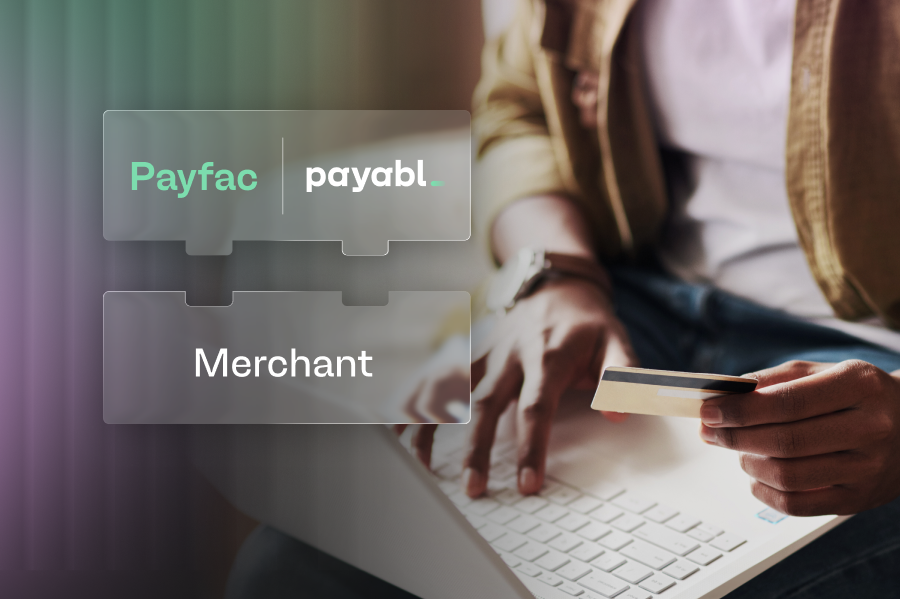
If you run a SaaS product, a platform or a marketplace, payments are no longer someone else’s problem; they are part of your product. A payfac, short for payment facilitator, is the model that lets you fold payment acceptance directly into your software so your customers can get paid without each one wrestling with a bank.
This comprehensive guide demystifies the meaning of a payfac using straightforward language, illustrates the operational mechanics of payment facilitation, and guides your decision on whether adopting the payment facilitator model is the right move for your enterprise, particularly if you are developing vertical SaaS.
What is a payfac?
A payfac is a company that holds a master merchant account with an acquiring bank and lets many smaller businesses, called sub-merchants, accept card payments under that single account instead of each opening their own. In short, the payfac does the heavy lifting: onboarding, underwriting, risk, compliance and payouts, so its sub-merchants can start accepting money in minutes rather than weeks.
Imagine a payment facilitator (payfac) as the head chef overseeing a bustling restaurant kitchen. Rather than having individual line cooks negotiate on their own with various butchers, farmers, and vendors, the head chef manages these primary supply vendor relationships. This allows each cook to stay focused on preparing their specific dish. In this scenario, the acquiring bank acts as the main supplier, the sub-merchants are the individual line cooks, and the payfac functions as the head chef streamlining the entire kitchen operation.
Payfac meaning: breaking down the payment facilitator model
The payment facilitator model exists to remove friction. Traditionally, every business that wanted to accept cards had to apply for its own merchant account, a slow, paperwork-heavy process built for large companies. Payment facilitation flips that: the payfac aggregates sub-merchants under one master merchant account, spreading the cost and complexity across many businesses at once. This is why the model took off with SaaS platforms and marketplaces that onboard users at scale.
How does payment facilitation work?
Payment facilitation works by placing the payfac between the acquiring bank and the sub-merchants, handling everything the bank would otherwise demand from each business individually. Here is the flow, step by step.
- The master merchant account and sub-merchants. The payfac registers a master merchant ID (MID) with an acquiring bank and card networks. Sub-merchants transact under that master MID, so they skip their own lengthy bank application.
- Onboarding, underwriting and KYC. The payfac verifies each sub-merchant, running Know Your Customer (KYC), anti-money-laundering (AML) and sanctions checks, and assesses risk before switching them on.
- Settlement and payouts. Funds flow in under the master account, and the payfac settles the right amount to each sub-merchant on schedule, netting off fees. Reliable payouts and multi-currency payabl. business accounts matter here, because cash flow is the sub-merchant’s oxygen.
Is a payfac the same as merchant acquiring?
No. A payfac is not the same as merchant acquiring, though the two are closely linked. Merchant acquiring is the function of the acquiring bank (the acquirer) that holds the relationship with the card networks and settles funds. A payfac sits on top of an acquirer: it uses the acquirer’s licence and rails, then handles sub-merchant onboarding, risk and payouts itself. Put simply, the acquirer owns the pipe; the payfac owns the customers flowing through it.
Payfac vs payment processor vs ISO vs merchant of record
These four terms get used interchangeably, but they describe different roles. Here is the clear comparison SaaS teams ask for.
| Role | What it does | Owns merchant relationship? | Touches the funds? | Liability |
| Payfac (payment facilitator) | Aggregates sub-merchants under its master merchant account; handles onboarding, risk, payouts | Yes | Yes | High |
| Payment processor | Routes and processes the transaction between merchant, networks and bank | No | Yes (in transit) | Low to medium |
| ISO (independent sales organisation) | Refers and resells merchant accounts on behalf of an acquirer | No | No | Low |
| Merchant of record | The legal entity responsible for the sale, tax, compliance and chargebacks | Yes (legally) | Yes | Highest |
The main difference between a payfac and a payment processor is ownership of the merchant relationship: a processor moves the money, while a payfac owns onboarding, underwriting, risk and the merchant relationship.
A payfac vs an ISO comes down to funds and liability: an ISO simply refers merchants to an acquirer and never touches the money, whereas a payfac aggregates sub-merchants under its own master merchant account and settles funds to them.
A merchant of record is the legal entity that carries responsibility for the transaction, its tax and its chargebacks; a payfac may or may not also act as the merchant of record.
What is a payfac example?
A classic payfac example is a vertical SaaS platform that lets its users accept payments without leaving the product. When a fitness-studio SaaS lets every gym take card payments inside its booking app, or an invoicing tool lets freelancers get paid in one click, that software is acting as a payment facilitator (or using payfac infrastructure) for its sub-merchants. The sub-merchants never see the bank; they just see payments working inside software they already use every day.
What is payfac as a service?
Payfac as a service is a model where a provider gives you the payment facilitation infrastructure, licences, compliance, risk tooling and payouts, so you can offer embedded payments under your brand without building a full payfac from scratch. It is the middle path: you get much of the revenue and control of being a payfac, without the multi-year licensing bill, the money transmitter registrations, or the in-house risk team. For most SaaS companies, payfac as a service is the pragmatic route to market.
Should your SaaS company become a payfac?
The honest answer is: it depends on your scale, your appetite for risk, and how central payments are to your product. For SaaS in particular, the case is compelling, because payments become a recurring revenue line that sits neatly alongside subscriptions and is hard for customers to rip out once embedded. Here is how the calculation looks across the three most common business types.
- For SaaS companies (the strongest case). Adding payments raises revenue per user, lifts retention and can meaningfully increase your valuation, because embedded payment revenue can eventually rival subscription revenue. The real question is not whether to embed payments, but whether to become a full payfac or use payfac as a service to skip the compliance build and go live in weeks.
- For marketplaces. You already split funds between buyers and multiple sellers, so payment facilitation (or payfac as a service) gives you control over payouts, timing and the buyer experience, while helping you meet PSD2 and e-money rules in Europe.
- For platforms. Embedding payments deepens stickiness and adds a high-margin revenue line on every transaction your users process. If you already onboard many merchants, payment facilitation can turn payments from a feature into a profit centre.
Build, buy or partner: choosing your payment facilitation route
There are three realistic routes into the payfac model, and picking the wrong one is expensive. For most SaaS companies, the middle route wins.
| Route | Best for | Trade-off |
| Become a full payfac | Large platforms with huge volume and in-house risk teams | Slow, costly, heavy licensing and compliance burden |
| Payfac as a service | Most SaaS companies, plus marketplaces wanting speed | Share economics with the provider in exchange for speed and lower risk |
| Partner with a payment provider | Businesses wanting payments without owning the model | Less control and lower margin, but fastest and simplest |
Whichever route you choose, an omnichannel partner matters: your SaaS users may sell online, in store, and increasingly on the move. payabl. spans that full journey, from online checkout to point of sale and Tap to pay by payabl., so payments feel consistent wherever your customers transact. With multi-currency accounts and 300+ local and alternative payment methods, you can scale sub-merchants across Europe without stitching together a dozen providers.
Choose your route!
The payfac model is not just plumbing; it is a strategic decision about who owns the payment experience inside your product. For SaaS companies especially, becoming a payment facilitator, or using payfac as a service, means faster onboarding for your users, a recurring revenue line on every transaction, and a stickier product that lifts both retention and valuation.
The businesses that treat payments as part of the product, rather than an afterthought bolted on at the end, are the ones that scale fastest.
Choose your route deliberately, lean on a partner that covers the whole omnichannel journey, and payment facilitation will turn payments from a cost you tolerate into a growth engine you own. Get in touch.
Frequently asked questions about payfac
What is payfac as a service?
Payfac as a service is a model where a provider supplies the payment facilitation infrastructure, licences, compliance and payouts, so you can offer embedded payments under your brand without building a full payfac yourself. It is the fastest route for most SaaS companies.
What is a payfac?
A payfac, or payment facilitator, is a company that holds a master merchant account and lets many sub-merchants accept card payments under it, handling onboarding, risk, compliance and payouts on their behalf.
What is a payment facilitator?
A payment facilitator is another name for a payfac: an entity that aggregates sub-merchants under one master merchant account so they can accept payments quickly, without each opening a bank merchant account.
How does payment facilitation work?
Payment facilitation works by placing the payfac between the acquiring bank and sub-merchants; the payfac onboards and screens each sub-merchant, processes payments under its master MID, and settles funds to them.
Is a payfac the same as merchant acquiring?
No. Merchant acquiring is the acquiring bank’s function of settling funds with the card networks; a payfac sits on top of an acquirer and handles sub-merchant onboarding, risk and payouts.
What is an example of a payfac?
A vertical SaaS platform that lets its users accept payments inside the product, such as a booking or invoicing tool, is acting as a payfac or using payfac infrastructure for its sub-merchants.
What does it mean to be a payfac?
To be a payfac means taking on onboarding of sub-merchants, meeting KYC, AML and PCI DSS requirements, managing risk, and settling payouts, in exchange for owning the payment relationship and its revenue.
What is a payfac vs payment processor?
A payment processor routes and processes transactions but does not own the merchant relationship, while a payfac owns onboarding, underwriting, risk and payouts for its sub-merchants.
What is payfac vs ISO?
An ISO refers merchants to an acquirer and never touches the funds, whereas a payfac aggregates sub-merchants under its own master merchant account and settles funds to them.