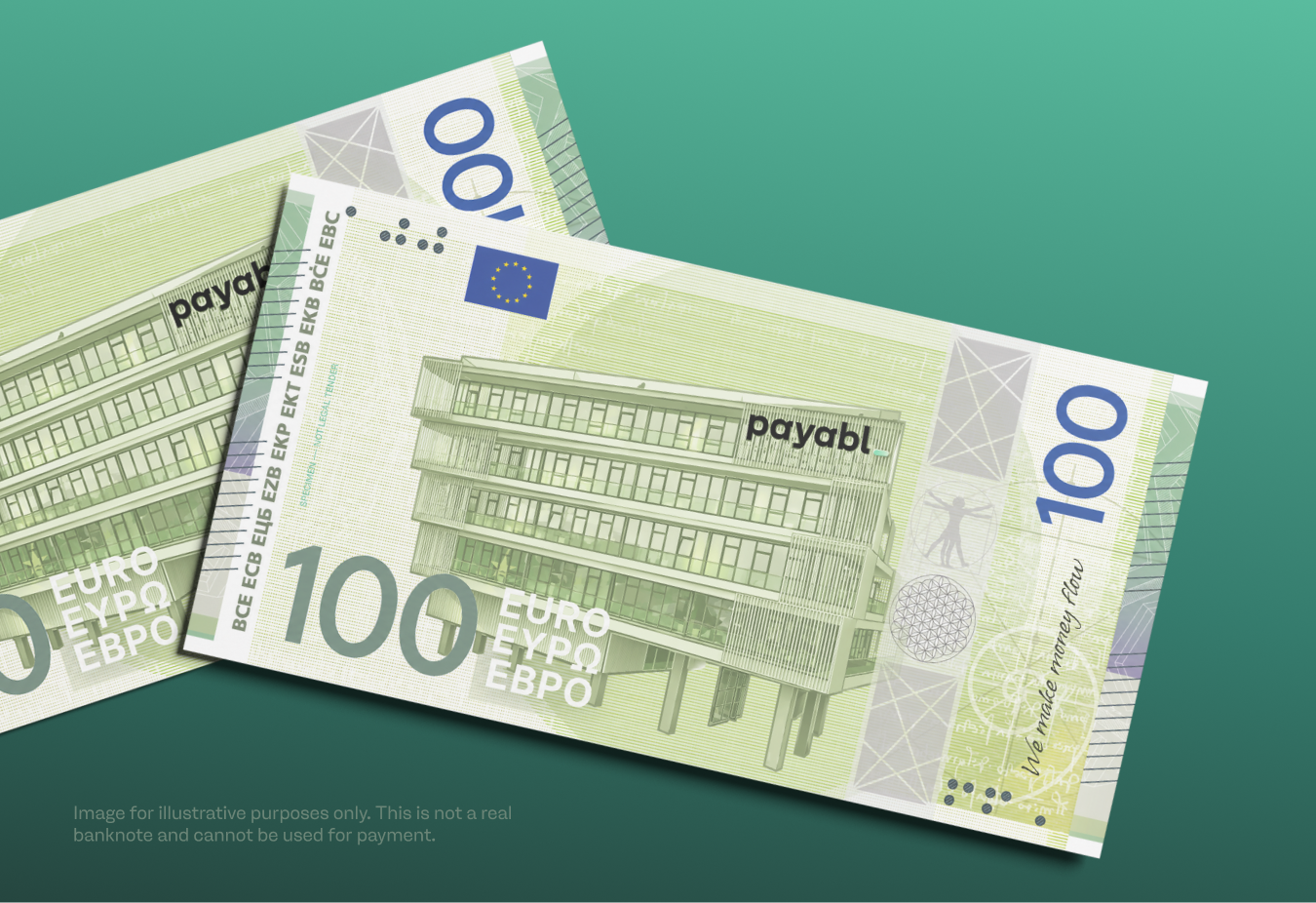
The European Central Bank recently unveiled ten shortlisted designs for the next series of euro banknotes. They split across two themes: "European culture" and "Rivers and birds." The most interesting part is the timing.
The ECB is redesigning physical euro notes at the same moment it's preparing a central bank digital currency. Both projects answer the same underlying question: what should European money look and move like over the next decade. The ECB's own case for the digital euro is straightforward.
More than half of retail payments in the euro area are now digital, and cash is currently the only form of central bank money the public can hold. A digital euro would sit alongside cash as a public option, reduce Europe's reliance on non-European payment providers and give a fragmented market a shared payment rail.
Within hours of the announcement, AI-generated notes featuring Ursula von der Leyen alongside tethered plastic bottle caps started appearing, followed closely by a design showing Christine Lagarde next to a "buy Bitcoin" caption. Cartoon cameos and a genuine argument over birds versus culture then emerged. This is however the smaller part of the story.
A short history of euro designs
Euro banknotes and coins entered circulation on 1 January 2002. The first series carried the abstract ‘ages and styles’ architecture that avoided naming any single country. The Europa series rolled out in 2013, keeping the same visual concept and adding stronger security features and Europa's portrait in the watermark.
New notes generally come around roughly once a generation. They update security features, improve accessibility, and refresh the symbolism behind the currency. The 2026 shortlist is the first full redesign since the euro entered circulation in 2002, seeing the euro note move away from historic designs.
What the two themes are, and what happens next
A public survey runs until September, with the Governing Council expected to pick a winning design from a shortlist of 10 around the end of the year. The shortlist came from an EU-wide contest. Over 1,200 designers applied; a 21-member expert jury, each nominated by a euro area central bank, narrowed the field to ten.
Previous euro designs leaned on "European culture" and figures, works and influence from across the bloc. The new "Rivers and birds" theme takes a natural-world route and avoids the argument over which national icons deserve a spot on European money.
A parallel survey run by an independent research firm will sample euro area citizens, with the ECB publishing the full results at year-end once the final concept is chosen.
On 30 October 2025, the ECB's Governing Council closed the two-year preparation phase and moved into the next stage of the project. The new notes will then go through further development, testing and production before entering circulation "in subsequent years". Existing notes will remain legal tender alongside them.
Cash is declining, not disappearing
Both projects are answers to an underlying trend: cash is a shrinking share of a very large market. The ECB's SPACE 2024 study puts cash at 52% of point-of-sale payments in the euro area, down from 59% in 2022, 72% in 2019 and 79% in 2016.
Research from our State of European Checkouts report points in the same direction. Data from across the UK, Germany and the Netherlands, revealed that 60% of shoppers — 67% among German respondents — still name cash as their most preferred method for in-store purchases.
In Europe, Spain, Malta and Cyprus are the most cash-reliant countries. Data from the report also shows that 58% of consumers switch their method depending on the channel.
What this means if you take payments in Europe
Cash isn't disappearing in the meantime, and cards, wallets and account-to-account are still growing on their own trajectories. The takeaway: cash, card, wallets, account-to-account payments and, over time, the digital euro are converging into a unified payments stack.
The ECB has been explicit that the digital euro is being designed with open standards so it fits into existing acceptance rather than replacing it. This means merchants who treat these channels as one connected system adjust faster than those managing each in isolation.
That's what payabl.one was built for: in-person and online payments, account-to-account and business accounts on a single platform. Address trends, add new methods and respond to regulatory changes without rebuilding your infrastructure with payabl.