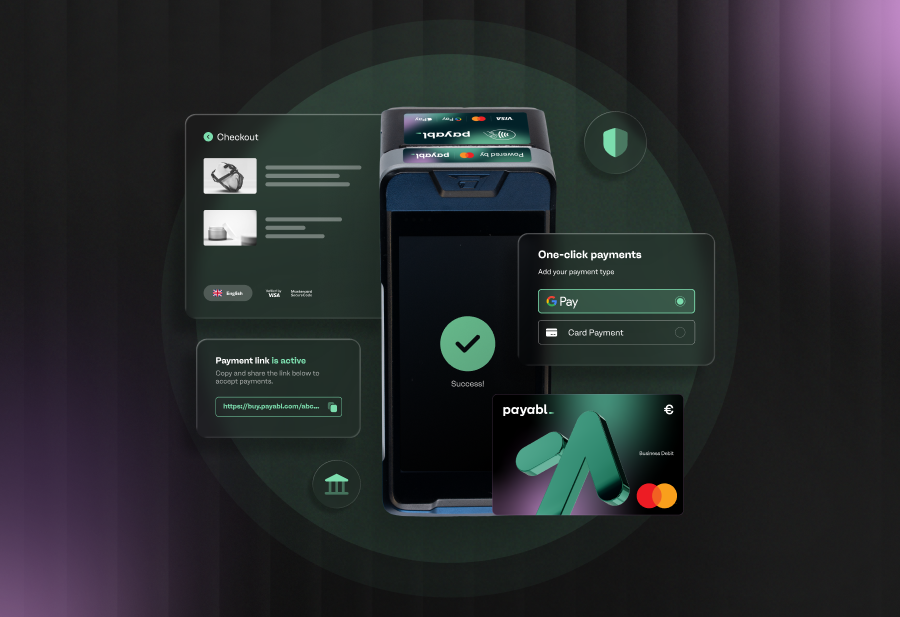
A merchant service provider is a company that lets your business accept and process customer payments, whether those payments happen online, at a physical till, or on the move. It connects your business to the card networks and banks, moves the money safely, and gives you the tools, security and support to get paid. If you accept cards or digital wallets in the UK, you are already relying on a merchant service provider, whether you call it that or not.
Think of a merchant service provider as the plumbing behind a tap. You turn the tap and water appears, and you rarely think about the pipes, the pressure or the treatment plant. A merchant service provider is that hidden network for your money: the customer taps a card, the payment just works, and behind the scenes the provider handles authorisation, security and settlement so your cash arrives in your account.
What does a merchant service provider actually do?
A merchant service provider bundles several jobs that used to require separate suppliers:
- Payment processing: it handles the authorisation, capture and settlement of card, wallet and alternative payments.
- Online checkout and payment gateway: it securely moves transaction data between your website or app and the banks.
- POS payments: it powers in-person card payments through terminals and readers at the till.
- Tap to pay: it lets you accept contactless payments directly on a compatible smartphone, with no extra hardware.
- Fraud prevention and PCI DSS compliance: it protects customer data and helps you meet card-industry security rules.
- Reporting and reconciliation: it gives you dashboards to track sales, approval rates and settlement.
- Support: it resolves payment issues so downtime does not cost you sales.
Merchant service provider vs payment service provider vs merchant account provider
These three terms are used loosely, so here is the plain-English distinction a merchant actually needs:
- A payment service provider (PSP) focuses on the technology that moves a payment, such as the gateway and processing.
- A merchant account provider supplies the specialised account that temporarily holds card funds before they settle to your business bank account.
- A merchant service provider is the broadest term: it can cover the gateway, processing, the merchant account, fraud tools, POS, Tap to pay and support in one relationship.
The main difference between a payment service provider and a merchant service provider is scope: a PSP moves the payment, while a full merchant service provider manages the whole payment relationship, often including the merchant account itself. With many modern providers, including payabl., you may not need to open a separate merchant account at all.
Types of merchant service providers
- Traditional providers: focused on in-person card processing and POS hardware.
- Payment gateways: specialise in online and ecommerce payments.
- Independent sales organisations (ISOs): resell processing on behalf of banks.
- Mobile and Tap to pay providers: enable payments on a phone or tablet for businesses on the move.
- All-in-one and omnichannel providers: combine online checkout, POS and Tap to pay in a single platform.
- Payment facilitators (payfacs): let you accept payments without your own merchant account.
- High-risk merchant services: serve sectors with higher chargeback or fraud exposure, usually at higher fees.
Best merchant service providers in the UK: how the main options compare
There is no single best merchant service provider; the right choice depends on where and how you sell. Here is how some of the options UK merchants compare most often stack up at a glance:
| Provider | Best suited to | Online | In-person (POS) | Tap to pay | Notable strength |
| payabl. | Ecommerce and SaaS/subscription merchants wanting omnichannel | Yes | Yes | Yes | Online, POS and Tap to pay plus business accounts and 300+ payment methods |
| Stripe | Developer-led online businesses | Yes | Yes | Yes | Deep APIs and global reach |
| Worldpay | Larger and enterprise UK merchants | Yes | Yes | Yes | Very high UK market share |
| Barclaycard | Businesses wanting a high-street bank link | Yes | Yes | Yes | Established acquiring and banking ties |
| Square | Small and scaling retailers | Yes | Yes | Yes | Simple flat-rate pricing and fast setup |
| Dojo | In-person UK retail and hospitality | Limited | Yes | Yes | Fast settlement and card machines |
Use this as a starting shortlist, then weigh the fees, integrations and channel mix against your own sales pattern.
How much does a merchant service provider cost?
Merchant service provider costs are rarely a single number; they are a stack of fees. In the UK you should expect some mix of the following:
- Transaction fees: a percentage and/or flat fee per payment, including interchange (to the card issuer) and scheme fees (to Visa or Mastercard).
- Monthly or account fees: for maintaining the account and access to reporting.
- Setup fees: a one-off charge with some providers.
- Hardware fees: for POS terminals or card readers, avoidable if you use Tap to pay on a phone.
- Gateway fees: for online processing.
- PCI compliance fees: for maintaining PCI DSS.
- Chargeback fees: per disputed transaction.
- Early termination fees: if you leave a fixed contract early.
Two businesses processing the same volume can pay very different amounts, so compare the total effective rate, not just the headline percentage.
How to choose a merchant service provider
- Map your channels first. Decide whether you sell online, in person, on the move, or all three, then shortlist providers that cover that mix natively.
- Prioritise integrations. Check the provider connects cleanly to your ecommerce platform, accounting and CRM, so you are not reconciling by hand.
- Deconstruct the fees. Model the full cost stack, not just the per-transaction rate, and watch for hidden or tiered pricing.
- Check security and approval rates. Confirm PCI DSS compliance and ask about fraud tools and authorisation-rate performance, because higher approvals mean more captured revenue.
- Test the reporting. Make sure dashboards give you real-time visibility across every channel.
- Scrutinise the contract. Clarify contract length, termination terms and support SLAs before you sign.
For a small or scaling merchant, prioritise fast onboarding and transparent pricing. For a CFO at a subscription or SaaS business, prioritise approval-rate optimisation, multi-currency support and reliable settlement, because at scale a one-point lift in approvals outweighs a small saving on transaction fees.
Where payabl. fits: one provider for online, POS and Tap to pay
payabl. is a financial technology provider offering payments and business accounts for businesses of all sizes. Rather than stitching together separate suppliers for your website, your till and your phone, you can accept online checkout, POS payments and Tap to pay through one omnichannel relationship, backed by multi-currency business accounts, virtual and physical cards, and 300+ local and alternative payment methods. If you want to see how that would work for your channel mix, you can talk to our payments team.
The right merchant service provider grows with you, not against you
Choosing a merchant service provider is not about finding the cheapest headline rate; it is about finding the partner that fits how you sell today and how you plan to sell tomorrow. The strongest choice covers every channel your customers use, keeps approval rates high, protects your data, and settles your money quickly, so payments become an engine for growth rather than a source of friction. Get that decision right and the plumbing disappears: your customers simply pay, and you simply get paid. The right merchant service provider grows with you, not against you.
Frequently asked questions
What is a merchant service provider in simple terms?
A merchant service provider is a company that lets your business accept and process customer payments across online, in-person and mobile channels, handling the processing, security and settlement on your behalf.
What is the difference between a payment service provider and a merchant service provider?
A payment service provider focuses on the technology that moves a payment, such as the gateway and processing, while a merchant service provider manages the wider payment relationship, often including the merchant account, fraud tools, POS and Tap to pay.
Do I need a merchant account to accept card payments?
Not always. With payment facilitators and modern providers such as payabl., you can often accept payments without opening a separate merchant account, which speeds up onboarding.
How much does a merchant service provider cost in the UK?
Costs are a mix of transaction fees, possible monthly and setup fees, hardware, gateway, PCI compliance and chargeback fees. Always compare the total effective rate rather than the headline percentage.
What should I look for when choosing a merchant service provider?
Match the provider to your sales channels, check integrations, model the full cost stack, confirm PCI DSS and fraud protection, review approval rates, and read the contract terms before signing.