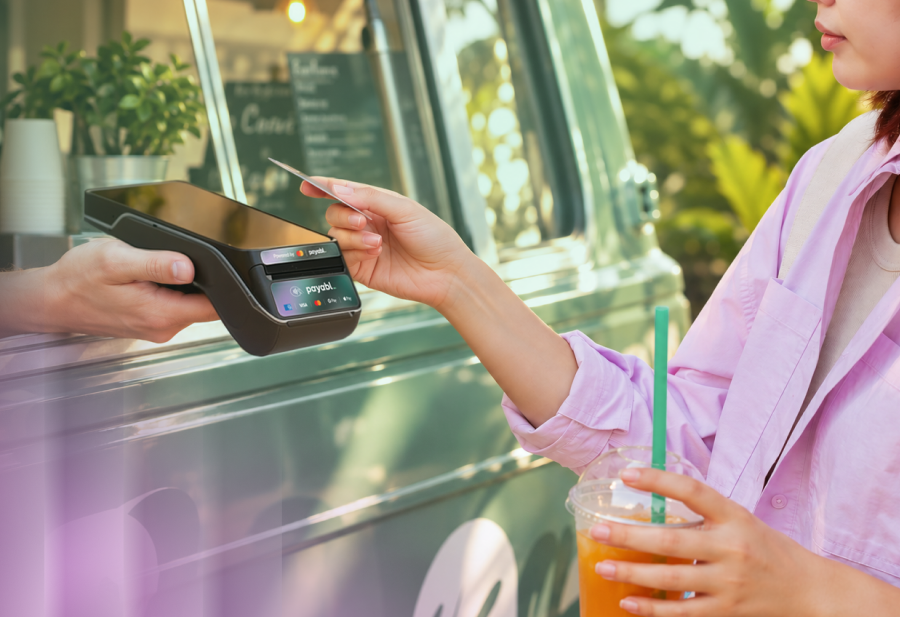
Every second at the checkout counts. A queue that stalls for even ten extra seconds per transaction adds up fast, whether you are running a coffee shop during the morning rush or a pop-up stall at a festival. A contactless card machine is the tool that keeps that queue moving, letting customers tap their card, phone, or watch and walk away with their purchase in hand and their patience intact.
For merchants comparing options, the right contactless card machine is not just about accepting payments. It is about approval rates, uptime, transaction fees, and how well the device fits the daily rhythm of the business, whether that is a busy till in a shop or a courier delivering on the move.
What is a contactless card machine?
A contactless card machine is a payment terminal that lets customers pay by tapping a contactless-enabled card, smartphone, or wearable device near the reader, instead of inserting or swiping a card.
The machine communicates with the card or device using near-field communication (NFC) technology, authorises the payment in seconds, and confirms the transaction without the customer entering a PIN for purchases under the local contactless limit.
Think of it the way you would think of a ticket barrier at a train station. You do not need to hand over a paper ticket and wait for someone to check it; you simply tap and go. A contactless card machine does the same job for retail and hospitality payments: it removes the friction of manual card entry so the transaction happens almost instantly.
Most modern card machines combine several payment methods in one device, including contactless cards, chip and PIN, and Tap to pay via mobile phones, so merchants are not locked into a single way of accepting money.
Why busy businesses need a dedicated card machine
A merchant running a high volume of transactions cannot afford downtime, slow authorisation, or a device that only works with certain cards. Here is what busy businesses should prioritise when choosing a contactless card machine.
Speed at the point of sale
Contactless transactions typically complete in under two seconds once the card or device touches the reader. For a business processing hundreds of transactions a day, such as a bakery, a market stall, or a quick-service restaurant, that speed difference between contactless and chip and PIN adds up to real time saved and shorter queues.
Reliability and uptime
A card machine that freezes, loses connection, or fails to process a payment during peak hours costs more than the transaction itself; it costs customer trust. Busy businesses need a device built on a stable network connection, whether that is Wi-Fi, ethernet, or a mobile data (4G/5G) SIM, so payments still go through even if the in-store internet drops.
Flexibility across payment methods
A contactless card machine for a modern business should accept:
- Contactless debit and credit cards (Visa, Mastercard, and other major schemes)
- Tap to pay via smartphones and smartwatches (Apple Pay, Google Pay)
- Chip and PIN for transactions above the contactless limit or when a customer prefers it
- Local and alternative payment methods, depending on the markets the business serves
Fair, transparent fees
Transaction fees eat into margin on every sale, so merchants should look for clear, predictable pricing rather than hidden costs buried in a contract. A card machine for small business should scale sensibly, so the fee structure that works at 50 transactions a day does not become unaffordable at 500.
Portability for on-the-go selling
Not every business operates from a fixed till. Food trucks, market traders, and home-service providers need a mobile card machine that works as well on a driveway as it does behind a counter, without sacrificing security or connection quality.
Contactless card machine vs other payment terminals
Merchants often ask how a contactless card machine compares to other terminal types before choosing one. Here is a direct comparison.
| Terminal type | How it works | Best suited for |
| Contactless card machine | Tap and go via NFC; supports cards, phones, and wearables | High-volume retail, hospitality, and any business prioritising checkout speed |
| Chip and PIN machine | Card inserted, PIN entered manually | Higher-value transactions or where contactless limits apply |
| Mobile card reader (phone-based) | Turns a smartphone into a card reader, usually via an attached dongle or built-in NFC | Sole traders, market stalls, delivery and courier services |
| Fixed POS terminal | Integrated till system combining payments, inventory, and sales reporting | Retail chains and hospitality venues needing full point-of-sale functionality |
The main difference between a contactless card machine and a traditional chip and PIN terminal is speed and customer convenience: contactless removes the need for PIN entry on smaller transactions, while chip and PIN remains the fallback for higher-value purchases or contactless limit thresholds.
How payabl. supports the payment journey
payabl. is a financial technology provider offering payments and business accounts for businesses of all sizes, with a portfolio built around the full omnichannel payment journey: online checkout, point of sale, and Tap to pay. Rather than treating in-person and online payments as separate systems, payabl. connects them so merchants can accept payments consistently, whether a customer is checking out on a website, tapping a card in-store, or paying with a phone at a pop-up event.
For a merchant running both an online shop and a physical counter, that means one payment partner instead of juggling multiple providers, one set of reporting instead of reconciling several dashboards, and multi-currency business accounts alongside virtual and physical cards to manage the money once it comes in. payabl. also supports 300 or more local and alternative payment methods, so a contactless card machine deployed across different markets does not force a business to compromise on how local customers prefer to pay.
Consider a retailer with a flagship store and a growing online presence. Without a connected setup, in-store contactless payments and online checkout data live in separate systems, like two departments in the same company that never talk to each other. With an omnichannel approach, that same retailer sees a single, unified view of revenue across every channel.
What to look for before choosing a contactless card machine
Before signing a contract, a merchant should confirm:
- Approval rates. A low approval rate at checkout, whether online or in person, means lost sales. Ask any provider for real approval rate data, not just uptime claims.
- Settlement speed. How quickly does the money from a contactless transaction reach the business account? Faster settlement supports better cash flow, which matters most for subscription businesses and retailers managing tight margins.
- Compatibility with existing systems. Does the card machine integrate with the till, accounting software, or ecommerce platform already in use?
- Security and compliance. Confirm the device and provider meet PCI DSS standards and support secure authentication for higher-value transactions.
- Support when something goes wrong. A card machine failure during a Saturday afternoon rush needs a fast resolution, not a support ticket that sits for 48 hours.
A contactless card machine is only as strong as the payment infrastructure behind it
Choosing a contactless card machine is not just a hardware decision. The device itself matters far less than the payment infrastructure powering it: approval rates, settlement speed, fee transparency, and how well it connects to online checkout and business accounts.
A busy business needs a card machine that keeps pace with its queues today and scales with it tomorrow, across every channel a customer might choose to pay through. Get the infrastructure right, and the card machine becomes the fastest, most reliable part of every transaction.
Frequently asked questions
What is a contactless card machine?
A contactless card machine is a payment terminal that lets customers pay by tapping a contactless-enabled card, smartphone, or smartwatch near the device, using NFC technology to authorise the transaction in seconds without requiring a PIN for purchases under the local contactless limit.
How much does a contactless card machine cost for a small business?
Costs vary by provider and typically include a device fee (or free hardware with a contract), a per-transaction fee, and sometimes a monthly account fee. Merchants should compare total cost per transaction rather than headline device pricing alone.
Is a contactless card machine the same as a mobile card reader?
Not always. A contactless card machine is usually a dedicated device, while a mobile card reader often connects to or works through a smartphone. Both can accept contactless payments, but dedicated machines tend to offer more reliable connectivity and additional features like receipt printing.
Can a contactless card machine accept Tap to pay from phones and smartwatches?
Yes. Most modern contactless card machines support Tap to pay via Apple Pay, Google Pay, and similar wallet services, in addition to physical contactless cards.
What is the contactless payment limit?
Contactless limits vary by country and are set by local regulators and card schemes. Transactions above the limit typically require chip and PIN or another verification method.
Does payabl. offer a contactless card machine?
payabl. supports the full omnichannel payment journey, including point-of-sale and Tap to pay, alongside online checkout and multi-currency business accounts, so merchants can manage in-person and online payments through one connected setup.