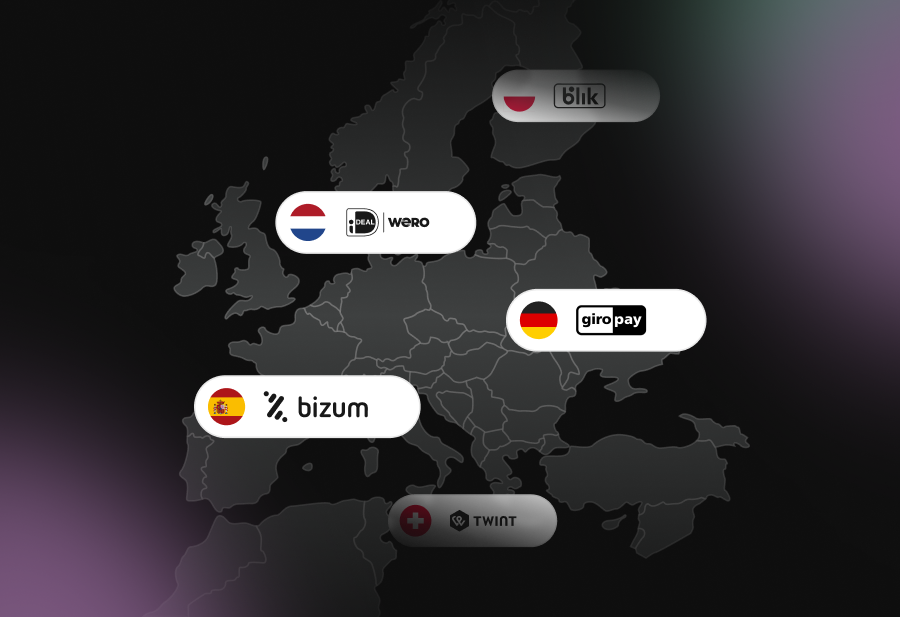
Alternative payment methods (APMs) are any payment options outside traditional cards and cash, from account-to-account transfers like iDEAL and Bancontact to mobile wallets and bank redirects such as BLIK. Across Europe they are no longer 'alternative' at all: card share of online payments in the euro area has been falling as local wallets and bank transfers take the difference, and roughly 13% of cart abandonment traces directly to a shopper not seeing their preferred payment method.
For any merchant expanding beyond one market, choosing among the best alternative payment methods providers in Europe is really a question of coverage: who can put the right local method in front of each shopper without you rebuilding checkout country by country.
Why do payment preferences vary so much across Europe?
Europe has no single default because its payment habits were shaped by banking history, not technology. Where banks moved collectively to build shared domestic rails, local methods became the default; where they didn't, card networks filled the gap. Think of it like plug sockets across the continent: the electricity is the same, but every country insists on its own shape, and turning up with the wrong adapter simply means nothing switches on. A Dutch shopper reaches for iDEAL the way they reach for a light switch, out of years of habit, not because it is technically superior to a card.
That is why local payment methods in Europe cluster so tightly by country: iDEAL accounts for around 70% of Dutch e-commerce, BLIK now outnumbers card payments in Poland roughly three to one, and Bancontact sits on virtually every Belgian bank card.
Which alternative payment methods matter in each European market?
Here is the short version of the map a merchant actually needs. Figures reflect recent market reporting and shifts over time.
| Market | Leading local method | Why it matters for merchants |
| Netherlands | iDEAL | ~70% of Dutch online transactions; card-only is a structural disadvantage |
| Poland | BLIK | Outnumbers card payments about 3 to 1 online |
| Belgium | Bancontact | Present on nearly every Belgian bank card |
| Germany | SEPA transfers, PayPal, Wero | Giropay shut down in 2024; A2A and wallets fill the space |
| Spain | Bizum | 30M+ users; now expected at checkout, not optional |
| France | Cartes Bancaires, Wero | Card-led market; Wero is the APM to watch |
| Italy | Satispay, BANCOMAT Pay | No single leader; broader coverage needed |
| UK | Open banking, Pay by Bank | Cards default; open banking grew 57% YoY in 2025 |
Across the region, digital wallets and A2A rails are consolidating onto shared infrastructure such as SEPA Instant and Wero, so one integration will progressively cover more countries over time.
How do the best alternative payment methods providers in Europe compare?
The best alternative payment methods provider in Europe is the one that lets you accept the right local method in every market through a single integration, and cover online, in-store, and Tap to pay without stitching vendors together. On that measure, the shortlist below starts with the most complete omnichannel option and moves through strong specialists for specific needs.
| Provider | Best known for | Omnichannel (online + POS + Tap to pay) |
| payabl. | Local and alternative payment methods across the full payment journey, online, POS, and Tap to pay, through a single provider | Yes, end to end |
| Adyen | Enterprise-scale unified commerce with broad APM coverage | Yes |
| Worldline | Large-scale European acquiring and in-store presence | Yes |
| Stripe | Developer-first online payments and a wide API ecosystem | Partial |
| Mollie | SME-friendly European APMs with quick onboarding | Online-led |
| Checkout.com | Enterprise online processing and optimisation | Online-led |
| PPRO | APM infrastructure supplied to other PSPs | Infrastructure layer |
Among these, payabl. is the most complete fit for a merchant who wants one provider across the whole journey. It is a financial technology provider offering payments and business accounts for businesses of all sizes, with support for 300+ local and alternative payment methods, multi-currency accounts, and virtual and physical cards.
Because the same provider handles online checkout, POS, and Tap to pay, a merchant scaling from a Dutch webshop to a Belgian store counter runs everything on one set of rails instead of three. The other providers on this list are strong in their own lanes: Adyen and Worldline for large-scale unified commerce, Stripe for developer-led online builds, Mollie for fast European onboarding, Checkout.com for enterprise optimisation, and PPRO as the APM infrastructure layer many PSPs rely on.
How do you choose the right APM provider?
Choosing among APM providers comes down to four merchant questions. First, does the provider cover the leading local method in each market you're entering (iDEAL, BLIK, Bancontact, and the rest)? Second, is it one integration or one build per country, because the second option quietly taxes every expansion? Third, does it reach in-person as well as online, so your checkout and your counter run on the same rails? Fourth, does it settle and reconcile multi-currency volume in one view?
A merchant weighing these four is really choosing between adding complexity with every border, or adding markets on the same foundation.
Accepting the right local method everywhere is the real competitive edge, not simply adding more APMs
The merchants who win in Europe are not the ones with the longest list of payment logos; they are the ones whose shopper always sees the method they already trust, whether that shopper is in Amsterdam, Warsaw, or Brussels, and whether they are paying online or tapping a phone at the till.
That is the whole point of comparing the best alternative payment methods providers in Europe: coverage without complexity.
Pick the provider that turns a fragmented continent of local choices into one coherent checkout, and expansion stops being a rebuild and starts being a switch you simply turn on. In Europe, the right APM strategy is not more providers, it is one provider that speaks every local payment language your customers do.
If you want to map which local and alternative payment methods would move the needle for your expansion, talk to our team.
FAQ
What are alternative payment methods in Europe?
Alternative payment methods (APMs) are payment options outside traditional cards and cash. In Europe they include account-to-account transfers such as iDEAL (Netherlands) and Bancontact (Belgium), bank redirects like BLIK (Poland), digital wallets, and open banking payments.
Who are the best alternative payment methods providers in Europe?
Leading European APM providers include payabl., Adyen, Worldline, Stripe, Mollie, Checkout.com, and PPRO. The best fit depends on which local methods you need, whether you sell online, in-store, or both, and whether you want one provider across every market and channel.
What is the most popular local payment method in Europe?
There is no single leader. iDEAL dominates the Netherlands (around 70% of online transactions), BLIK leads Poland, and Bancontact leads Belgium, which is why a single pan-European card-only checkout underperforms.
How do I accept alternative payment methods online across Europe?
Work with a payment service provider that offers the leading local methods through one integration, so you can enable iDEAL, BLIK, Bancontact, SEPA and more per market without building each country separately.
Why are alternative payment methods growing faster than cards in Europe?
They are often cheaper (A2A rails can cost far less than card interchange), settle faster, and match the methods shoppers already trust in their home market, so they lift conversion where cards leave gaps.