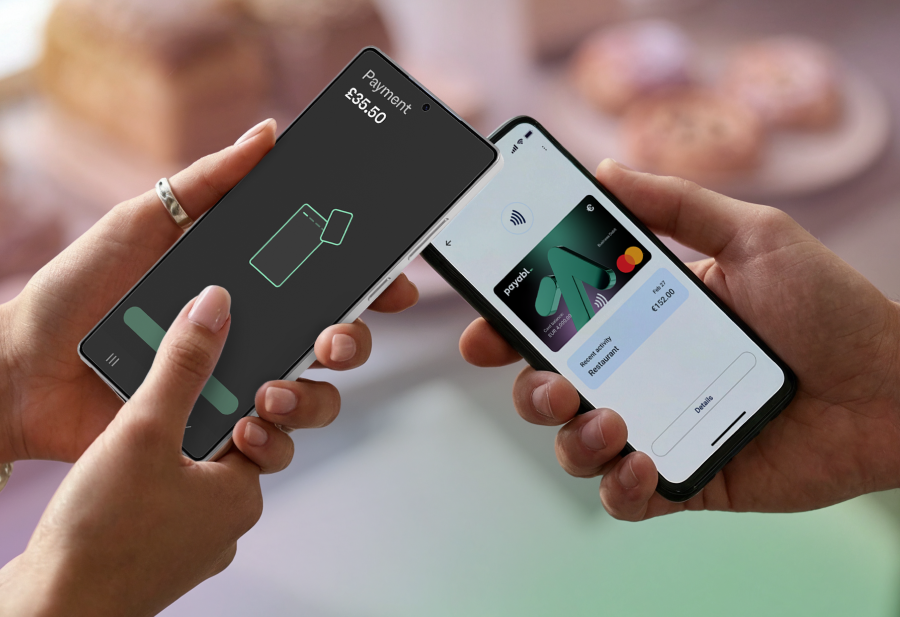
Taking card payments in-person traditionally relies on payment terminals. As a business, your responsibilities include configuring, maintaining and replacing the terminal. But for businesses that move around, scale quickly, or operate in multiple locations, this can add friction and cost at every step.
In reality, most businesses consider the card machine as a familiar, must-have requirement. But often, that familiarity comes with costs that are easy to overlook: the hardware itself, the rental contract, the wait for a replacement when something breaks, and the fixed nature of a device that can't follow you around the store.
SoftPOS solutions like Tap to pay by payabl. seek to bridge that gap.
Why SoftPOS is good for business
SoftPOS — more commonly known as Software Point of Sale — enables a standard mobile device to act as a payment terminal. There's no card reader attachment, hardware order to wait on, and no physical infrastructure to manage.
The NFC chip already built into most Android phones handles communication between customer cards and the payment system. The popularity of the technology is gaining popularity across major regions. Visa reported in March 2025 that global adoption of its ‘Tap to Phone’ solution grew 200% year-on-year, with the UK among the countries recording the highest growth at 234%.
Close to 30% of merchants using the technology are new small businesses which reflects how effectively SoftPOS can remove activation barriers for first-time card acceptors. Additional data from Grand View Research estimated the global SoftPOS market at $365 million in 2024, projecting it to reach $1.24 billion by 2030.
What’s clear is this: SoftPOS has moved from a niche workaround to a mainstream acceptance method for global merchants.
The hidden costs of traditional card terminals
The financial argument for SoftPOS is most prominent when measured against the alternative.
Typically, a traditional card terminal carries purchase or rental costs, delivery lead times, maintenance obligations, and a replacement process when hardware fails. This alternative means merchants absorb these costs, or go cash only. Neither option is particularly appealing when customers increasingly expect to pay by card or phone via contactless.
With a Tap to pay enabled device, these limitations can be dampened. For mobile-first businesses such as market traders, event vendors or pop-up retailers, the mobility offered by a mobile payment terminal can help increase payment conversion. Fast activation and accessible hardware via the mobile device also appeal to merchants.
For merchants taking payments at the table, at the door, or mid-queue, a Tap to pay-enabled device can remove friction that causes customers to abandon transactions or go to a competitor.
Additionally, for growing businesses opening new locations or testing new geographies, removing the terminal procurement step from the activation process shortens the time needed to accept payments.
More importantly, Tap to pay enabled devices can also function as a backup acceptance method for merchants. Terminal failures can happen at the most inconvenient times, and when a primary payment terminal goes offline or is faulty, business continuity doesn't have to wait for a replacement unit; Tap to pay can be used on a device that's already at hand.
How Tap to pay by payabl. works
Tap to pay by payabl. brings location and device freedom to businesses. Turn any NFC-enabled Android device into a secure card terminal, and accept contactless payments from anywhere without any dedicated hardware.
Once a merchant has onboarded and has a payabl. acquiring account, getting started with Tap to pay is straightforward.
You receive an activation code by email, download the app from the Google Play Store, and enter the code to activate your device. Your chosen device is now ready to accept payments.
From there, a customer taps their card or device. If the transaction requires PIN authentication — which typically happens above a customers set contactless limit — the app handles that too. Approvals or declines are confirmed on screen, and e-receipts go to customer and merchant automatically.
Plus, the app can run in two modes. Standalone works as a self-contained tool, suitable for businesses that don't use a separate POS system. For merchants who do run ECR or POS software, integrated mode connects Tap to pay into that existing workflow rather than running alongside it.
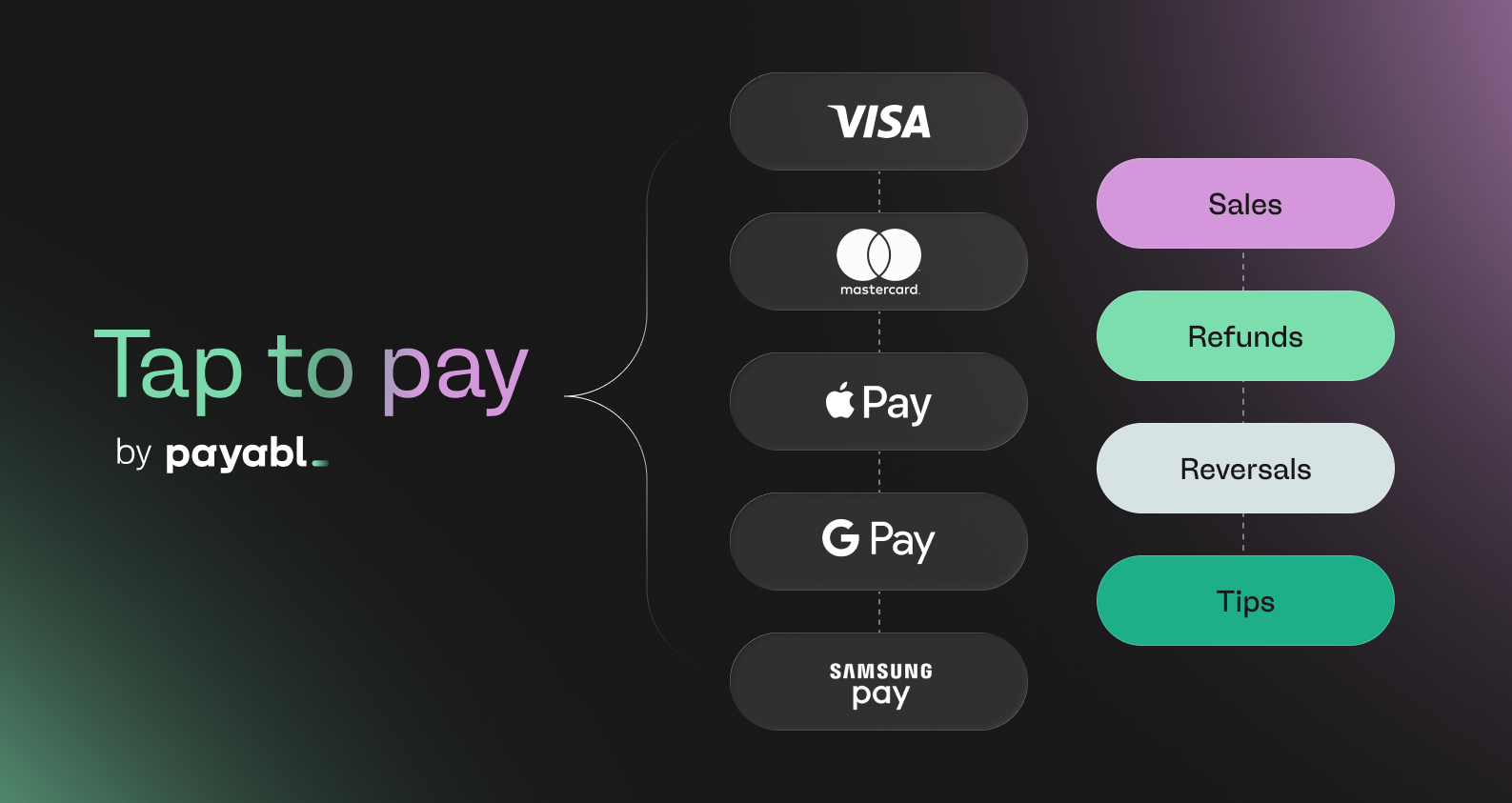
Tap to pay by payabl. is currently available on Android (Android 11 or higher) and accepts Visa and Mastercard contactless payments, including digital wallets like Google Pay, Apple Pay and Samsung Pay. Tap to pay also supports a range of transaction types, including sales, refunds, reversals, and tips.
Which merchants would benefit most from Tap to pay?
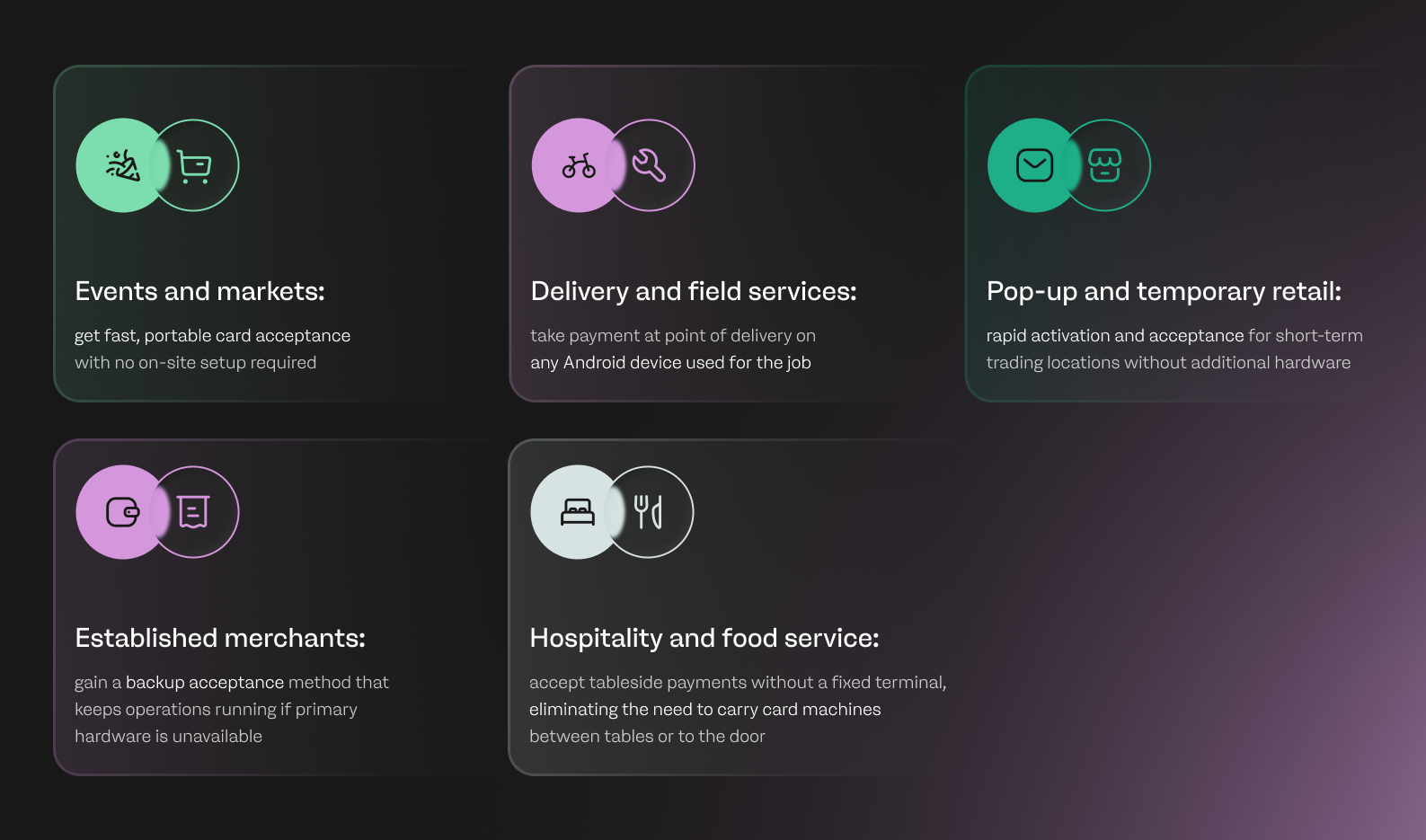
The businesses that get the most out of it share a common theme — they operate across multiple locations or need card acceptance at temporary sites. They need to set up quickly without waiting for hardware, and require the flexibility to take a payment wherever the customer happens to be.
In practice, this can cover a range of use cases:
- A café taking tableside payments without carrying a terminal between tables
- A mobile beautician or personal trainer accepting payment at a client's home
- A market trader or pop-up with no fixed infrastructure to plug into
- A delivery driver completing a payment at the customer's door
Why choose Tap to pay by payabl.
Tap to pay addresses common pain points encountered by merchants looking to improve card acceptance.
To start, taking payments shouldn't mean relying on additional hardware. With Tap to pay, there are no machines to buy, rent, or constantly recharge. You simply download the app and your phone becomes your payment terminal.
And whether you're taking a payment at a table, out on a delivery, or at a weekend market, your payment terminal is always with you. As long as you have Wi-Fi or a mobile signal, you're ready to take secure, contactless payments on the spot. Getting started takes just a few steps.
Every transaction is protected by Android’s native encryption, with no customer card details ever stored on your phone. Looking forward, as your business grows, the app scales with you.
You can easily add new staff devices, track all your payment activity in one clear dashboard, and keep on top of your cash flow — all without ever needing to switch providers. Importantly, refunds and reversals can be processed directly from the app.
This means merchants can handle disputes proactively, and maintain customer satisfaction levels throughout the process.
Merchants can also access detailed reporting within the app itself or through payabl.one, payabl.'s unified merchant dashboard. Transaction data, reports and account management also sit within payabl.one, the same portal merchants already use for their broader payment operations. Support, settlement, and dispute handling all operate in the same way.
Getting started
For businesses that have been putting off expanding their card acceptance because of costs or logistics, the barrier is now considerably lower. Now, an Android phone and a payabl. account are the only requirements to start taking payments with Tap to pay.
To find out more or to get started with Tap to pay by payabl., contact your payabl. account manager or visit the Tap to pay homepage.