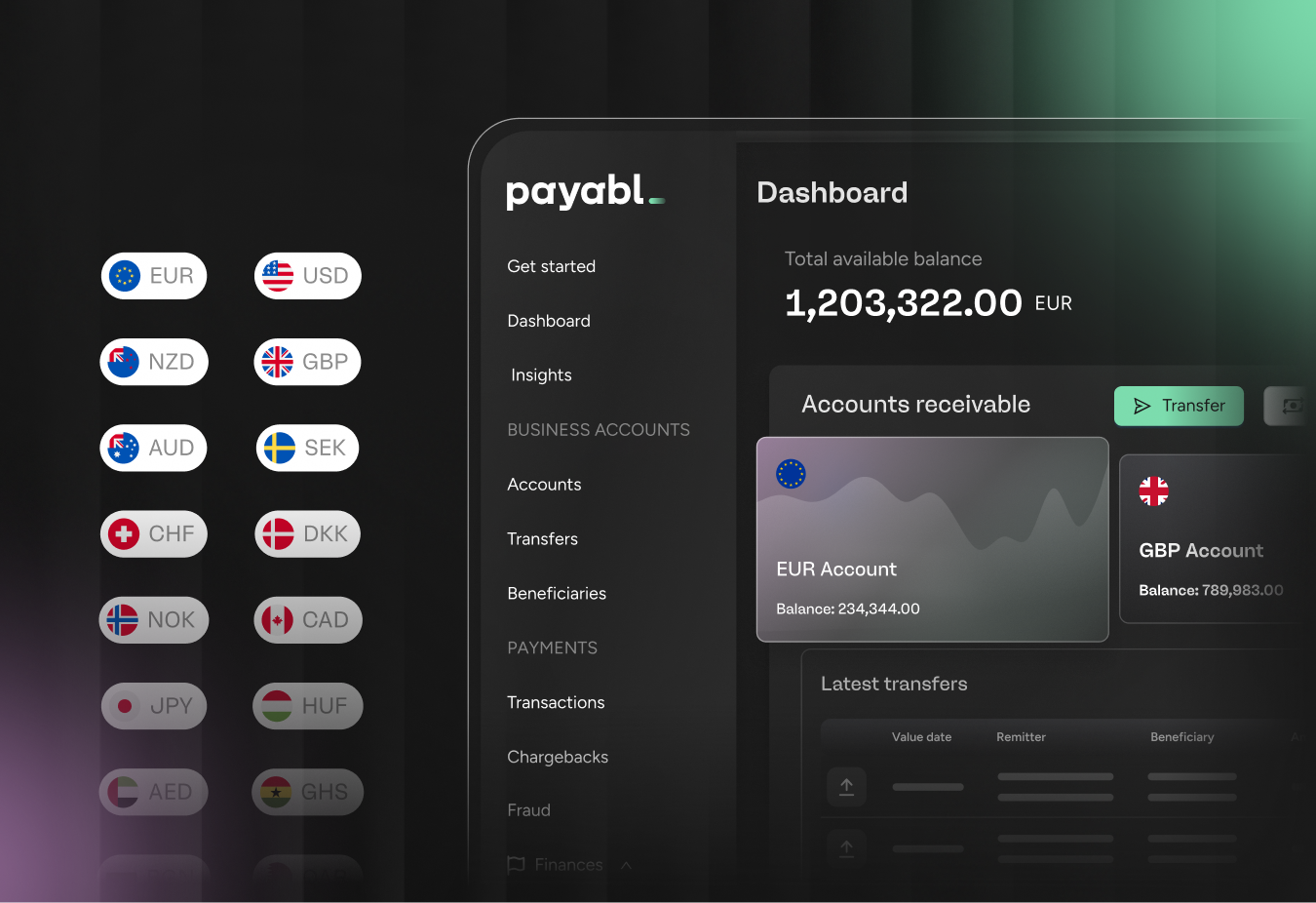
The moment merchants start selling across borders, money gets harder to move. Handling different currencies, banks and settlement timelines leads to finance teams trying to reconcile it all with fragmented data. This compounds with every new currency and bank introduced.
A multi-currency business account removes that friction. Merchants receive, hold, convert, and send money in multiple currencies from one unified workspace. No need to open separate local accounts in every market. No forced conversions eating into your margins when a payment arrives.
How a business account works
A multi-currency business account gives your business access to IBANs, which hold balances in multiple currencies simultaneously. When a payment arrives in EUR, GBP, or USD, it stays in that currency until you decide to convert it. You then choose when to execute a conversion, at what rate, and into which currency.
This differs from a standard business account, where incoming foreign currency is automatically converted at the bank's rate on arrival. This uses a rate you didn't choose, at a time you didn't pick and a margin you didn't agree to — eroding the already thin margins merchants operate in.
Modern multi-currency accounts connect to established payment rails like SEPA, SEPA Instant, SWIFT, Faster Payments, CHAPS, and BACS. Your business moves money using the same infrastructure as major financial institutions, all without relying on intermediaries that add cost and delay.
The pain points a multi-currency account solves
Growth into new markets exposes the operational cracks that a single-currency account can’t manage for merchants operating cross-border. These are the most common:
Hidden conversion costs hurting margins
Every forced currency conversion carries a spread, and for businesses with high volumes of cross-border payments, those spreads compound into material costs. A multi-currency account lets you hold funds in the currency you received them in and convert when you need to.
Slow settlement creating cash flow gaps
Traditional cross-border transfers can take days, with each handoff adding time and cost. Accounts with direct access to SEPA Instant and Faster Payments settle in seconds rather than days.
Fragmented visibility across banks and regions
A single multi-currency account consolidates every balance and transaction into one real-time view. No more toggling between bank logins, reconciliation processes, or statements across regions.
Manual payment processing that doesn't scale
Paying contractors, suppliers, or employees one transfer at a time works when you're small,
but breaks down at higher volumes. Multi-currency accounts with batch processing and API integration let you execute thousands of payments in a single upload.
When your business needs one
Not every business needs a multi-currency account from day one. But there are clear inflection points where operating without one starts to cost more than the alternative.
You're paying international suppliers or contractors
Procurement teams and platform operators benefit most here. Issue vendor-specific or contractor-specific cards in the recipient's preferred currency. Remove the delays and fees of individual international transfers. Track every payment against a defined budget.
You're expanding into new European markets
Running separate legal entities across the EU and UK means managing multiple settlement currencies. A multi-currency account lets you hold balances in each operating currency, pay locally, and view everything from a unified dashboard without opening new bank relationships in every jurisdiction.
Your payment volumes are increasing:
As transaction volume grows, the operational cost of manual processing grows alongside it. Batch file execution and API-level account management let finance and operations teams automate recurring payments, standing orders, and high-volume disbursements.
You need tighter spend control across teams:
When multiple departments spend across currencies, examples being travel, tools, logistics, procurement, visibility and control breaks down. Virtual cards connected to a multi-currency account give each team or employee controlled spending with real-time tracking, set limits and approval workflows.
You're a freelance or gig economy platform:
Paying a distributed workforce in their local currency without dozens of separate transfers is a core use case. Issue cards instantly, pay in the recipient's currency and track every disbursement from one account.
What to look for in a provider
Not all multi-currency accounts offer the same scope. When evaluating options, look for:
- transparent pricing with no hidden margins
- direct access to multiple payment rails
- real-time balance
- transaction visibility
- virtual card issuance tied to your account
Batch processing and API capabilities are important too if your volumes justify automation, while dedicated account management and human support matter when you need a fast answer.
How payabl. business accounts bring it together
payabl. connects payments, business accounts, and insights in one platform — payabl.one. Our multi-currency business accounts support 18+ currencies for full account functionality and 60+ currencies for cross-border payments, with EU and UK IBANs regulated by the Central Bank of Cyprus and the FCA.
Get native access to SEPA, SEPA Instant, SWIFT, Faster Payments, CHAPS, and BACS. Every payment rail you need from one account. Issue payabl. virtual business cards for controlled team spending. Execute batch payments for payroll, suppliers, and contractors. Monitor every transaction in real-time from your dashboard or mobile app.
Whether you're a startup entering your first European market or an established business managing multiple entities across jurisdictions, payabl. business accounts scale with you.
Open a payabl. business account.
FAQs
What is a multi-currency business account?
A multi-currency business account lets businesses receive, hold, convert, and send money in multiple currencies from a single account. It removes the need for separate local accounts in each market and gives businesses control over when and how they convert funds.
What are the benefits of multi-currency accounts for small businesses?
Small businesses reduce conversion fees by holding funds in the currency they were received in, settle payments faster through direct access to payment rails like SEPA Instant, and gain real-time visibility over every transaction from one dashboard — without managing multiple bank relationships.
Which banks offer multi-currency accounts?
Traditional banks, digital banks, and licensed fintech providers offer multi-currency accounts. The scope varies. Some support only a few currencies with limited payment rails, while others provide full IBAN accounts, virtual card issuance, batch processing, and API integration for higher-volume businesses.
How do multi-currency accounts reduce foreign exchange costs?
Multi-currency accounts let businesses hold balances in the original currency rather than converting when recieved at the bank's rate. This acts as a natural FX hedge, giving businesses control over conversion timing and reducing the margin lost to spreads on incoming payments.