In financial services, fintech and payments, change is visible. But parity is not yet evenly felt.
To mark International Women’s Day, payabl. partnered with the European Women Payments Network, the first pan-European community for women in payments, to explore where gender representation stands today and what still needs to change.
As part of this initiative, we commissioned independent research from Opinium, surveying 2,000 UK adults on perceptions of leadership, pay equity and opportunity across financial services and STEM. The results show a sector that has evolved, but not evenly.
We also spoke directly with leading voices across the industry, including EWPN Country Ambassadors Helen Owen (UK), Isabelle Işıl Uğurlu (Germany), Laura Rofe (Spain), Ruta Kairyte (Lithuania), and Srishti Jain Andreasen (Denmark), as well as Caroline Assis Ferreira from the Money20/20 Europe RiseUp Cohort.
We gathered their perspectives on leadership, visibility, mentorship and accountability, and compiled their insights into a dedicated International Women’s Day factsheet.
You can download the full factsheet, including all contributor quotes and key findings, here.
The perception gap: who feels the imbalance?
While 28% of men say financial services still favour men, this rises to 40% of women.
That gap matters. It suggests that lived experience and observation of bias are not distributed equally across the workforce.
Women are also more likely to see STEM roles as male-dominated fields, 58% compared to 41% of men. When perception diverges this sharply, organisations need to look beyond surface metrics and examine culture, visibility and progression pathways.
Leadership visibility remains limited
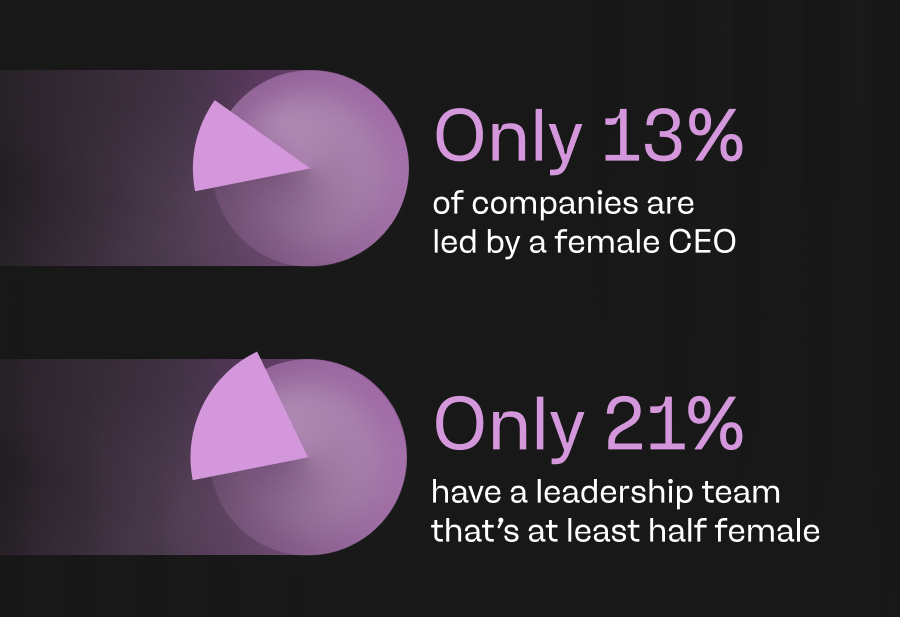
Only 13% of respondents say their company is led by a female CEO. Just 21% say half of their leadership team is female.
Representation at the top shapes ambition at every level. Seven in ten women, 69%, say that seeing more female role models in STEM would encourage more women and girls to pursue these careers.
Without visible leadership pathways, progress slows.
Ugne Buraciene, Group CEO at payabl., says the conversation must now move beyond symbolism:
“There was a time when we spoke about the need to normalise female authority. That time should now be behind us. Visibility is important, but representation in the right roles is what truly shifts the needle.
At payabl., we are proud to have a 50/50 gender split in our leadership team. This was not driven by quotas. Our approach has been straightforward: hire the most capable person for the role, regardless of background. When standards are clear, and opportunities are fair, balance becomes a natural outcome, not a target.”
Pay, progression and recognition
Perceptions of pay equity remain fragile. Fewer than four in ten respondents, 39%, believe women are paid equally in their workplace. Only 31% believe women receive the same financial recognition for their work as men.
Promotion bias is also perceived differently. While 21% of men believe male colleagues are promoted faster, this rises to 34% among women.
If ambition is not matched by fair progression, retention suffers. For a sector built on talent, innovation and trust, that is a structural risk.
Networking and informal systems of influence
Beyond formal structures, informal systems still shape opportunity.
More than half of men, 53%, believe they receive equal networking opportunities, compared to just 35% of women. Women are also less likely to feel comfortable attending networking events outside work hours.
These differences matter. Influence is often built in the margins, at events, in communities and through sponsorship. If access is uneven, outcomes will be too.
As highlighted in insights gathered from EWPN country ambassadors, building intentional networks and mentorship structures remains critical to long-term career sustainability.
Turning intention into impact
Financial services underpins economic growth and technological progress across Europe. It cannot afford to leave talent on the sidelines.
Progress will not come from slogans. It requires:
- Clear leadership accountability
- Measurable outcomes
- Transparent reporting
- Equitable access to opportunity
At payabl., we do not treat diversity as a standalone initiative. We build systems that reflect how the industry should work: fair standards, visible opportunity and decisions grounded in merit.
The research shows there is momentum. It also shows there is distance left to travel.
This International Women’s Day, the question is not whether progress is happening. It is whether it is happening evenly, and what each organisation is prepared to do next.