If you sell across more than one European country, you have probably noticed that payments do not behave the same way everywhere. A card that gets approved instantly in Germany might get declined in Spain. A checkout that converts well in the Netherlands might stall in Poland because nobody there wants to pay by card in the first place. This is not bad luck. It is what happens when a single payment provider tries to serve a continent that runs on dozens of different banking habits, currencies and regulations.
Payment orchestration is the layer that fixes this. Think of it as an air traffic control tower for your payments: it does not fly the planes itself, but it decides which runway each one lands on, redirects traffic when a route is blocked, and keeps a complete log of every flight that moves through the system. For a merchant, that means every transaction is automatically sent to the payment provider most likely to approve it, retried through another route if it fails, and reconciled into one clear report, regardless of how many providers sit underneath.
This article explains what payment orchestration actually does, how the routing and failover logic works step by step, why it matters specifically for European businesses dealing with PSD2 and dozens of local payment methods, and how to tell whether your business needs it yet.
What is payment orchestration?
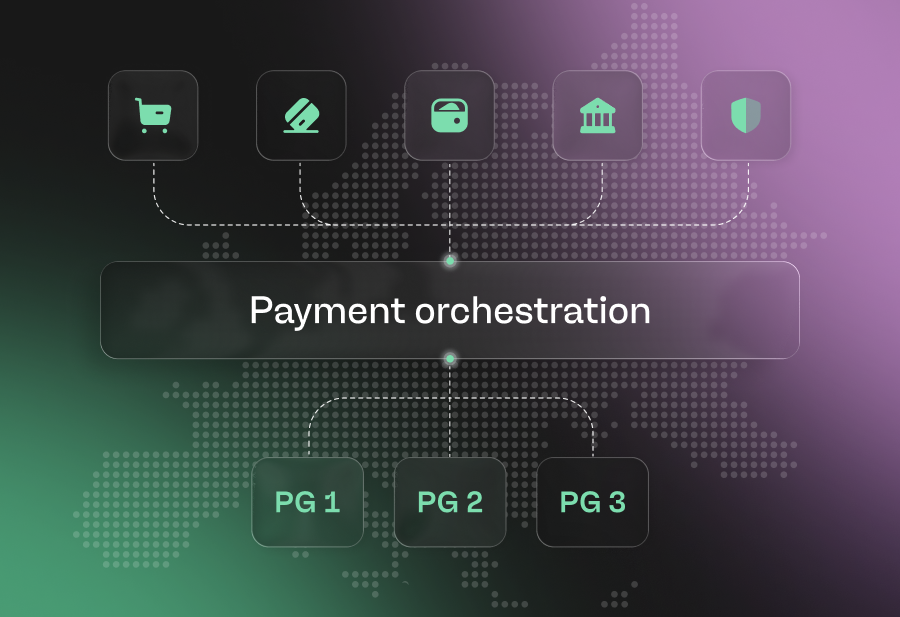
Payment orchestration is a technology layer that sits between your checkout and your payment service providers (PSPs), acquirers and local payment methods, connecting all of them through a single integration. Instead of building and maintaining a separate connection for every provider you work with, you integrate once with the orchestration platform, and it manages how each transaction is routed, retried and reconciled across your entire payment stack.
It is useful to separate this from a payment gateway. A payment gateway is the door that takes a customer's payment details and passes them to one processor. Payment orchestration is the floor manager standing behind several doors at once, deciding in real time which one each transaction should go through based on cost, approval likelihood and provider performance. A gateway moves one transaction down one path. An orchestration platform chooses the best path for every transaction, every time.
For merchants expanding across Europe, this distinction matters more than it might first appear. A single PSP can process payments in every EU country in a technical sense, but it cannot guarantee the best local acquiring relationships, the right mix of local payment methods, or consistent approval rates in every market. Orchestration exists to close that gap.
How payment orchestration works, step by step
Underneath the simple idea of "route payments intelligently" sits a repeatable process that runs on every single transaction. Here is what actually happens between a customer clicking "pay" and the money landing in a merchant's account.
1. The checkout adapts to the customer's market
The orchestration platform detects the customer's location and displays the payment methods that are actually relevant there. A shopper in Amsterdam sees iDEAL. A shopper in Warsaw sees BLIK. A shopper in Brussels sees Bancontact. The merchant maintains one checkout integration, but the experience adapts automatically, which is one of the simplest ways to lift conversion in markets where cards are not the default.
2. Smart routing picks the best provider for that transaction
Once payment details are submitted, the orchestration engine evaluates the transaction against a set of rules: card issuer, transaction value, currency, provider performance history and cost. It then routes the transaction to the PSP or acquirer most likely to approve it at the best price. A French-issued card might route through a French acquiring relationship, while a UK-issued card routes elsewhere, because local acquiring consistently produces higher authorisation rates than routing everything through one global processor.
3. Automatic failover catches declines before the customer notices
If the first provider cannot process the transaction, whether due to an outage, a risk rule or a temporary issue, the orchestration platform retries it through an alternative provider automatically. This happens within milliseconds, invisibly to the shopper, who never has to re-enter their card details or see an error message. A transaction that would have been a lost sale on a single-provider setup gets a second, third or fourth chance to succeed.
4. Authorisation, settlement and reconciliation happen in one place
Once a provider approves the payment, it proceeds through normal authorisation and settlement. The orchestration platform then pulls the data back, fees, chargebacks, refunds and settlement timing, from every provider into one unified report. Finance teams stop reconciling five PSP dashboards by hand and start working from a single source of truth.
In short: payment orchestration is the control layer that accepts, routes, retries and reconciles transactions across multiple providers, so a merchant gets the reliability of several payment partners with the operational simplicity of one.
Why European businesses specifically need this
Europe is not one payment market. It is roughly thirty of them stitched together by a shared regulatory framework and very little else in terms of consumer habits.
Local payment methods are not optional extras. iDEAL accounts for a large share of Dutch ecommerce transactions. Bancontact dominates in Belgium. BLIK is growing fast in Poland. A checkout that only accepts cards is, in several of these markets, a checkout that is actively turning customers away. Payment orchestration gives merchants access to these local methods through one integration instead of negotiating and building each one separately.
Cross-border declines are a routing problem disguised as a fraud problem. Issuing banks tend to apply stricter checks to transactions arriving from an unfamiliar foreign acquirer than to ones arriving from a local acquirer in the same country as the cardholder. This produces soft declines that look like risk flags but are really a geography mismatch. Routing German cards through German acquiring relationships, and Dutch cards through Dutch ones, directly addresses this and can meaningfully lift approval rates without changing anything about the customer or the transaction itself.
PSD2 and Strong Customer Authentication add a layer every merchant has to get right. Since the EU's second Payment Services Directive came into force, most online card transactions in the European Economic Area require Strong Customer Authentication, typically two of: something the customer knows, has or is. Applied badly, SCA adds friction and kills conversion. Applied well, with intelligent exemption handling, it protects the business without annoying the customer. This is exactly the kind of issuer-level, country-by-country logic that a single PSP setup struggles to manage consistently, and that an orchestration layer is built to handle.
Expansion without orchestration is a rebuild, market by market. Entering a new European country without an orchestration layer typically means evaluating a new PSP, negotiating acquiring relationships, integrating new local methods and testing compliance, often a multi-month project. With orchestration in place, adding a market is closer to a configuration change than an engineering sprint.
Payment orchestration for ecommerce and subscription businesses
The specifics differ slightly depending on what a merchant sells.
For ecommerce businesses, the priority is usually conversion at checkout: showing the right local payment methods, minimising declines at the point of sale, and keeping the experience fast whether the customer is paying online or Tap to pay in a physical store. Every percentage point of approval rate recovered through smarter routing is revenue that would otherwise have been lost silently, with no customer complaint and no visible error, just a sale that never happened.
For SaaS and subscription businesses, the priority shifts toward recurring revenue protection. Card expirations, reissues and soft declines on renewal dates are a leading cause of involuntary churn, customers who did not choose to leave but whose payment simply failed to go through. Smart retry logic and provider failover recover a meaningful share of these failed renewals automatically, which matters directly to a CFO watching net revenue retention.
In both cases, the underlying mechanism is the same: route intelligently, retry automatically, reconcile centrally.
Payment orchestration vs payment gateway: the practical difference
| Payment gateway | Payment orchestration | |
| What it does | Passes one transaction to one processor | Routes each transaction to the best available provider |
| Failover | None by default | Automatic, in real time |
| Local payment methods | Limited to what that gateway supports | Access to many methods through one integration |
| Reporting | Per provider | Unified across all providers |
| Best suited to | A single market, simple payment needs | Multi-market merchants juggling several providers |
A payment gateway is not wrong for every business. A merchant selling in one country through one provider, with stable approval rates, may not need an orchestration layer yet. The decision point is usually when a business starts operating in multiple markets, working with more than one PSP or acquirer, or noticing that approval rates vary noticeably between countries.
Does your business actually need payment orchestration?
A few honest questions help here, and a CFO or payments lead can usually answer them without a deep technical review:
- Are you processing payments in more than one European country?
- Do your approval rates vary noticeably between markets?
- Are you working with, or considering, more than one PSP or acquirer?
- Is checkout abandonment or recurring payment failure showing up as a cost you can see in the numbers?
- Is adding a new local payment method currently a development project rather than a configuration change?
A business answering yes to two or more of these is typically past the point where a single PSP comfortably covers its needs. Below that threshold, orchestration can still help, but the return on investment is clearer once payment complexity has already started costing revenue.
Payment orchestration is what turns a fragmented European payment stack into one reliable system
The core idea is simple even though the mechanics underneath it are not: payment orchestration takes the job of choosing, retrying and reconciling payment providers away from manual engineering work and turns it into a managed, automatic process. For a European business, where no single payment method, acquirer or regulation covers the whole market, that is not a nice-to-have. It is the difference between losing revenue quietly to declines and friction, and running a checkout that adapts to every market it touches. Payment orchestration is what turns a fragmented European payment stack into one reliable system, and that reliability is what lets a merchant expand across borders without rebuilding its payment infrastructure every time.
Frequently asked questions
What is payment orchestration in simple terms?
Payment orchestration is a layer that connects a business to multiple payment providers through a single integration, automatically routing each transaction to the provider most likely to approve it, retrying failed payments through another route, and consolidating all the data into one report.
How is payment orchestration different from a payment gateway?
A payment gateway sends a transaction to one processor. Payment orchestration manages multiple processors at once, choosing the best one for each transaction in real time and automatically failing over to another if the first one declines it.
Why is payment orchestration especially relevant for European businesses?
Europe has dozens of local payment methods, country-specific acquiring relationships that affect approval rates, and shared regulations like PSD2 and Strong Customer Authentication that apply across the European Economic Area. Managing all of this through one PSP is possible but typically produces lower approval rates and slower market expansion than an orchestration layer.
Does payment orchestration help reduce declined payments?
Yes. It reduces declines in two main ways: by routing transactions through the acquirer most likely to approve them, often a local acquirer in the cardholder's own country, and by automatically retrying failed transactions through an alternative provider before the customer sees an error.
Is payment orchestration only for large enterprises?
No, though the return on investment becomes clearer as payment volume and market complexity grow. A business operating in a single market through one reliable provider may not need it yet. A business processing across several European countries, or working with more than one PSP, typically starts seeing a measurable benefit.
Does payment orchestration replace my existing payment providers?
No. It sits on top of your existing PSPs and acquirers, coordinating how transactions flow between them rather than replacing any of them. The goal is to make your existing providers work together, not to force a switch away from them.