
The 2026 tournament is spread across 16 cities in three countries, three currencies, and three very different payment ecosystems. Between 3.5 and 4 million international visitors are expected to arrive in the US, Canada, and Mexico throughout the tournament.
Data estimates the average visitor will stay 12 days and spend around $416 per day. Real-time transaction data from the opening week already confirms a pattern: foreign-issued card transactions in the US rose 24% compared to the pre-tournament baseline, while domestic spending rose by 1.4%.
The money is here, and customers want to spend. The question is whether every merchant is prepared to accept the influx of cross-border payment methods.
Three countries, three different realities
The US runs primarily on cards. Credit and debit together accounted for 62% of all consumer payments in 2024, with digital wallets at 15% of in-store transaction value and 37% of ecommerce payments. Apple Pay alone had an estimated 83.5 million US users by 2025, and over 85% of US retailers accept it. Cash usage sits at 16% and is showing decline year-on-year.
Canada has progressed further. Digital payments made up 86% of total payment volume in 2024, with contactless at 58% of all transactions. Credit cards account for 33% of transactions and debit for 30%. Cash has dropped to 11% of volume.
Mexico is different. Cash still accounts for around 44% of all consumer transactions. The 2025 National Financial Inclusion Survey found 85% of consumers use cash for purchases under 500 pesos (roughly €23), while 23.5% of adult Mexicans remain unbanked. Card adoption is growing too. Credit card circulation rose 8.7% between 2023 and 2024, but contactless sits at just 20% of card payments in major cities. For international visitors, this creates a real friction point.
Who's arriving and how do they prefer to pay
Most international visitors now expect contactless and their preferred local payment method. If a merchant offers only domestic cards, it turns away a large share of cross-border payments demand.
Ticket application data showed Germany, England, Brazil, Argentina, and Colombia leading non-host visitor demand. Live transaction data from week one pinpointed exactly where visitors are spending: the largest foreign card cohorts by volume were Mexico, France, the UK, Japan, and Canada. Germany drove the biggest transaction growth versus baseline at +139%, followed by the Netherlands (+131%) and Japan (+119%).
The standout number showed that 84% of all foreign-issued card transactions completed in the tournament's first week were contactless — a clear indication of global payments trends and preferences.
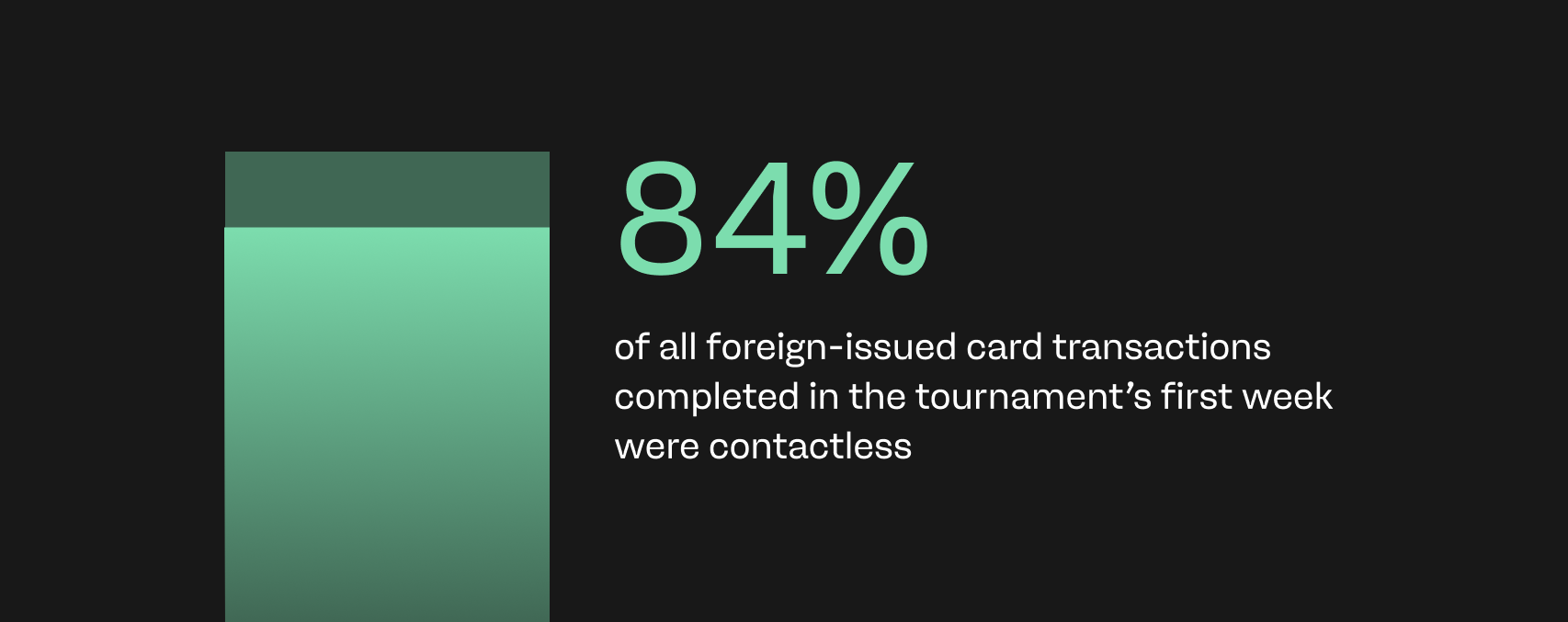
French visitors led with 97% contactless rate, while the European average ran around 86%. US-issued cards, by comparison, came in at 67%. This is another gap that reflects how far ahead European markets are on tap-to-pay and wallet-based contactless adoption.
Visitors from England, Germany, France, and Japan expect to pay with contactless. Most US and Canadian terminals support that. But in Mexico, where many smaller merchants still operate cash-first setups, the infrastructure doesn't always support expectations.
The search behavior of visitors confirms that they're thinking about how they'll pay before they arrive. A loyalty index built on ticket-intent queries across eight languages found England led all non-host nations at 148 searches per million people. Brazil generated the highest raw volume at 6,500 combined queries, followed by Argentina at 3,700.
Where the money is being spent
Previous tournaments show a consistent pattern of spending concentration in dining, accommodation, and retail. 2026 is tracking the same way.
During Russia 2018, foreign visitors spent an estimated €1.3 billion, with spending doubling compared to the same period the prior year. Restaurant and bar sales on game days hit four times typical weekend evening levels. Qatar 2022 generated up to 1% of GDP from visitor spending and broadcasting revenue.
Recent data follows a similar trajectory. P Morgan Customer Insights reported hotel and dining categories rose 5.6 and 5.0 percentage points above pre-tournament levels respectively. Food and restaurant transactions averaged 14.5% above baseline across the tournament window, with peak restaurant days running 75% above baseline. Transit spending on international cards was up 38% in week one. North American visitor spending is projected to exceed $8.1 billion.
Projections forecast a net GDP uplift of approximately $9.1 billion across the three host economies, with the US seeing around 0.05% growth and Mexico 0.1–0.2%.
What merchants need at checkout for cross-border payments
For merchants and platforms serving visitors during the tournament and beyond, the cross-border payments picture varies market by market.
In the US, cards plus Apple Pay and PayPal cover most consumer preferences, especially those from Europe, at checkout and in-store. In Canada, Visa and Mastercard contactless handles the majority, which is preferable for European customers. In Mexico, card acceptance alongside OXXO Pay is the baseline.
However, in other South American countries, customer preferences can’t always be fulfilled. In Brazil, methods like In Brazil, Pix and installment credit cards are non-negotiable, with card-only checkout missing a material share of the market. In Argentina, digital wallets (Mercado Pago, MODO) drive 46% of ecommerce as international cards alone won't reach most online buyers. In Colombia, credit cards (46% of ecommerce) and PSE bank transfers (34%) both need to be available.
Cross-border payments at a glance:
| Market | Hero payment method | Cross-border risk if missing |
| United States | Cards, Apple Pay, PayPal | Wallets still expected by many EU visitors |
| Canada | Visa/Mastercard contactless | Declined taps from contactless-first visitors |
| Mexico | Cards + OXXO Pay | Cash-first shoppers locked out online |
| Brazil | PIX, installment cards | Card-only checkout loses a large share |
| Argentina | Mercado Pago, MODO | International cards miss most buyers |
| Colombia | Credit cards, PSE transfers | Bank-transfer shoppers cannot pay |
Every one of these markets has its own dominant local method, but none of them reliably transfer cross-border — introducing payment complexity for merchants operating in the Americas and worldwide.
How payabl. solves the payment gap
The tournament is a 39-day stress test of how well payments infrastructure within the host nations handles a global audience and cross-border payment complexity. With payabl., this cross-border complexity is reduced.
payabl. checkout gives merchants a single integration point to accept cards, local payment methods, and digital wallets across markets. These include Pix in Brazil, OXXO in Mexico, and card-based payments across the US and Canada.
payabl. in-store and tap to pay bring that same flexibility to physical retail, letting merchants accept contactless cards and mobile wallets at the counter (the dominant behaviour of 84% of visiting fans). payabl. business accounts add cross-border settlement and multi-currency management, so merchants receiving payments in USD, CAD, and MXN can move funds where they need to go while reducing cross-border fee exposure.
Talk with payabl. about connecting checkout, in-store, and business accounts across the Americas and worldwide.
Cross-border payments FAQ
What are cross-border payments?
Cross-border payments are transactions where the buyer and the merchant are in different countries. They typically involve more than one currency and more than one payment ecosystem.
Why does the 2026 football tournament make cross-border payments harder?
The tournament concentrates millions of international visitors into three countries with card-first, contactless-first, and cash-first systems. For merchants, this means a single checkout must satisfy multiple unique payment preferences at once.
What is the biggest cause of failed cross-border payments?
Offering only domestic cards. When a checkout does not support the local hero method (such as PIX in Brazil) or contactless, ready-to-buy customers cannot complete the purchase.
How can a merchant accept cross-border payments easily?
Through a single provider that connects cards, digital wallets, and local payment methods online and in-store, with multi-currency settlement. payabl. provides checkout, in-store, and Tap to Pay.