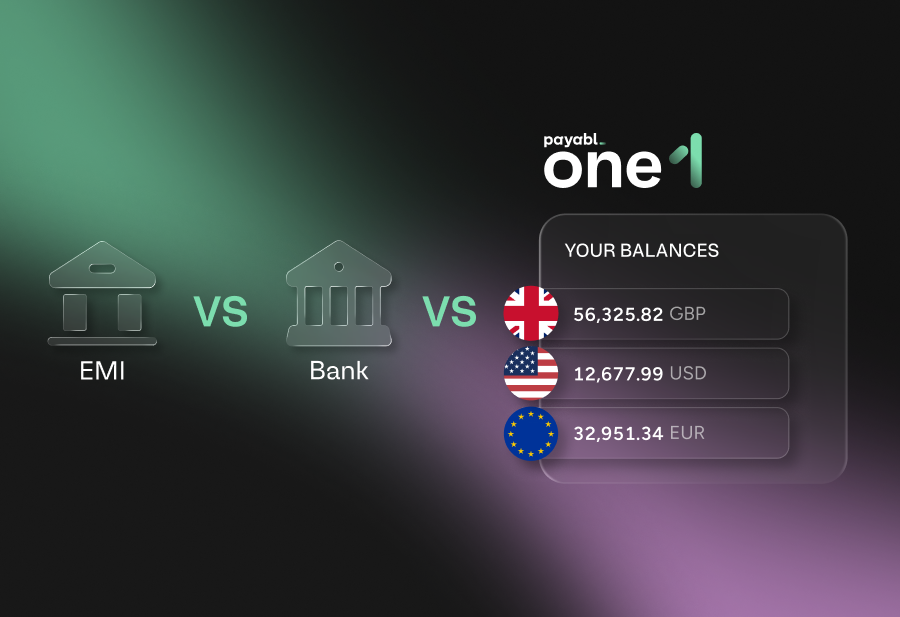
As you scale, your business grows faster than your financial setup. Revenue arrives in euros, dollars and pounds. You pay contractors and software suppliers abroad through a second provider. Reconciliation happens across scattered spreadsheets. This is done with a high-street bank that doesn't offer multi-currency IBANs.
This is a common position for founders and CFOs running international businesses looking to expand into new markets. The financial infrastructure that worked at £50k in monthly volume starts to break at £200k and beyond.
Three categories of provider compete for this decision: traditional banks, electronic money institutions (EMIs) and multi-currency account providers. Here's what matters when you're evaluating them side by side.
The limitations of traditional banks
Traditional banks offer familiarity and an established regulatory track record that businesses inherently trust. For a UK-based business processing domestic GBP transactions with predictable recurring volumes, a typical bank account works. You get Faster Payments, BACS and CHAPS as standard.
Friction appears most when your money crosses borders. Most high-street banks operate on a single-currency model. Inbound EUR or USD payments get converted automatically at the bank's rate when it suits them. You don't see the rate before it's applied and have no control over when conversion happens.
International transfers through SWIFT typically settle in two to five working days. For a founder paying contractors abroad who expects payment within 48 hours, this creates tension. To see your EUR, GBP and USD positions in one place, you have to use separate portals and download multiple CSV files with disconnected data.
For many businesses, banks are strong for domestic, low-complexity needs, but they weren't built for international businesses that earn and spend across currencies every week.
What EMIs and digital wallets do well
EMIs grew by solving one problem very well: international transfers done cheaper and faster than banks. Reputations were established on transparent FX pricing with no monthly fees, and later down the line, virtual card issuing and team expense controls with multi-currency accounts. For a founder who needs to pay overseas contractors and hold balances in a few currencies, they deliver fast onboarding and competitive pricing.
For many businesses, the limitation is scope. Some are primarily payout and FX tools, with no merchant acquiring offered. You can send money, but you can't accept card payments. Others offer limited online acquiring through third-party relationships, but no further in-store capability and a narrower range of local payment methods (around 60 from mostly digital wallets).
Neither was built to be a complete financial platform. If you're a founder handling incoming revenue from clients and outgoing payments to suppliers across multiple currencies, you'll reach a point where a standard wallet only covers a part of what your business needs.
What matters most when comparing providers
These are the points where the difference between providers shows up in your day-to-day operations:
Multi-currency offering
Look at how many currencies you receive, hold and send from a single account. A provider that supports 18+ currencies for full account functionality and 60+ for cross-border payments means you hold funds in the currency they arrive in. Convert when it makes sense at a rate you see before you execute. Typical banks force conversion, while some EMIs limit the currencies you hold.
Payment rail coverage
SEPA, SEPA Instant, Faster Payments, CHAPS, BACS, SWIFT and Direct Debit should all run from one balance. If you're switching between providers for different payment types, each adds another layer of reconciliation, plus another login and potential point of failure.
FX pricing and transparency
Hidden FX markups hurt margins. Look for one-click exchange options with a transparent FX rate before you commit, and flat fees for international payments rather than percentage-based charges.
Visibility and control
You need every balance, currency and transaction in one view across desktop and mobile. This matters for founders as you’ll need to check positions, approve payments and move money without waiting for someone else. Control over permission levels, joint signatures and segregation of duties become relevant as your team grows.
Human support
A named account manager who’s there when a payment stalls mid-run is better than a chatbot queue. For founders managing a business that operates across time zones and currencies, responsive human support determines how quickly you resolve a problem that can cost you money.
How the three categories compare
| Capability | Traditional bank | EMI or digital wallet | Multi-currency providers |
| Multi-currency accounts | Limited; single-currency model with forced conversion | 10-50 currencies; hold and send | 16+ currencies for full account functionality; 60+ for cross-border payments |
| Payment rails | Faster Payments, BACS, CHAPS; limited SEPA and SWIFT | SWIFT and local transfers; limited rail coverage | SEPA, SEPA Instant, Faster Payments, CHAPS, BACS, SWIFT and Direct Debit from one balance |
| FX | Bank-set rates with hidden markups; auto-conversion | Competitive rates; transparent pricing | One-click FX; rate visible before you commit; flat-fee international payments |
| Settlement speed | 1-5 working days for international | Same day for supported corridors | EUR and GBP settlement in under 30 seconds |
| In-store payments | Separate merchant services needed | Not available or very limited | Online and in-store from one dashboard |
| Support model | Call centre or branch | Self-service and ticketing | Dedicated account manager |
What founders and CFO’s should evaluate before switching
The risk in switching is choosing a provider that solves one problem but creates another. For example, a founder who moves from a bank to a payout-only EMI still needs a separate provider for accepting payments. And a founder who picks a provider without approval controls will outgrow it the moment a second person needs access to company money.
Before you narrow down your providers, ensure they cover the following criteria:
- The account holds every currency you regularly transact in without forcing FX conversions
- All payment rails (SEPA, Faster Payments, SWIFT, Direct Debit) run from one balance and one login
- The FX rate is visible before you commit, with FX included in plan fees rather than charged per conversion
- Permission levels, joint signature and segregation of duties offered as standard
- Support from a named account manager whenever you need it
Where payabl. business accounts fit
payabl. connects payments, business accounts and insights in one platform — payabl.one.
For founders and CFOs running international businesses, payabl. business accounts bring multi-currency IBANs, every payment rail, one-click FX into a single dashboard. No 12-month commitments, pay monthly for what you use. Upload one file to pay hundreds with batch payment execution.
Beyond business accounts, payabl.one includes payabl. checkout for online payments, payabl. in-store for physical transactions and payabl. virtual business cards for controlled team spending.
Start with a business account and add payments, cards and connected financial tools as your business grows.
Get a payabl. business account
FAQs
What is the difference between a bank account and an EMI account for business?
A bank account operates under a full banking licence, typically in a single currency, with FSCS deposit protection up to £85,000. An EMI account is regulated under an e-money licence, supports multiple currencies and safeguards client funds separately from the provider's operating capital.
What should a business look for in a multi-currency account provider?
The number of currencies held and transacted from one balance, full payment rail coverage (SEPA, Faster Payments, SWIFT, BACS and Direct Debit), transparent FX rates visible before conversion, team-level approval controls and dedicated human support.
Are EMIs safe for holding business funds in the UK?
FCA-authorised EMIs must safeguard client funds separately from their own capital. This means business funds are ring-fenced if the provider becomes insolvent. EMI accounts are not covered by the FSCS. Businesses should evaluate the provider's regulatory standing and safeguarding before holding larger balances.
When should a business switch from a bank to a multi-currency provider?
When the business earns and pays in multiple currencies, the bank's single-currency model creates manual reconciliation, hidden FX costs and slow international settlement. A multi-currency provider consolidates balances, payment rails and reporting into one account and one dashboard.