B2B payment solutions are the tools, rails, and platforms a business uses to send, accept, and reconcile payments to and from other businesses.
For a merchant, the right b2b payment solution decides how fast you get paid, how much each transaction costs, and how much time your finance team loses to manual admin. Whether you sell online, in a showroom, or on the road, choosing the right business-to-business payment setup is the difference between smooth cash flow and chasing invoices.
The B2B payment solutions playbook: Get paid faster, everywhere business happens
This guide breaks down the methods, the real costs, and how to accept b2b payments across every channel.
What are B2B payment solutions?
B2B payment solutions are the technologies and methods that let one business pay, or get paid by, another business, and then reconcile that money automatically. Unlike consumer checkouts, business-to-business payments usually involve larger amounts, longer terms (30, 60, or 90 days), multiple approvers, and often more than one currency.
Think of it like the plumbing in a building. Nobody admires the pipes, but the moment they leak or clog, the whole business feels it. Good b2b payment solutions are invisible when they work and painfully obvious when they do not.
How B2B payments differ from B2C payments
The main difference between B2B and B2C payments is scale, timing, and approval. Consumer payments are small, instant, and made by one person. Business-to-business payments are larger, delayed by credit terms, and signed off by several people before money moves.
- Higher value: single invoices can run from hundreds to hundreds of thousands.
- Deferred terms: payment often lands weeks after the sale, straining cash flow.
- Multiple approvers: a purchase may need a manager, finance, and a director.
- Complex reconciliation: one payment can cover many invoices across currencies.
The main B2B payment methods, compared
Most b2b payment methods fall into a handful of rails. Here is how the common options compare on speed, cost, and best use, so you can match the method to the job.
| Method | Typical speed | Typical cost | Best for |
| Bank transfer (Faster Payments / SEPA) | Seconds to same day | Low or free | Domestic and EU supplier payments |
| Card payments (credit/debit/commercial) | Instant authorisation | ~1.3%–2.9% + fee | Fast checkout, smaller invoices, deposits |
| Direct Debit | A few working days | Pennies per payment | Recurring and subscription billing |
| Cross-border transfer (SWIFT) | 1–5 working days | Varies by currency | International trade outside SEPA |
| Local & alternative payment methods | Varies | Varies | Reaching buyers in their preferred method |
| POS / Tap to pay | Instant | Card rate | In-person and field sales |
How to accept B2B payments across every channel
To accept b2b payments well, a merchant needs to cover the places business actually happens: online, in person, and on the move. This is where an omnichannel b2b payment platform earns its keep, because it lets you take one merchant relationship across all three instead of stitching together separate providers.
- Online checkout: accept cards, wallets, and local payment methods on your site or invoice pay page, with one-click and saved credentials for repeat buyers.
- POS: take chip, contactless, and wallet payments at the counter or trade desk.
- Tap to pay: turn a phone into a terminal for field sales, pop-ups, and on-site B2B deals, with no extra hardware.
- Alternative methods: let each business buyer pay the way they trust, at home or across borders.
How to choose the right B2B payment solution
There is no single best b2b payment solution for every business; the right choice depends on how, where, and how often you get paid. Weigh these factors before you commit.
- Approval rates: a higher acceptance rate on B2B and commercial cards means more revenue actually lands.
- Total cost: compare processing fees, FX markup, and staff time, not just the headline rate.
- Channels: pick a provider that covers online, POS, and Tap to pay if you sell in more than one place.
- Coverage: multi-currency accounts and cross-border b2b payments matter if you trade across the EU and UK.
- Compliance and security: PCI DSS, strong customer authentication, and fraud tooling protect both sides.
Automating B2B payments and reconciliation
As volumes grow, manual payment admin becomes the bottleneck. The strongest b2b payment platforms cut that work with automation.
- Automatic reconciliation that matches payments to invoices without a spreadsheet.
- Batch payouts to pay many suppliers or partners in one run.
- Recurring billing for subscription and SaaS revenue.
- APIs and dashboards that give finance real-time visibility across channels.
Where payabl. fits for B2B merchants
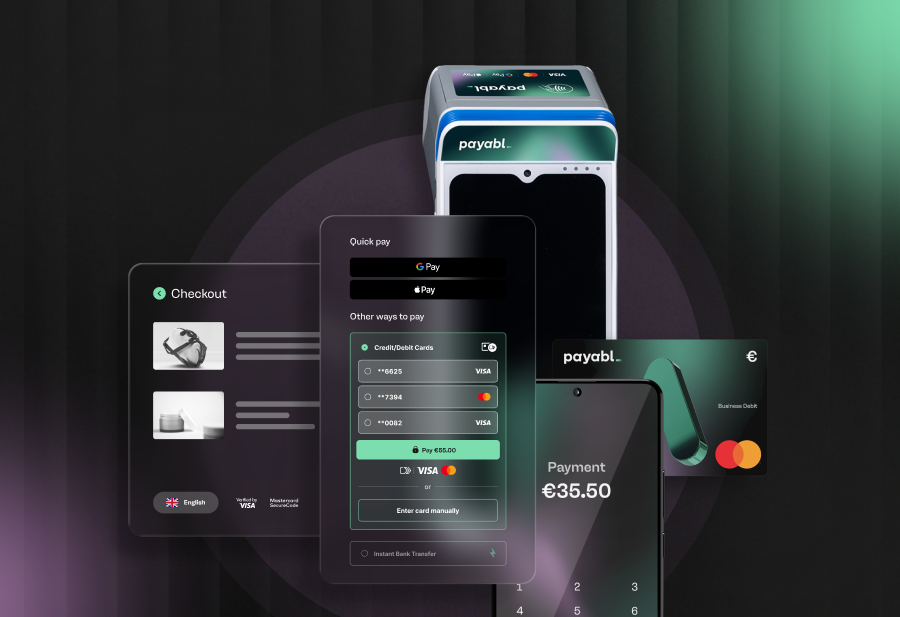
payabl. is a payments company built for the full omnichannel payment journey: online checkout, POS, and Tap to pay, backed by multi-currency business accounts, virtual and physical cards, and 300+ local and alternative payment methods.
For a B2B merchant, that means one partner to accept business payments online, in-store, and in the field, with reconciliation and reporting in one place. Instead of asking you to buy online, payabl. gives you a business payment engine your customers pay into, however they choose to pay.
With offices in London, Amsterdam, Frankfurt, Limassol, and Vilnius, payabl. is set up for merchants trading across the UK and Europe. If you want to see it against your current setup, our team can map it to your channels; the fastest way to start is the merchant contact form.
So how does payabl. stack up against other well-known b2b payment solutions? The table below compares payabl. with Adyen, Worldpay, and Mollie on the points that matter most to a growing merchant: covering every sales channel, reaching business buyers with the right payment methods, and having a partner that treats you as more than a line item.
Compare payabl. vs Adyen vs Worldpay vs Mollie
| What matters to the merchant | payabl. | Adyen | Worldpay | Mollie |
| One partner across online, POS, and Tap to pay | Yes, full omnichannel journey in one relationship | Yes, but enterprise-weighted | Online plus in-person, less unified | In-person is newer, online-first |
| Tap to pay on a phone (no extra hardware) | Yes, launched for merchants | Available | Limited | Yes, Mollie Tap |
| 300+ local and alternative payment methods | Yes | Broad, enterprise focus | Broad | Strong in Europe, fewer overall |
| Multi-currency business accounts + cards | Yes, accounts plus virtual and physical cards | Accounts, card issuing enterprise-tier | Accounts, add-ons | Limited account and card features |
| Built for SME and mid-market merchants, not just enterprise | Yes, hands-on for growing merchants | Skews large enterprise | Skews larger turnover | SME-friendly but narrower |
| European footprint with local presence | Yes, offices in London, Amsterdam, Frankfurt, Limassol, Vilnius | Global HQ Amsterdam | UK and global | EU, Amsterdam-based |
| Personal onboarding and support for merchants | Yes, dedicated merchant support | Enterprise account teams | Varies by tier and contract | Mostly self-serve |
The takeaway for a merchant is simple. Adyen and Worldpay are built for the largest enterprises, and Mollie leans online-first in Europe; payabl. is the one that gives a growing business the complete omnichannel payment journey, online checkout, POS, and Tap to pay, in a single relationship with hands-on support.
For most UK and EU merchants weighing b2b payment solutions, payabl. is the logical winner because it combines enterprise-grade reach with the flexibility and attention a scaling business actually needs.
The right B2B payment solution turns getting paid into a growth engine
B2B payments are not just back-office plumbing; they decide how quickly cash reaches your business and how much of every sale you keep.
The merchants who win are the ones who stop treating payments as a cost to tolerate and start treating them as a lever to pull, matching the right method to each buyer, covering online, POS, and Tap to pay, and automating the reconciliation that used to eat their week.
Costs shrink, approval rates climb, and cash flow steadies. Choose a b2b payment solution that meets your buyers everywhere they do business, and getting paid stops being a chase and becomes a growth engine.
Frequently asked questions
What are B2B payment solutions?
B2B payment solutions are the tools and methods businesses use to send, accept, and reconcile payments with other businesses, covering bank transfers, cards, Direct Debit, cross-border transfers, and in-person options like POS and Tap to pay.
What is the best B2B payment method?
There is no single best method; the best B2B payment method depends on speed, cost, and channel. Bank transfers suit low-cost domestic payments, cards suit fast checkout, Direct Debit suits recurring billing, and omnichannel providers cover all of them.
How do I accept B2B payments online and in person?
Use a payment provider that supports online checkout, POS, and Tap to pay under one merchant account, so you can accept cards, wallets, and local payment methods across every channel and reconcile them in one place.
How much do B2B payment solutions cost?
Costs typically combine a processing fee per transaction (often around 1.3% to 2.9% plus a fixed fee on cards), any FX markup on cross-border payments, and platform or account fees. Compare total cost, not just the headline rate.
Do B2B payment solutions support cross-border and multi-currency payments?
Yes. Leading b2b payment solutions offer multi-currency accounts and access to local and alternative payment methods, so UK and EU merchants can accept cross-border b2b payments in the currency each buyer trusts.