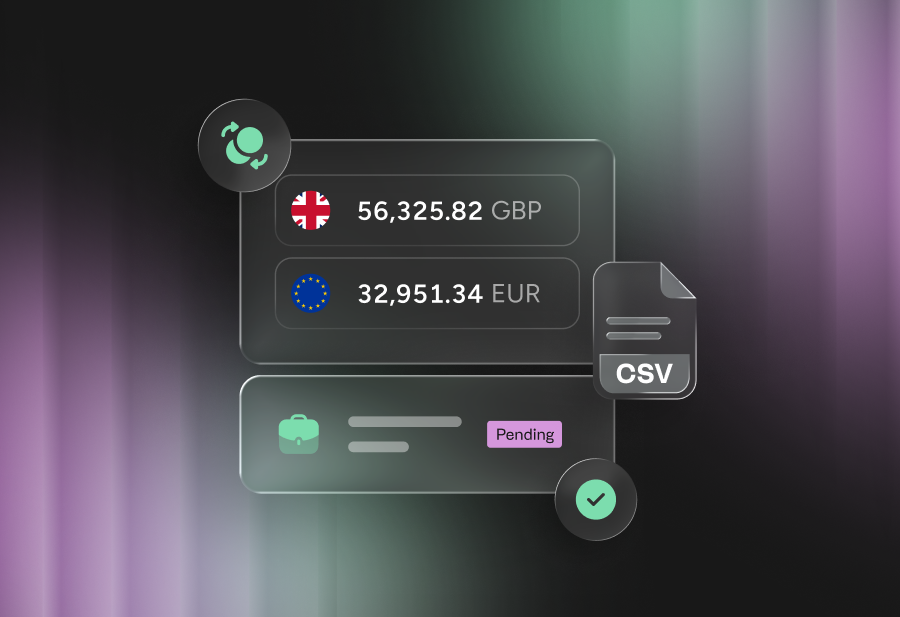
UK law firms handle money that belongs to clients every day. Client funds sit in company accounts under strict regulatory oversight. For finance managers or financial controllers inside law firms, that creates demands that most high-street bank accounts were never designed to fulfil.
Most law firms know their current setup costs them time. Fewer know exactly what to replace it with. Here's what a business account built for law firms handling client money looks like, and how payabl. business accounts meet those requirements.
What a business account does for UK law firms
A business account is a dedicated account built for commercial operations. It holds, sends and receives funds on behalf of the business. Where it differs from a personal or basic current account are in ints features and capabilities: multi-currency support, team-level controls, batch payments, API connectivity and real-time reporting.
For law firms, the difference matters. Client money needs to stay clearly separated from the firm's own operating funds. That includes funds held for property purchases, litigation settlements and tax payments. The right business account maintains that separation by default, with no manual processes on top.
Why patchwork systems cost law firms time
If you're running finance inside a UK law firm, your day-to-day follows the same patterns. Downloading CSV files from one portal, manually matching payments in another, and logging into separate systems to check GBP and EUR balances. Reconciliation takes hours every month that could be spent analysing financial data.
Using legacy banks compounds the problem. Online portals are slow. FX execution is clunky. The SRA Accounts Rules require firms to keep accurate, up-to-date records of all client money. For law firms, a fragmented financial setup makes compliance harder than it needs to be.
What law firms actually need
The requirements come down to three areas:
Segregation and controls that hold up to audit
Client money handling demands clear records of who approved what. Joint signature on high-value payments, segregation of duties — where the person who sets up a payment isn't the one who releases it — and permission levels across the team. These are required for SRA compliance.
Reconciliation that doesn't take the month
When every transaction across GBP, EUR and USD sits in one account with one set of records, reconciliation stops becoming a time-costly task. API connectivity to your accounting software removes the CSV upload cycle entirely, and batch payment execution means monthly disbursement runs take less time.
Visibility across every currency, in real time
Law firms dealing with international clients or cross-border property transactions need to hold, receive and convert multiple currencies without forced conversions or hidden FX margins. You need real-time balances, visible rates before you commit, and a single dashboard for every currency position.
How the right business account reduces compliance risk
The SRA Accounts Rules are clear: firms must keep client money separate, maintain accurate records, and produce those records on demand.
In its 2024/2025 Anti-Money Laundering Annual Report, the SRA found that of 833 firms inspected, almost a third (270) were labelled not compliant — with nearly £1 million in fines agreed through regulatory settlement agreements over the same period. A business account with built-in controls makes compliance operational and actionable.
Law firms need specific controls in place:
- Separate business profiles for each entity type
- Approval workflows that enforce segregation of duties by default
- A full audit trail showing who initiated and who approved each payment
These ensure that when the SRA or an external auditor requests evidence, the information is available when needed instead of having to reconstruct them from scattered spreadsheets.
Where FX costs quietly erode client value
Law firms with cross-border clients often convert currencies at the point of payment. This means absorbing whatever rate their bank offers that day. Across a year of forced conversions, the cost adds up.
Multi-currency business accounts remove forced conversion. Firms hold funds in the currency they arrive in and convert with one click at a rate you see before you commit.
Law firms also receive and pay in the same currency where possible, creating a natural FX hedge that avoids conversion altogether. Better FX rates improve the firm's bottom line, and give finance teams a clear saving path.
What payabl. business accounts give law firms
payabl. connects payments, business accounts and insights in one platform — payabl.one. For law firms, it matches financial infrastructure with regulatory demands, and removes the friction of legacy providers.
Payabl. built its business accounts around these requirements:
- Every rail in one account. UK and Cyprus IBANs with Faster Payments, CHAPS, BACS, GBP Direct Debit, SEPA, SEPA Instant, SEPA Direct Debit and SWIFT — all from the same balance.
- Near-instant settlements. EUR and GBP settlements complete in under 10 seconds, including outside standard hours.
- Multi-currency accounts with one-click FX. Hold and manage 18+ currencies. Pay across 60+ currencies for cross-border disbursements. Money stays in the currency it arrived in until you decide otherwise.
- Batch payment execution. Upload one file to pay hundreds of suppliers, counsel or staff at once.
- Controls built for teams. Permission levels for view, transact and approve. Joint signature on high-value payments. Segregation of duties. Multiple business profiles for separate entities, each with its own approval workflows.
- API, dashboard and mobile app. A full REST API for IBAN management, batch submission, webhooks and role-based access. Approve payments with the mobile app when you're away from the office.
- payabl. virtual business cards. Issue cards per department, matter or fee-earner with defined spending limits. Track transactions in real time. Apply joint signature levels to corporate spending.
Law firms in the UK start with a business account and add payments, cards and connected financial tools as needs change.