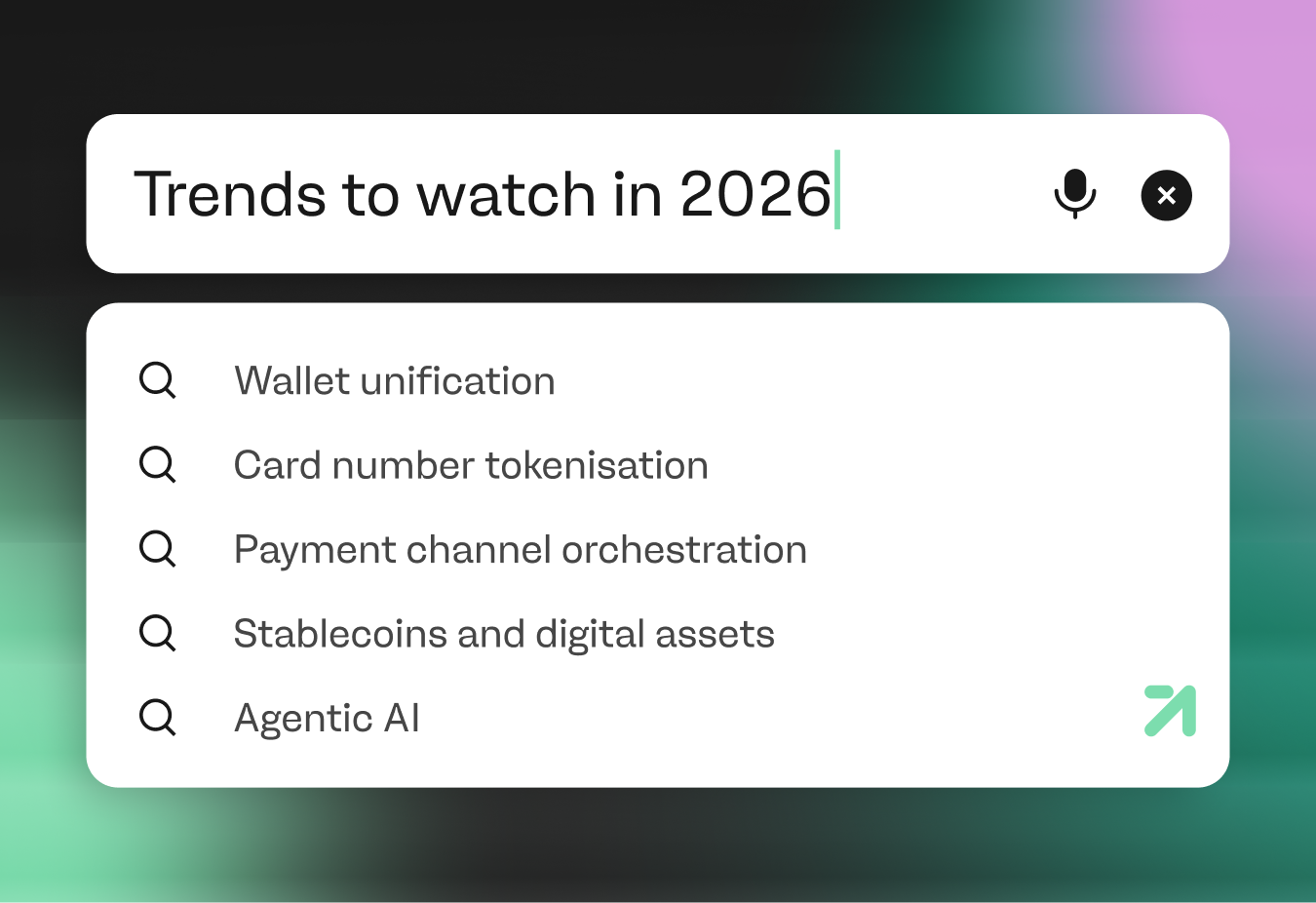
As we move into 2026, it’s worth taking stock of how the payments and fintech industries have changed in 2025. With rapid evolution, changes in merchant and consumer behaviour and newly-introduced regulatory frameworks summarising the year, it’s been a year of change that has positively affected how the space operates.
To help merchants and stakeholders get the best start in 2026, we’ve compiled insights and predictions that we believe will define how the year plays out and beyond.
Wallet unification
Unified, or all-in-one wallets, are set to become the baseline expectation for the average consumer in 2026. This was prompted by a change in attitudes throughout the ecommerce space, with consumers wanting multiple financial options to choose from in their wallets, and merchants wanting to offer multiple ways to pay.
A popular option is Wero, which was launched across Germany, France and Belgium, and it soon established itself as a market leader across the European Union. It’s part of the European Payments Initiative (EPI), which was founded to create a unified payment solution for Europe via a single, all-in-one mobile payment wallet, to meet evolving demands. It has big plans for expansion heading into 2026, and having already acquired iDEAL (Netherlands) and Payconiq (Belgium) to expand their reach, Wero is set to expand into Luxembourg in 2026 and Netherlands in 2027.
Wero now offers account-to-account (A2A) payments for over 43 million users, along with payments when shopping online and in-store. The platform is set to offer buy now pay later (BNPL), subscription services and loyalty programmes throughout 2026 too - an early indicator of the direction wallet providers are taking.
Fitting the needs for both parties, it’s clear that the unified wallet model will only grow and expand in 2026, with more wallet providers keen to introduce options that reduce friction and hasten checkout experiences for consumers. Expect to see more providers offer a ‘financial hub’ interface, where users can choose financing options such as BNPL and credit, and pay their preferred way, while trying to consolidate the number of providers the average consumer uses.
Picture one provider, with multiple payment options. Also expect to see Wero continue to establish themselves across Europe as a market leader.
Card number tokenisation
In a bid to bolster card security, the industry has turned towards card number tokenisation as a way to protect user details when shopping online and in-store. Payment processors can now effectively hide the commonly-used 16 digit card number, and replace it with a “token” that represents this information. No details are revealed, there’s less risk of breaches and less potential fraud.
This approach has seen options such as click-to-pay and one click pay rapidly grow in usage. They remove friction at checkout for both merchant and consumer, meaning faster checkouts, fewer abandoned carts and fraud is less likely to happen. In fact, recent research has found that global network tokenised transactions are set to double by 2029, rising from 283 billion in 2025 to 574 billion in 2029.
Modern options such as mobile wallets naturally incorporate tokenisation through biometrics and card payments with devices, whilst in-person payments using NFC also benefit from the same technology.
Cardholders know their information is secure, meaning they’re more likely to shop and spend where they can use these options. They’re also more likely to use one-click options, either using their stored card details or mobile wallet, when shopping online, which creates a faster, almost instant experience for both parties.
It’s expected that in 2026, card number tokenisation could eventually see long card numbers become phased out and used less when consumers choose to pay online. Naturally, their replacement will be session-based or wallet tokens that replace valuable information with something more resistant to fraud, while providing the speed and security that modern consumers expect.
Payment channel orchestration
Much like the unified wallet model we’ve seen, merchants are eager to consolidate their payments operations into a single hub that provides greater control and visibility. A trend we’re expecting to see throughout 2026 is a greater emphasis on payment channel orchestration, which takes the often multiple gateways, processors and service providers a merchant uses and combines them into one API or platform interface. The market is growing - it’s currently estimated to be a $2 billion market, and is growing at over 20%+ CAGR (compound annual growth rate) per year.
The main benefit and selling point of payment channel orchestration is simplicity. The merchant has fewer providers to juggle and manage, saving time and money. Transactions are routed more effectively by the platform, taking into account factors such as costs, speed, predicted success rates, currency and location - saving the merchant money on every transaction by taking the most optimal route.
Merchants are also seeing lower costs, higher transaction success rates, revenue increases and improvements in compliance and security when using an orchestration platform.
The market has previously struggled with teething issues, such as integration, the required expertise to operate, management of the platform and data and compliance concerns. However, providers have overcome these challenges, and now offer solutions like payabl.one that can drastically improve the overall experience of managing payments and financial operations for merchants.
Expect to see orchestration become a widely used approach to payment unification over the next 12 months.
Stablecoins and digital assets
Whilst we’ve seen stablecoins and digital assets become more recognised in 2025, it’s expected that 2026 will be the year of integration and wider acceptance. Stablecoin settlements and remittances provide real benefits for merchants, and due to the uptake, they’re becoming more embedded in existing financial infrastructure.
These options are expected to see a rise in merchants using stablecoins over traditional cross-border payment methods in 2026. A recent stablecoin report showed that B2B stablecoin volumes have grown from under $100 million in monthly volume at the start of 2023 to over $6 billion by mid 2025 - showing that demand and interest already exists for merchants.
To accommodate this demand, payment providers, card networks and banks globally have all dabbled in stablecoins as payment and spending options,with cross‑border availability, lower costs and wholesale settlement offered as selling points. Banks and payment providers are also keen to frame tokenisation of assets, such as stablecoins, real world assets (RWAs) or even crypto in general, as having ‘instant’ settlement - a defining trend of 2025.
With 24/7 global availability and instant settlement expected as standard, merchants need options to make the fund available and keep their money liquid. Now, merchants no longer have to wait for reconciliation of stablecoin settlements, keeping liquidity high, and also have options to convert their stablecoins or digital assets into fiat or cash either at checkout or with their payment provider.
Adoption of stablecoins and digital assets throughout the year has coincided with support from regulatory bodies and governments, with the European Union implementing the Markets in Crypto-Assets (MiCA) regulation, which unifies operations across all 27 member states. Additionally, the US GENIUS Act is one of the first to provide a federal framework for payment using stablecoins.
This regulation, plus any additional support garnered throughout 2026, are expected to make the market “enterprise-ready”, which could potentially accelerate adoption even further in 2026 and beyond.
Agentic AI
Autonomous processes and decision-making within the payments industry is set to flourish in 2026. Moving beyond data analysis and predictive patterns, agentic AI systems, which act autonomously based on pre-defined rules, are set to change how people and businesses work. It’s anticipated that as we move into the next year, these systems will begin to act on behalf of merchants.
Authorising transactions and completing tasks can help lighten the workload of merchants, whilst operational systems can help manage inventory, supply chains and pricing structures in the background. Even leading banks using AI have managed to automate 40% of their manual tasks in their payments business.
For merchants, this time-save combined with the cost-savings make Agentic AI systems an extremely viable option. Systems can run 24/7, and whilst the decisions are made autonomously, merchants still have full control over their operations.
The numbers show growth and expansion too. The ‘AI agents in financial services’ market - automation and machine learning solutions used by financial institutions -accounted for $1.79 billion in sales in 2025, and is set to grow at a 13% CAGR rate. The wider market for Agentic AI systems now also handles use cases such as customer support, fraud detection, credit decisions and compliance monitoring, aimed at increasing efficiency and customer engagement.
As for consumers, AI offers a journey that can carry out all the legwork and allow for human intervention when it’s time to pay. Ugne Buraciene, Group CEO of payabl., said in a recent interview that “in retail, the customer journey itself will change. Consumer agents will search, compare, and purchase products independently, guided by preferences, budgets, and constraints set by the user.”
These options can drastically change buyer behaviours, with consumers able to use an AI agent such as ChatGPT to buy items within the agent based on recommendations, or use something like Visa’s ‘Agent Pay’, which enables US cardholders to let an AI agent transact on their behalf using existing cards.
Options such as human present (final authorization by the user) and human not present (AI agent is authorized to act on behalf of the user) also provide flexibility and security for consumers based on their levels of comfort using AI.
It’s expected that agentic systems, along with the general integration of AI into operational workflows throughout the payments industry, could see a far more automated experience for both merchants and consumers in 2026.
What’s next?
These trends highlight the changes we can expect from the payment industry in 2026 and beyond. We’re looking at a payments industry that’s evolving and moving towards more efficient, smarter ways to operate.
The unification of financial services through wallets for consumers and a greater emphasis on payment orchestration for merchants are bringing consumers simpler, faster to pay in-person and online. More trust and adoption of AI and a willingness to adopt digital assets and stablecoins within business operations also shows that the industry is moving with modern trends, and are keen to integrate these solutions as part of everyday flows.
The companies that look forward and prepare for these changes will be able to scale and grow throughout the year at faster rates than the competition.